Node.js Development Services:
Custom Node.js Application Development
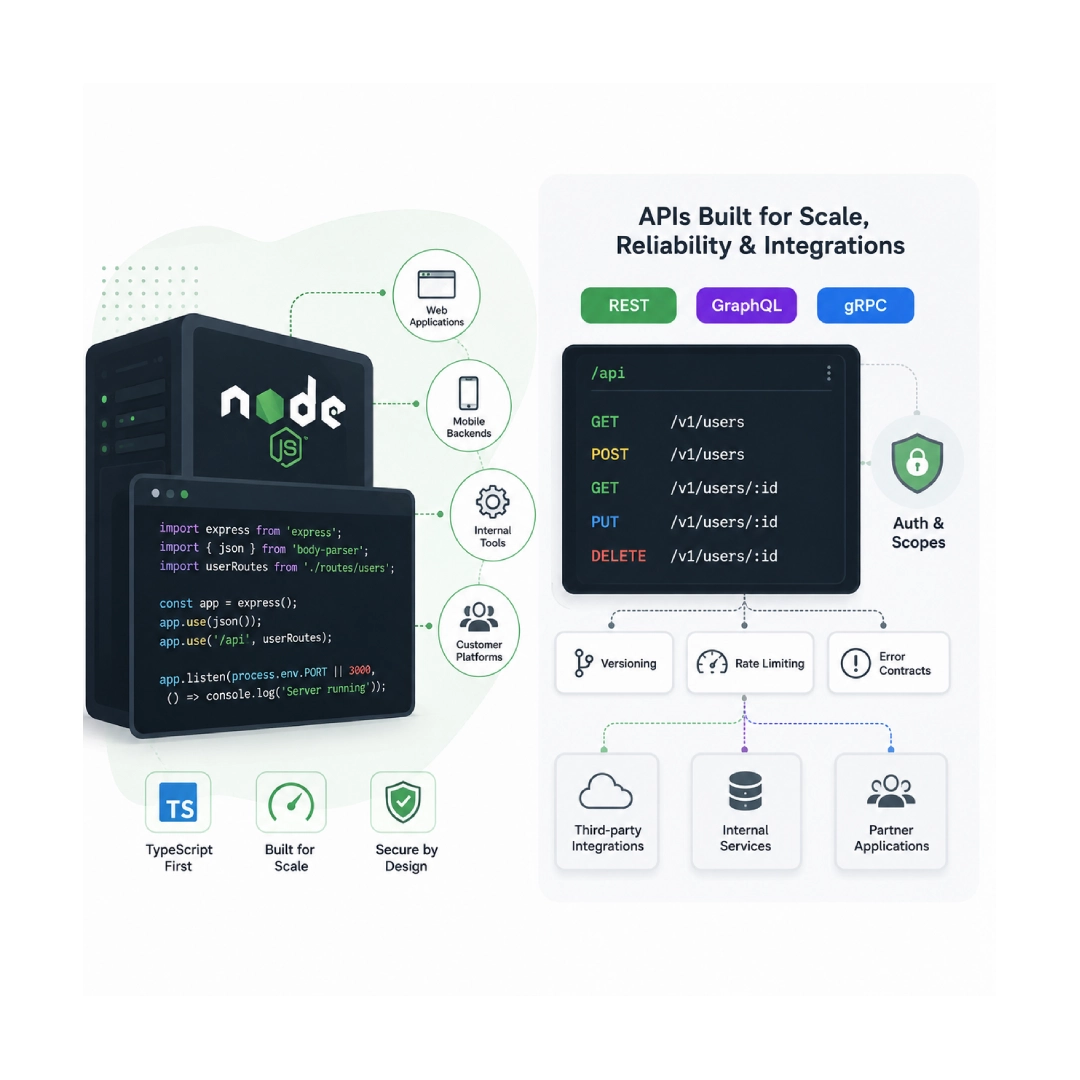
End-to-end backend builds for web apps, mobile backends, internal tools, and customer-facing platforms — architected around your actual load pattern, not a generic CRUD template. TypeScript-first by default; over 75% of professional Node.js codebases now ship with TypeScript, and we don’t build any differently.
REST, GraphQL & gRPC API Development
Public APIs, internal service-to-service APIs, and partner integration layers. We design API contracts before we write a single route handler — versioning strategy, rate limiting, auth scopes, and error contracts decided upfront, not patched in after your third-party integrator complains.
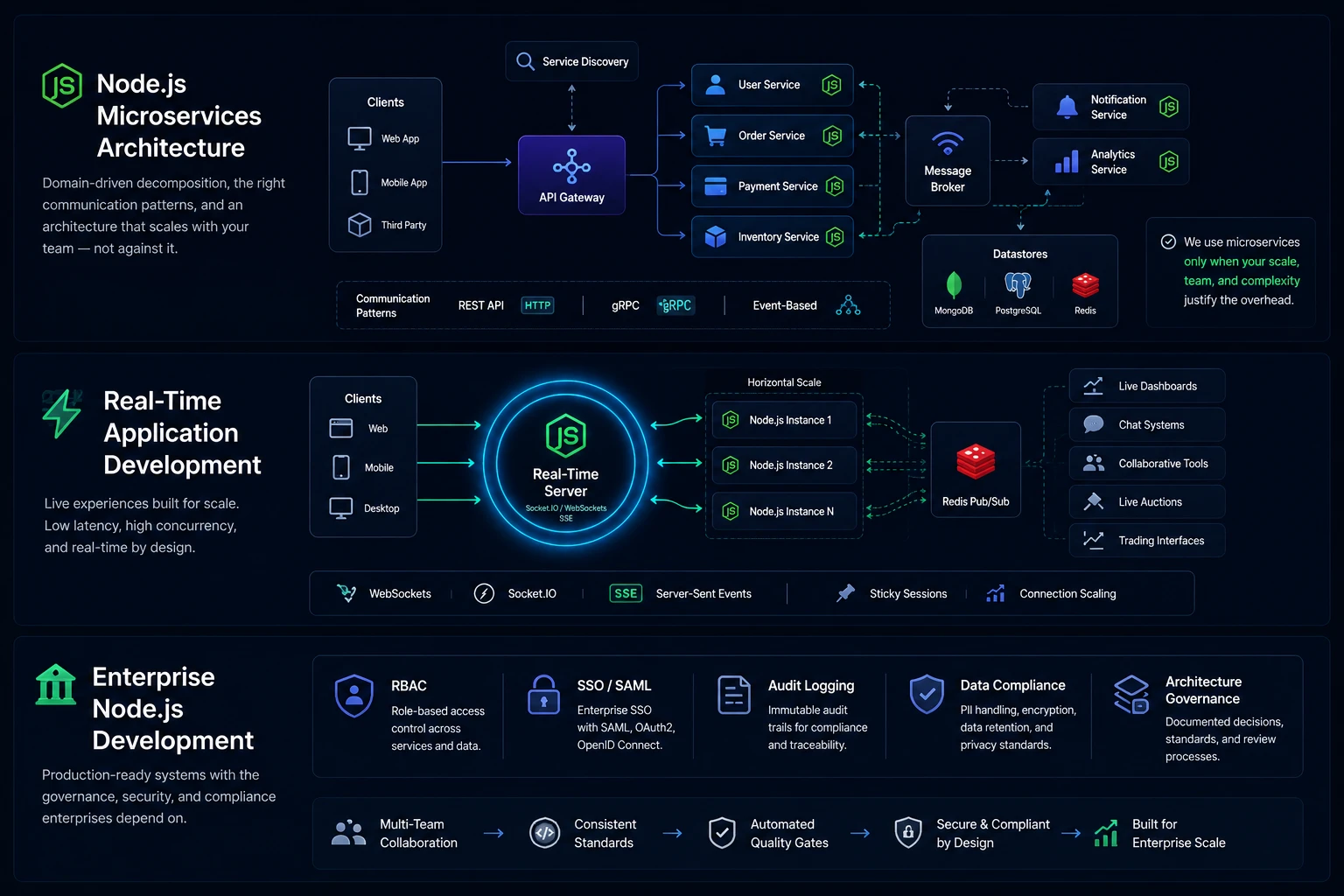
Node.js Microservices Architecture
Domain-driven service decomposition, inter-service communication (REST, gRPC, or event-based), service discovery, and API gateway design. We only recommend microservices when your team size, deployment cadence, and domain complexity actually justify the operational overhead — not because it’s the current trend.
Real-Time Application Development
WebSockets, Socket.IO, and Server-Sent Events for live dashboards, chat systems, collaborative tools, live bidding/auction platforms, and trading interfaces. Built with connection scaling and horizontal fan-out (Redis pub/sub, sticky sessions) in mind from day one.
Enterprise Node.js Development
Multi-team, multi-service backends with the governance layer enterprises actually require: RBAC, audit logging, SSO/SAML integration, compliance-ready data handling, and documented architecture decision records — not just working code.
SaaS Backend Development
Multi-tenant architecture, subscription billing integration (Stripe, Razorpay, Paddle), usage metering, tenant data isolation strategy, and plan-based feature gating designed to scale from your first 10 customers to your first 10,000.
Node.js + Next.js Full-Stack Development
Unified TypeScript stack across frontend and backend — Next.js on the front, Node.js/Express/Fastify/NestJS on the backend, sharing types and validation logic end to end. Fewer integration bugs, faster shipping.
Node.js Migration & Modernization
Moving off legacy PHP, Java, or .NET monoliths — or off an outdated Node.js version stuck on callbacks and unmaintained dependencies — onto a modern, typed, actively supported Node.js stack (current LTS, supported through 2028). Includes dependency audit, breaking-change mapping, and phased cutover so you’re not gambling your production traffic on a big-bang rewrite.
Third-Party & Payment Gateway Integration
Stripe, Razorpay, PayPal, Twilio, SendGrid, AWS S3, and CRM/ERP integrations — built with idempotency, retry logic, and webhook verification handled correctly, because payment integrations are the one place “mostly working” isn’t good enough.
Serverless Node.js Development
AWS Lambda, Google Cloud Functions, and Azure Functions for event-driven workloads, scheduled jobs, and unpredictable-traffic endpoints where paying for idle servers doesn’t make sense.
Node.js Database Architecture & Engineering
Schema design and query optimization across MongoDB, PostgreSQL, MySQL, and Redis. Includes indexing strategy, connection pool sizing, read/write splitting, and sharding design for datasets that have outgrown a single instance.
Node.js Performance Optimization & Load Testing
Node.js development company: Event-loop lag diagnosis, CPU/heap profiling, N+1 query elimination, caching layer design, and load testing (k6, Artillery) before you find out about your bottleneck from a customer complaint instead of a dashboard.
Node.js Security Audits & Hardening
Dependency vulnerability audits (npm audit and beyond), OWASP-aligned reviews, input validation and injection-attack testing, authentication/authorization audits, and secrets management review.
DevOps, CI/CD & Node.js Deployment Architecture
Docker containerization, Kubernetes deployment (one process per pod, horizontally scaled — not a single overloaded cluster-module instance), CI/CD pipelines, and infrastructure-as-code for AWS, Azure, and GCP.
Node.js Application Support & Maintenance
Ongoing monitoring, dependency upgrades, incident response, and a support SLA — for teams who inherited a Node.js codebase from a previous vendor or an ex-employee and need someone to actually own it going forward.
Distributed Systems & Data Consistency Design
CAP-theorem-aware design decisions, distributed transaction strategy (sagas over two-phase commit, in most real cases), and consistency-model selection matched to what the business actually needs — not the textbook default.
Caching Strategy & Design
Multi-layer caching (CDN, application, database) with Redis/Memcached, cache invalidation strategy, and TTL design that prevents the two classic failure modes: stale data and cache stampedes.
Cloud-Native Architecture (AWS / Azure / GCP)
Cloud infrastructure design built around managed services where they save engineering time, and custom infrastructure where managed services would cost you control you actually need.
How the top Node.js development company, Cybertize Works:
- Discovery & System Design — We map your data model, traffic pattern, and integration surface before writing code. You get an architecture document, not a guess.
- Sprint-Based Development — TypeScript-first, test-covered, with staging environments from week one.
- Code Review & Security Pass — Every service goes through peer review and a dependency/security audit before it touches production traffic.
- Load Testing & Launch — We test under simulated load, not just happy-path QA.
- Handover or Ongoing Support — Full documentation and either a clean handover to your team or a maintenance SLA with us.
System Design Services
System Design Consulting
Architecture reviews and greenfield design sessions before you write production code — the highest-leverage, lowest-cost point to fix a design mistake is before it’s built.
Scalable Architecture Design
Horizontal scaling strategy, stateless service design, and capacity planning mapped to your actual projected growth curve, not a generic “it’ll scale” assurance.
High Availability & Fault-Tolerant System Design
Redundancy planning, circuit breakers, graceful degradation, and failover architecture so one dependency going down doesn’t take your whole platform with it.
Event-Driven Architecture (Kafka, RabbitMQ, SQS)
Asynchronous processing pipelines, message queue design, and event sourcing for systems where synchronous request/response breaks down under real load.
Multi-Tenant SaaS Architecture Design
Tenant isolation models (shared schema vs. schema-per-tenant vs. database-per-tenant), evaluated against your compliance requirements and unit economics — not picked by default.
Industries We Build Node.js Systems For
Node.js development company: Retail & loyalty/rewards platforms · Fintech & payments · Real estate & PropTech · Media & digital publishing · D2C & e-commerce · Healthtech · Logistics & supply chain · EdTech · Enterprise SaaS
Our own portfolio spans both sides of this: we run production-grade Node.js systems for client platforms like large-format retail loyalty ecosystems, and we operate Rashtra Bharat, a high-traffic Hindi news platform, on our own Node.js/Next.js infrastructure. We don’t just build backends for other people’s traffic — we run our own at scale.
The Node.js Techniques We Actually Use — and the Problems They Solve
A lot of “Node.js development” content online talks about Express routes and stops there. That’s not where the real engineering work happens. Here’s what separates a Node.js backend that survives its first real spike in traffic from one that doesn’t — and it’s also, frankly, the list of mistakes we see most often in codebases handed to us for a rescue.
The event loop is the single most misunderstood part of Node.js. Node.js runs your JavaScript on one thread. Any synchronous, CPU-heavy operation — large JSON parsing, image transforms, hashing, uncached regex on big strings — blocks that thread, and every other request queued behind it stalls too. This is consistently the top cause of “random” slowness in Node.js apps that looks like a database problem but isn’t. The fix is standard now: offload CPU-bound work to worker threads or a separate service, and treat worker threads as an in-process tool, not a horizontal scaling strategy.
Memory leaks are quiet until they aren’t. Unclosed event listeners, unbounded in-memory caches with no TTL or eviction policy, closures holding onto large objects longer than needed, and streams that never close — these are the four patterns behind most Node.js memory leaks in production, and they’re a meaningfully large contributor to unplanned production outages industry-wide. They rarely crash a service immediately. They crash it three weeks later, under real traffic, at 2 a.m. We build with heap-snapshot diagnostics and event-loop-lag alerting from day one specifically so this doesn’t happen on your watch.
Most “Node.js performance problems” are actually database problems. Undersized connection pools, missing indexes, and N+1 query patterns show up as “Node.js is slow” far more often than the runtime itself is the bottleneck. We profile the database layer before we touch runtime tuning, because that’s where the actual latency usually lives.
Deployment architecture matters more than most teams realize. The old advice to use Node’s cluster module for multi-core scaling is largely outdated for containerized deployments. The current standard for enterprise workloads is one Node.js process per container/pod, scaled horizontally by the orchestrator (Kubernetes HPA, ECS, etc.), with the cluster module reserved for single-VM setups. Teams still running cluster-module architectures on Kubernetes are usually leaving both performance and operational simplicity on the table.
TypeScript adoption is no longer optional for serious teams. TypeScript now runs in the large majority of professional Node.js codebases, and for good reason — it catches an entire category of production bugs (wrong shapes crossing service boundaries, silent undefined propagation) at compile time instead of in your error tracker. We build TypeScript-first by default, including shared types between frontend and backend where the stack allows it.
Framework choice is a real architectural decision, not a preference. NestJS for teams that need enforced structure and testability at scale, Fastify or Express for lean, high-throughput services where you want fewer opinions baked in, and increasingly, teams pairing both — a Fastify or Express layer for raw throughput, NestJS modules where the domain complexity justifies the structure. We choose per-service, not per-company-default.
Why Cybertize Technologies
Cybertize Technologies provides node js development services in India has its developers in — Delhi, Mumbai, Gujarat, Indore, Bangalore & in the USA.
We’re not a resourcing agency — we’re an engineering partner. You get named developers and architects who stay on your project, not a rotating pool. That continuity is the difference between a codebase that’s understood and one that’s inherited three times over in a year.
50+ clients, real production systems. Not case studies about demo apps — live platforms carrying real payment flows, real user data, and real traffic, including our own: Rashtra Bharat runs at meaningful scale on infrastructure we built and operate ourselves. We eat what we cook.
Presence across India and the US, actual overlap hours. Teams in Delhi, Mumbai, Gujarat, Indore, and Bangalore mean deep, cost-efficient engineering capacity — with US-hours availability for clients who need real-time collaboration, not a 12-hour async lag on every decision.
System design before code, on every engagement. We don’t start a sprint before we’ve mapped the data model, the failure modes, and the scaling path. This is the single biggest reason our clients don’t come back to us six months later needing a rebuild.
Full-service group, not a single-service vendor. Cybertize Technologies handles the engineering. Our sister company, Cybertize Media Productions, handles video, brand, and content — which means clients who need both a serious backend and serious brand execution don’t have to coordinate two vendors who’ve never spoken to each other.
Transparent, India-competitive pricing without India-average execution. Node.js development from India typically runs $18–$45/hour depending on seniority — a fraction of US or Western European rates for comparable engineering quality. We compete on that pricing without compromising on the architecture discipline you’d expect from a premium Western agency.
We say no to bad architecture, even when it’s easier to say yes. If microservices are wrong for your team size, we’ll tell you. If you don’t need Kubernetes yet, we’ll tell you that too. Our job is your system working in production, not your invoice being bigger.