Our Headless CMS Development Services
Headless CMS Strategy & Platform Selection
A structured evaluation of Contentful, Sanity, Strapi, Storyblok, Hygraph, and Payload CMS against your actual rendering architecture, editorial workflow, and budget — not a feature-matrix comparison lifted from a vendor’s own marketing page. We start with how content reaches your users and how fast a publish event propagates, because that question eliminates half the shortlist before a single feature gets compared.
Custom Content Modeling & Schema Architecture
Content types, references, and nested structures designed for how your editors actually think about content — not a generic blog-and-page schema stretched to cover a product catalog it was never built for. Poor content modeling is one of the most common root causes of slow, hard-to-maintain headless implementations, and it’s nearly impossible to fix after months of content have been entered against the wrong schema.
Headless CMS Integration with Next.js, React & Node.js
Frontend builds wired to your chosen CMS via REST or GraphQL, with rendering strategy (SSG, ISR, SSR) matched to how frequently content actually changes — the same architectural discipline we bring to every Next.js and React engagement, applied specifically to content-driven builds.
WordPress to Headless Migration
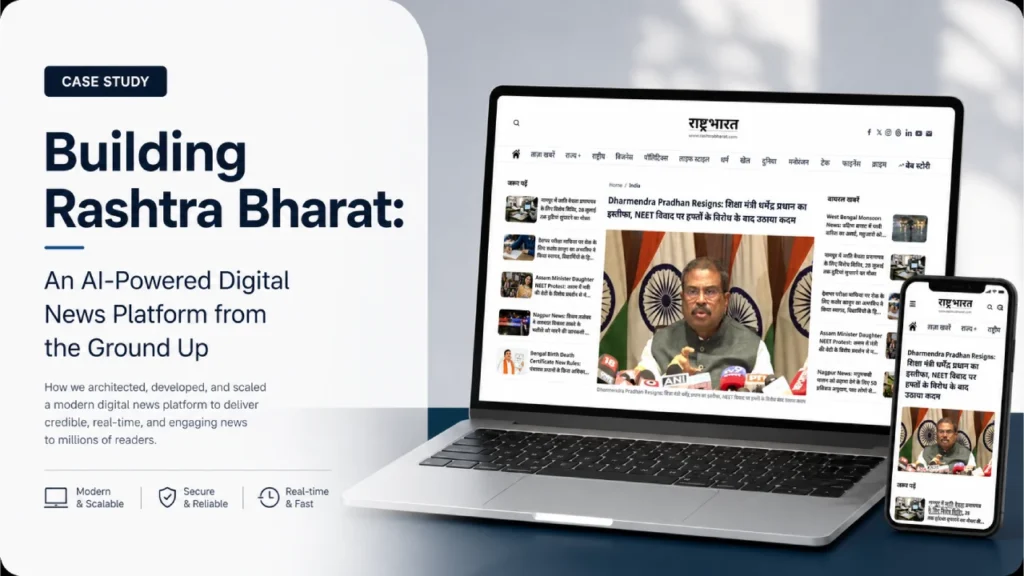
Decoupling an existing WordPress installation — keeping its editorial workflow via the REST API or WPGraphQL while a modern frontend (Next.js, React) takes over rendering. The migration path we’ve executed on our own production platform, not just a client engagement.
Content Preview & Editorial Workflow Engineering
Real-time, accurate preview is consistently the most common complaint in headless CMS implementations, and it’s almost always a design failure, not a platform limitation. We build preview environments that show editors exactly what will publish — before it publishes — because a content team that can’t trust preview stops trusting the whole system.
Multi-Channel & Omnichannel Content Delivery
One content model, delivered consistently across web, mobile apps, digital signage, and partner APIs — the core promise of headless architecture, engineered so your content team publishes once instead of adapting the same story for three different systems.
Headless Commerce Integration
Product content, catalog data, and merchandising content delivered via API into Shopify Hydrogen, custom storefronts, or existing e-commerce platforms — architecture built for a market growing at over 20% CAGR precisely because personalization and omnichannel commerce experiences demand it.
Enterprise Multi-Site & Multi-Brand Content Architecture
Shared content models and design systems across multiple brand sites or regional properties, with governance and permissions structured so each brand team has autonomy without duplicating the underlying content infrastructure.
More Custom CMS Development Services by Cybertize Technologies:
Headless CMS Development Company: Headless CMS Localization & Multi-Language Content
Field-level translation workflows and locale-aware content delivery for organizations publishing across India, the US, and beyond from a single content backend — built into the schema from day one, not retrofitted after your third market launch.
API Design & Content Delivery Layer Engineering
GraphQL and REST API layers built with caching, rate limiting, and webhook-driven revalidation designed correctly — since webhook behavior and publish-to-live latency are as important to editorial adoption as the CMS interface itself.
Custom Headless CMS Development (Node.js-Based)
For organizations with content requirements no off-the-shelf platform fits cleanly, a fully custom headless CMS built on Node.js — your data model, your admin interface, your API, with none of the licensing cost or schema constraints of a third-party platform.
Legacy CMS to Headless Replatforming
Migrating off Drupal, Adobe Experience Manager, Sitecore, or an aging custom CMS onto a modern composable stack — with content migration scripts, redirect mapping, and a phased rollout plan, since migrating 24 months of legacy content is where most headless projects actually blow their budget if it isn’t planned for upfront.
Headless CMS Performance & Scaling Architecture
CDN configuration, image transformation pipelines, and API response caching engineered for content-heavy sites where a media library alone can become the bottleneck if it isn’t architected for scale from the start.
Ongoing Headless CMS Support & Maintenance
CMS version upgrades, schema evolution as your content needs grow, API monitoring, and a support SLA — for teams who need a partner that stays accountable for the system after launch, not just through go-live.
System Design Services for Headless Content Architecture
Composable Architecture Consulting
MACH-aligned architecture design — evaluating where a headless CMS fits alongside your commerce platform, search, personalization, and analytics tools as independently selected, best-of-breed components rather than one locked-in monolithic suite.
Rendering Strategy & Frontend Architecture Design
The single highest-leverage decision in any headless project: how content reaches the rendering layer, and how fast a publish event actually goes live. We work this out before evaluating CMS platforms, not after, because it eliminates most of the wrong choices automatically.
Content Delivery Network & Caching Architecture
Multi-layer caching from CMS to CDN to edge, with webhook-driven revalidation so published content appears where it should, when it should — the architecture layer most “headless is fast” claims are quietly depending on.
Migration & Content Governance Strategy
A phased migration plan — pilot one content type before migrating the whole site — plus a governance model defining who owns schema changes going forward, since ungoverned schema sprawl is how a clean headless implementation turns messy within a year.
API Contract & Integration Design
Designing your content API as a stable, versioned contract that other systems (mobile apps, partner integrations, internal tools) can build against confidently — since your headless CMS is now infrastructure other teams depend on, not just a website backend.
Industries We Build Headless CMS Platforms For
Media & digital publishing · Retail & e-commerce · Fintech & BFSI · Real estate & PropTech · Hospitality & travel · Healthtech · EdTech · Government & public sector digital services · Enterprise multi-brand organizations
Government portals are among the fastest-growing adopters of headless architecture right now, with adoption in that sector projected to grow more than 25% annually as agencies modernize legacy digital infrastructure. We bring the same discipline to public-sector and enterprise engagements that we bring to media: content that has to reach multiple channels reliably, at scale, without a rebuild every time a new channel appears.
How We Work
- Rendering & Platform Strategy — We define how content reaches your frontend and how fast it needs to go live, then shortlist CMS platforms against that reality, not a generic checklist.
- Content Modeling Workshop — Schema design done with your actual editorial team in the room, on one pilot content type before committing to the full migration.
- Integration & Preview Build — Frontend integration and a working, accurate preview environment built together — because a headless system with broken preview is a system your editors will quietly abandon.
- Migration & QA — Phased content migration with redirect mapping and validation, not a single high-risk cutover weekend.
- Launch & Ongoing Ownership — Editor training, documentation, and either a clean handover or a maintenance SLA with our team.
Headless CMS Techniques We Use — and the Problems They Actually Solve
Most “why go headless” content stops at “it’s more flexible.” That’s true, but it’s not where headless projects actually succeed or fail. Here’s what separates a headless CMS implementation that content teams love from one that quietly turns into a slow-moving disaster — and it’s also the list of problems we most often get called in to fix.
Preview is the single most common headless CMS complaint, and it’s a solvable design problem, not an inherent platform limitation. Editors can’t do their job if they can’t see what they’re publishing before it goes live, and a purely headless system that sacrifices this in favor of pure API delivery is a common and avoidable mistake. In 2026, this gap has closed considerably — tools like Storyblok’s Visual Editor, Sanity’s Presentation mode, and Builder.io have made real-time, in-context preview a genuine feature rather than a workaround, which is exactly why platform selection has to account for editorial experience, not just API elegance. We build preview environments that mirror production rendering exactly, because “close enough” preview is what erodes editor trust in the whole system.
Poor content modeling compounds quietly, and it’s nearly impossible to fix cheaply once content has been entered against the wrong schema. Overly complex or poorly planned schemas make API queries slow and the whole system hard to maintain — and unlike a rendering bug, a bad content model doesn’t announce itself immediately. It shows up eighteen months later as an editorial team that can’t represent the content they actually need to publish, or a frontend team writing increasingly convoluted queries to work around a structure that never fit the real content. We design schemas around real editorial needs from a pilot content type first, and refactor deliberately as patterns emerge, rather than guessing the full model upfront.
Headless implementations shift real work onto engineering, and teams routinely underestimate how much. A meaningful share of teams — reported as high as 42% in industry surveys — face significant challenges specifically because a headless CMS removes the pre-built templates and default themes a traditional CMS ships with, meaning your team has to design and build the entire presentation layer separately. This isn’t a reason to avoid headless; it’s a reason to budget realistically for it, and total implementation cost — CMS licensing plus frontend development, hosting, preview tooling, migration, and QA — is the number that actually matters, not the CMS subscription price alone.
Webhook and revalidation architecture determines whether “headless is fast” is actually true for your site. The rendering-architecture decision — how a publish event propagates from CMS to live page — has to be solved before evaluating editorial UX or schema tooling, because it’s the first pass/fail gate that eliminates platforms that can’t meet your actual latency requirements. We design this layer explicitly: webhook-triggered revalidation, CDN cache invalidation, and a clear answer to “how long between publish and live” before any content model gets finalized.
Migration is where most headless projects actually blow their budget, not the CMS license. Content migration from a legacy system routinely adds tens of thousands of dollars in scope that teams don’t account for upfront, and the right mitigation is the same one experienced teams keep converging on: pilot one content type, validate the full pipeline end to end, then migrate the rest — instead of discovering migration problems mid-way through moving thousands of articles at once.
Why Cybertize Technologies
We design editorial experience and engineering architecture together, not sequentially. The most common reason headless projects sour six months in is that engineering optimized for API elegance while marketing was never consulted on preview and publishing workflow. We put both in the room from week one.
50+ clients, and a real headless migration behind us. We’ve executed the exact WordPress-to-headless transition many of our clients are considering, on our own production platform — Rashtra Bharat’s migration wasn’t a case study we read about, it’s work we did.
Presence across India and the US, real overlap hours. Teams across Delhi, Mumbai, Gujarat, Indore, and Bangalore give you deep engineering capacity at India-competitive cost, with US-hours availability so content and engineering decisions don’t wait a day for a time-zone gap to close.
We start with rendering architecture, not a CMS demo. Most CMS evaluation failures are sequencing failures — teams pick a platform before defining the architecture it has to feed, then discover the constraint later. We run that sequence in the right order, every time.
Vendor-neutral platform recommendations. We’re not a Contentful reseller or a Sanity partner pushing a single platform regardless of fit. We recommend Strapi, Sanity, Storyblok, Hygraph, Payload, or a fully custom Node.js-based CMS based on your actual requirements and budget.
One group for engineering and creative. Cybertize Technologies builds the platform. Our sister company, Cybertize Media Productions, handles brand film and video content — one accountable group instead of two vendors coordinating badly on a multi-channel content strategy.
India-competitive pricing, without India-average execution. You get composable-architecture discipline and a genuine focus on editorial usability at rates that are a fraction of US or Western European agency pricing for comparable engineering quality.