Table of Contents
AI Agent Development: Why Most AI Agent Projects Still Fail

Start with the number every business leader considering an AI agent project needs to sit with before anything else. Gartner’s 2026 research found that 89 percent of AI agent pilots never make it to production, and separately, that over 40 percent of agentic AI projects launched today will be cancelled by 2027. The reason is almost never the model. It is that organizations struggle to operationalize what worked in a demo, identity and permissions, auditability, reliability under real load, and clear business ownership all get deferred until the pilot hits a wall it was never built to survive.
The flip side of that statistic is what makes this worth building anyway. The 11 percent of agent projects that do reach production deliver an average return of 171 percent. Klarna’s support agent, built on LangGraph, now handles two-thirds of all customer inquiries and performs work equivalent to 853 employees, saving the company roughly 60 million dollars a year. JP Morgan reports 95 percent faster research retrieval using agent-based systems. These are not pilot-stage numbers. They are production systems that survived exactly the operational gap most projects fall into.
At Cybertize Technologies, this is the gap we help clients close, and this guide lays out what that actually takes: what an AI agent is, which frameworks are winning in production right now, what real projects cost, and the governance structure that determines which side of that 89 percent line a given project ends up on.
What an AI Agent Actually Is, and What It Isn’t

An AI agent is not just a chatbot with a longer prompt. The useful distinction, consistent across current technical guidance, is this: a standard LLM responds to a question. An agent reasons about a goal, plans a sequence of steps, uses tools to act on the world, observes the results, and adjusts its approach based on what it finds, continuing that loop until the task is genuinely complete or it needs to escalate to a human. Think of the difference between asking someone a question and handing someone a project to finish on their own judgment.
AI Agent Development: That distinction matters for scoping a business project correctly. A large share of what gets pitched internally as “we need an AI agent” is actually a simpler need, a well-structured prompt, a retrieval system, or a single-step automation, that does not require the additional cost, complexity, and governance overhead genuine multi-step agentic autonomy brings with it. One frequently cited industry observation from a widely discussed Hacker News and Reddit debate in 2026 put it bluntly: a meaningful share of agentic projects would actually perform better as simple, deterministic prompt chains. The most reliable production systems in 2026, including Klarna’s, blend deterministic steps, rules, API calls, system checks, with agent reasoning specifically where it adds real value, in handling exceptions, making judgment calls, and synthesizing information a rigid workflow cannot anticipate. Knowing which parts of your workflow genuinely need that reasoning flexibility, and which parts are better left as fast, predictable, rule-based steps, is the first and most consequential scoping decision in any agent project.
The Framework Landscape in 2026
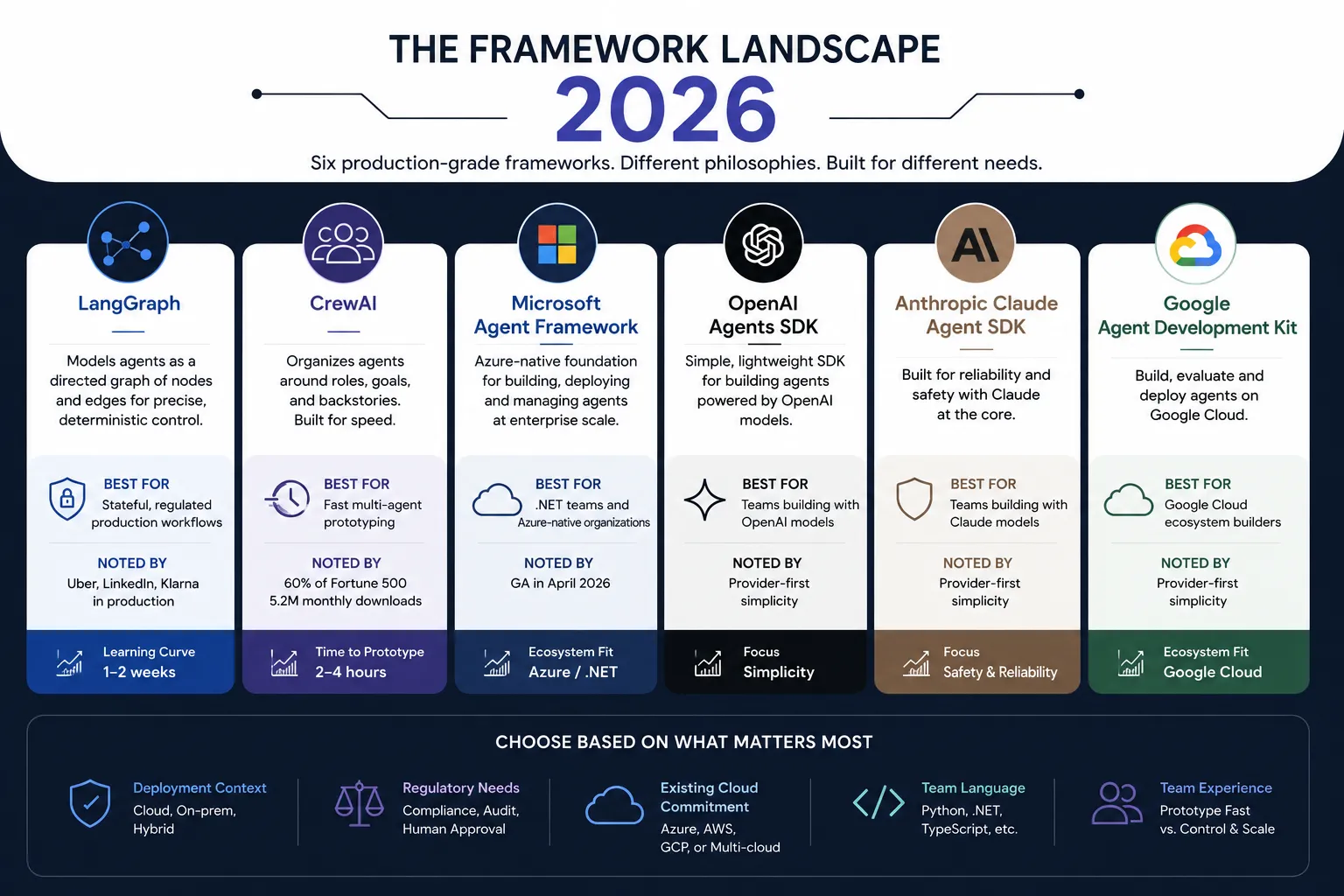
Eighteen months ago, building an agent meant hand-writing a reasoning loop and hoping the state management held together past a demo. That era is genuinely over. By early 2026, at least six production-grade agent frameworks are competing for real enterprise codebases, each built around a different underlying philosophy for how an agent should reason and act.
LangGraph, which reached general availability in October 2025, models an agent’s workflow as a directed graph of nodes and edges, giving developers precise, deterministic control over exactly how an agent moves between steps. It has become the default choice for stateful production workflows specifically in regulated industries, where auditability and explicit human-approval checkpoints matter as much as raw capability, and companies including Uber, LinkedIn, and Klarna have run LangGraph agents in production for over a year. The tradeoff is a genuine one to two week learning curve before a team becomes productive with its graph-based abstraction, overhead that is not worth paying for a genuinely simple, single-step task.
CrewAI takes a fundamentally different approach, organizing agents around roles, goals, and “backstories” rather than an explicit graph, closer to assembling a team than designing a flowchart. It has become the fastest path from an idea to a working multi-agent prototype, commonly two to four hours, and reports usage across 60 percent of Fortune 500 companies with 5.2 million monthly downloads. Teams frequently start with CrewAI for speed and graduate to LangGraph once they need more precise control over complex conditional logic.
Microsoft Agent Framework, which reached general availability in April 2026 as the unified successor to Microsoft’s earlier AutoGen and Semantic Kernel projects, has become the natural default for organizations already committed to .NET and Azure-native infrastructure. OpenAI’s Agents SDK and Anthropic’s Claude Agent SDK both prioritize simplicity for teams building primarily around their respective model providers, while Google’s Agent Development Kit serves a similar role inside the Google Cloud ecosystem. No single framework dominates every category, and choosing based on GitHub star count alone is a documented mistake. LangGraph leads specifically on production maturity and persistence. CrewAI leads on community size and speed to first prototype. The right choice depends far more on deployment context, regulatory environment, existing cloud commitments, team language preference, than on any single feature comparison.
| Framework | Best fit | Learning curve |
|---|---|---|
| LangGraph | Regulated industries, complex conditional workflows, deterministic control | 1-2 weeks |
| CrewAI | Fast multi-agent prototyping, role-based team structures | 2-4 hours to first prototype |
| Microsoft Agent Framework | .NET and Azure-native enterprises | Moderate, Azure-familiar teams |
| OpenAI Agents SDK / Claude Agent SDK | Teams building primarily around one model provider | Low, provider-native simplicity |
| Google ADK | Google Cloud-native deployments | Moderate |
One architectural point worth understanding regardless of framework choice: agent frameworks handle orchestration, routing, scheduling, and retry logic, not data access on their own. The Model Context Protocol, MCP, has become the standard way agents actually connect to a business’s real tools, databases, and APIs without custom integration code for every single system, and most current frameworks now support it natively rather than treating it as an afterthought.
What Real Agent Deployments Actually Cost
Cost scales directly with the number of agent turns and tool calls a task requires, not with the complexity of the underlying business problem alone. A simple three-agent workflow can consume three to five times the tokens of a single, well-crafted prompt, because each agent turn typically involves its own reasoning pass, tool call, and observation step before the next decision gets made. The practical cost-control pattern most production teams have converged on is using a cheaper, faster model for simple agent roles, summarization, classification, straightforward routing, and reserving a stronger, more expensive reasoning model specifically for the steps in a workflow that genuinely require judgment.
This is also where governance and cost control intersect directly. Without monitoring in place, a poorly bounded agent can enter a retry loop or a runaway reasoning chain that burns through a token budget in hours rather than days, which is why current best practice treats an observability layer tracking cost per task, retry frequency, and escalation rate as a required part of any production deployment, not an optional nicety layered on afterward.
The Governance Layer That Actually Determines Success
This is the part of agent development most technical guides skip and most failed projects skip too, which is exactly why it belongs at the center of this one. CIOs and CISOs consistently cite the same five concerns as the real blockers to scaling agents past a pilot: prompt injection, over-permissioned agents, unintended actions, insufficient traceability, and unclear ownership when something goes wrong. None of these are model-capability problems. They are engineering and organizational discipline problems, and they are exactly the gap that separates the 11 percent of projects reaching production from the 89 percent that don’t.
The governance structure that works in practice, consistent across multiple current implementation guides, does not require heavy bureaucracy even for small and mid-sized companies. It requires a simple risk matrix classifying every action an agent might take into one of four categories: informational actions, reversible actions, critical actions, and prohibited actions, paired with a staged autonomy model that expands an agent’s independence only as trust is genuinely earned. That staged model typically moves through three phases: the agent recommends and a human acts, then the agent acts with human approval required before each action, and only in the final stage does the agent gain narrow, bounded autonomy, often capped at a specific dollar value or action type, to act independently within clearly defined limits.
Measurement discipline matters just as much as the permission structure itself. Counting conversations handled or tasks completed is a weak signal on its own. The metrics that actually predict whether an agent is creating real business value are time genuinely saved, correct escalation rate, when the agent recognized it was out of its depth and handed off appropriately, errors avoided, and user satisfaction, since an agent that answers a high volume of queries but escalates poorly can create less real value than one that handles fewer requests but reliably removes genuinely critical work from a human’s plate.
One emerging governance concern deserves specific attention as multi-agent systems, several agents working together rather than a single agent alone, become more common. Research published in December 2025 on multi-agent failure modes found that in simulated systems, a single compromised agent poisoned 87 percent of downstream decision-making within four hours, faster than traditional incident response processes could contain it. That finding is why current governance guidance increasingly calls for system-level circuit breakers and quarantine mechanisms in multi-agent deployments specifically, not just individual-agent-level permission controls, since a densely connected multi-agent system fails as a system, not as isolated parts.
Organizations that formalize this discipline see a measurable difference in outcomes. Companies with dedicated AI leadership, a Chief AI Officer or equivalent role, achieve a 44 percent success rate moving generative AI prototypes into production, against 36 percent for organizations without one, and report AI-attributable revenue growth at more than double the rate of those without dedicated leadership. The share of surveyed organizations reporting a Chief AI Officer jumped from 26 percent in 2025 to 76 percent in 2026, a rapid shift that reflects how directly governance structure is now tied to whether an agent project actually survives contact with production.
A Practical Path From Pilot to Production
Pull the data above together and a consistent implementation sequence emerges across the organizations actually succeeding at this. Start narrow. The teams making real progress focus on two or three high-value, production-shaped use cases with a clearly named business owner and defined success metrics, rather than running a dozen scattered pilots designed to impress a leadership meeting rather than deliver a measurable outcome, since projects without clear ROI are consistently the first casualties when budgets tighten.
Audit the actual process before writing any agent logic, mapping exactly where a human currently makes each decision, what data that decision depends on, and where the real bottleneck sits, rather than assuming an agent should own the entire workflow end to end from day one. Define the risk matrix and staged autonomy plan before granting the agent any capability beyond recommending an action, and build the observability and cost-tracking layer in from the start rather than retrofitting it once a pilot has already proven the concept but revealed nothing about how it behaves under real production load and adversarial input.
Choose the framework based on deployment context rather than popularity. A regulated financial services workflow needing explicit audit trails and human checkpoints has a genuinely different right answer than a fast-moving internal tool where CrewAI’s speed to first prototype matters more than LangGraph’s deterministic control. And plan the cost model around agent turns and tool calls specifically, not a flat per-user or per-seat estimate, using cheaper models for simple agent roles and reserving premium reasoning capability for the steps that actually require it.
At Cybertize Technologies, this sequence, narrow scope, real process audit, staged autonomy, and governance built in from the start rather than bolted on afterward, is the exact discipline we bring to every agent project we build for clients, because the data in this guide is consistent on one point above all others: agents do not fail because the underlying technology is too advanced. They fail because they were never engineered to survive the reality of production in the first place.
Frequently Asked Questions
-
What percentage of AI agent projects actually succeed?
Only about 11 percent of AI agent pilots reach production, according to Gartner’s 2026 research, with over 40 percent of agentic AI projects expected to be cancelled by 2027. The projects that do reach production, however, average a 171 percent return on investment.
-
What is the difference between a chatbot and an AI agent?
A chatbot responds to a question. An AI agent reasons about a goal, plans a multi-step approach, uses tools to take real action, observes the results, and adjusts its behavior, continuing that loop until the task is complete or it needs to escalate to a human, rather than simply answering a single prompt.
-
Which AI agent framework should a business actually use?
It depends on deployment context more than any single feature. LangGraph is the common choice for regulated industries needing deterministic control and audit trails. CrewAI is the fastest path to a working multi-agent prototype. Microsoft Agent Framework fits Azure-native enterprises, and OpenAI or Anthropic’s SDKs suit teams building primarily around one specific model provider.
-
Why do most AI agent projects fail to reach production?
Almost never because of the underlying model. The consistent finding across Gartner, Forrester, and IDC research is that organizations struggle to operationalize what worked in a demo, identity and permissions, auditability, reliability, and clear business ownership are deferred until the pilot hits a wall it was never engineered to survive.
-
How much does building an AI agent actually cost?
Cost scales with the number of agent turns and tool calls a task requires rather than a flat rate. A simple three-agent workflow can consume three to five times the tokens of a single prompt, which is why most production teams use cheaper models for simple agent roles and reserve stronger reasoning models specifically for steps that require real judgment.
-
What is the biggest governance risk in deploying AI agents?
Insufficient permission scoping and traceability. CIOs and CISOs most commonly cite prompt injection, over-permissioned agents, unintended actions, and lack of auditability as the real blockers to scaling agents, and research on multi-agent systems found a single compromised agent can poison 87 percent of downstream decisions within four hours if system-level safeguards are not in place.
-
Do businesses need a Chief AI Officer to succeed with AI agents?
Not strictly required, but the data shows a real correlation. Organizations with dedicated AI leadership achieve a 44 percent success rate moving prototypes into production compared to 36 percent without one, and report AI-attributable revenue growth at more than double the rate, reflecting how closely governance structure ties to production outcomes.
-
Should every business automation use a full AI agent instead of a simpler tool?
No, and this is one of the most common scoping mistakes. A meaningful share of projects pitched internally as needing an AI agent would actually perform better and more reliably as a simpler, deterministic prompt chain or automation, reserving genuine agentic reasoning specifically for the steps that involve real exceptions or judgment calls.
-
What is a staged autonomy model for AI agents?
A governance approach that expands an agent’s independence only as trust is earned, typically moving through three phases: the agent recommends an action and a human acts, the agent acts but requires human approval first, and finally the agent gains narrow, bounded autonomy, often capped at a specific dollar value or action type, to act independently.
-
What metrics actually indicate whether an AI agent is delivering business value?
Time genuinely saved, correct escalation rate, errors avoided, and user satisfaction matter far more than raw volume metrics like conversations handled. An agent that answers fewer queries but reliably escalates the right ones and removes genuinely critical work from a human’s plate often creates more real value than a high-volume agent with a poor escalation rate.
Cybertize Technologies Private Limited builds AI agents engineered to survive production, not just impress in a demo, with governance and observability designed in from day one. Connect now.
Sources:
- LangChain, The Best AI Agent Frameworks in 2026
- Let’s Data Science, AI Agent Frameworks 2026: LangGraph vs CrewAI and More
- SocialCrawl, AI Agent Frameworks in 2026: A Developer’s Field Guide to What Actually Ships
- Uvik Software, Agentic AI Frameworks 2026: Production Comparison
- Alice Labs, Best AI Agent Frameworks 2026: 7 Compared
- Fungies.io, Multi-Agent Orchestration Frameworks in 2026
- Azumo, 60+ AI Agent Statistics for 2026: Adoption, ROI and Market Growth
- Kore.ai, AI Agents in 2026: From Hype to Enterprise Reality
- Neontri, Enterprise AI Agents: The 2026 Strategy, Selection and Deployment Guide
- Company of Agents, AI Agent ROI in 2026: Avoiding the 40% Project Failure Rate
- THE DAILY BRIEF, 89% of AI Agent Pilots Never Scale: Gartner’s 2026 Data
- Reinventing.ai, The AI Agent Reckoning: Why 40% of Enterprise Projects Will Fail by 2027
- Tony Ciencia, Enterprise AI Agents in 2026: How to Implement Them with Control, Safety, and ROI
- Zylos Research, AI Agent Governance and Compliance in 2026
- Gartner, agentic AI project failure and enterprise application forecasts, 2026