Table of Contents
State of UI/UX Design in India: A Discipline That Has Outgrown Its Old Reputation
Ten years ago, “UI/UX designer” in India often meant someone who made things look nice after the product was already built. That description no longer fits. Design has moved upstream, into product strategy conversations, into board-level growth metrics, and increasingly into direct collaboration with AI systems that are reshaping how design work gets produced in the first place.
At Cybertize Technologies, we build interfaces and design systems for clients across fintech, D2C, and enterprise SaaS, and the shift in this report is one we see directly in client conversations, budgets that used to treat design as a line item now treat it as a growth lever with its own ROI conversation attached. This report lays out the data behind that shift, covering the ten dimensions that matter most for anyone hiring, budgeting, or building a career in Indian UI/UX design right now.
Size of the Indian UI/UX Market
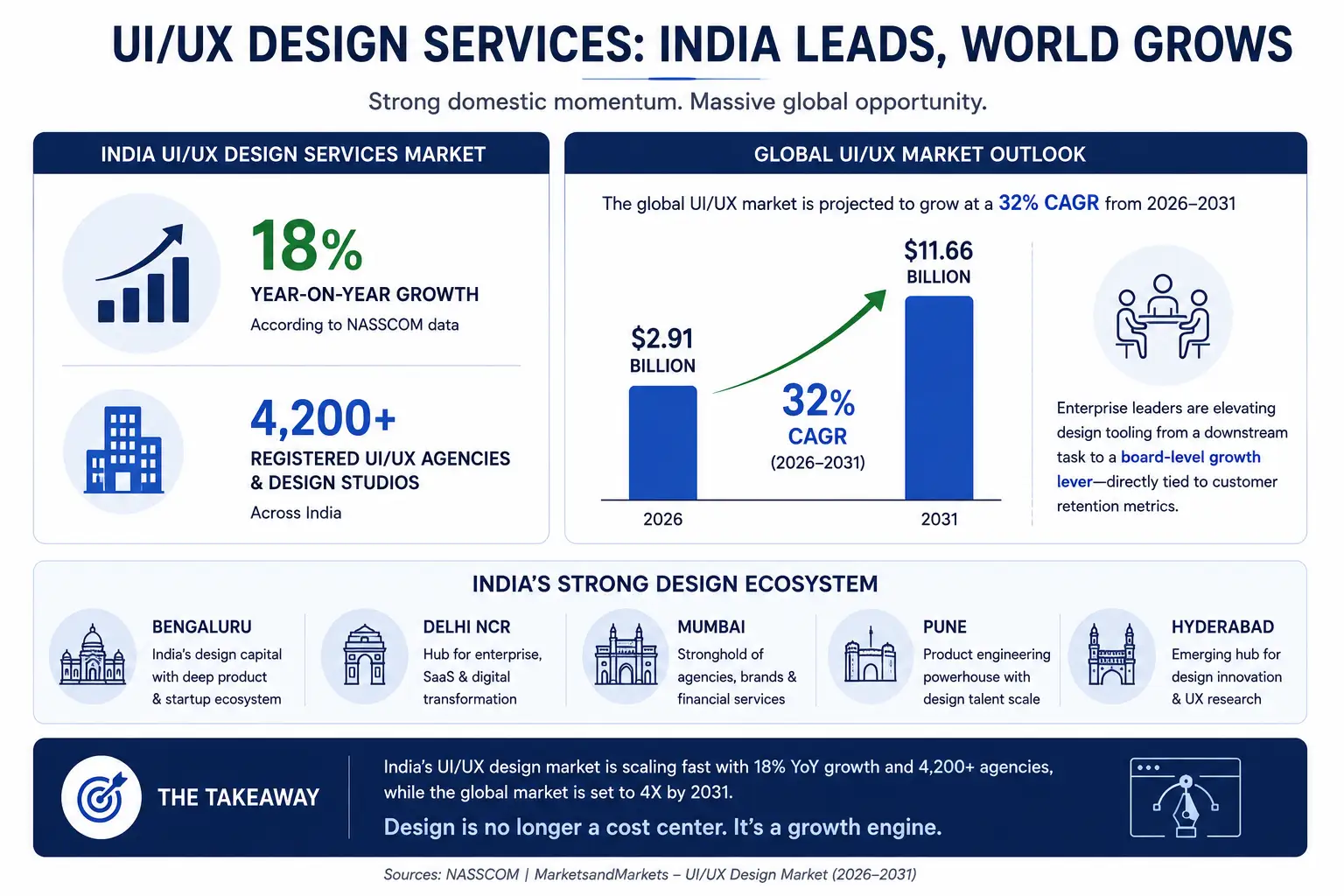
State of UI/UX Design in India: India’s design services market is growing at roughly 18 percent year on year, according to NASSCOM data, and now supports more than 4,200 registered UI/UX agencies and independent design studios concentrated across Bengaluru, Delhi NCR, Mumbai, Pune, and Hyderabad. That growth sits inside a much larger global expansion. The global UI/UX market itself is projected to climb from roughly 2.91 billion dollars in 2026 to 11.66 billion dollars by 2031, a compound annual growth rate of 32 percent, as enterprise leaders reclassify design tooling from a downstream task to a board-level growth lever tied directly to customer retention metrics.
Also Read: AI Development Cost Guide 2026
India’s specific talent gap gives a clearer sense of where this market is headed than the funding figures alone. Industry estimates put India’s need at more than 80,000 additional UI/UX designers by 2027 just to meet current demand, a gap driven by product companies, D2C brands, and increasingly AI-native startups all competing for the same pool of experienced talent at once.
Hiring Trends
Demand for UI/UX talent in India remains strong and broad-based. Job trackers show more than 15,000 active UX design listings at any given time, spanning tech, e-commerce, finance, and healthcare, and product and platform companies including Google India, Flipkart, Razorpay, Swiggy, Nykaa, Paytm, and Myntra consistently rank among the highest-paying employers for design talent in the country.
The nature of what companies are hiring for has shifted too. Job listings increasingly ask for designers who can integrate generative and agentic AI directly into research, design, and workflow processes, not just produce visual assets, and roles explicitly framed around designing experiences for human and AI-agent interaction have started appearing at both product companies and enterprise consultancies. Portfolio quality now frequently outweighs formal design credentials in hiring decisions, particularly at startups, though graduates from NID, Srishti, and IIT design programs continue to compete strongly for the most senior and strategic roles.
Salary Benchmarks
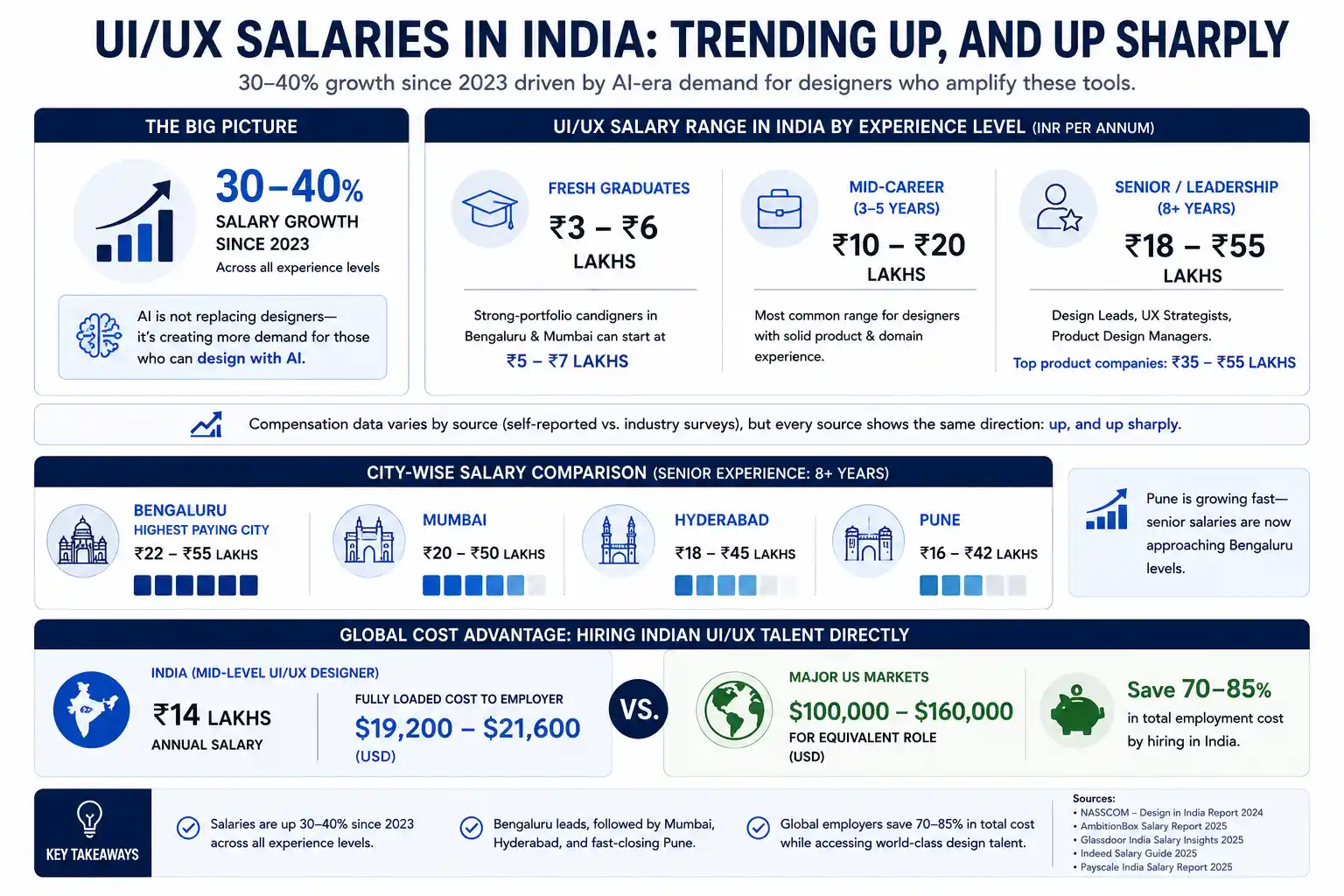
Compensation data varies noticeably by source, largely because self-reported salary trackers and formal industry surveys sample different segments of the market, but the overall direction across every source is the same: up, and up sharply. UI/UX salaries in India have grown roughly 30 to 40 percent since 2023, a jump attributed directly to AI-driven demand for designers who can work alongside these new tools rather than being replaced by them.
By experience level, fresh graduates typically earn 3 to 6 lakhs per year, with strong-portfolio candidates in Bengaluru and Mumbai starting as high as 5 to 7 lakhs. Mid-career designers with three to five years of experience generally fall in the 10 to 20 lakh range, and senior designers with eight or more years of experience, often working as design leads, UX strategists, or product design managers, command 18 to 55 lakhs depending on company and city, with the very top of the market at large product companies reaching 35 to 55 lakhs for senior product designers.
City matters substantially. Bengaluru consistently pays the highest UI/UX salaries in India, followed by Mumbai and Hyderabad, while Pune has grown quickly enough that senior salaries there are beginning to approach Bengaluru levels. For international employers hiring Indian design talent directly, the cost advantage remains significant even accounting for full employer costs. A mid-level Indian UI/UX designer at a 14 lakh rupee salary typically costs an employer roughly 19,200 to 21,600 dollars fully loaded, compared to 100,000 to 160,000 dollars for an equivalent hire in a major US market.
State of UI/UX Design in India: Design Tool Usage
Figma’s dominance in the Indian and global design tool market is close to total. Figma now holds roughly 40 to 41 percent global market share in collaborative design and prototyping, well ahead of Adobe XD at 13.5 percent and InVision at 7.6 percent, with 93 percent adoption among organisations in the software design category and 91 percent of new design teams choosing it as their first tool. India specifically accounts for roughly 7 percent of Figma’s global user base, the largest concentration outside the United States, which itself holds 38 percent.
What has changed more recently than market share is what Figma is being used for. At its Config 2026 conference, Figma introduced AI agents and code-native design tools, letting designers work directly with code on the design canvas, generate design directions from cloned repositories, and sync changes back to code automatically, part of what the company describes as turning its platform into a full intelligent canvas for digital creation rather than a static design tool. That shift toward tools handling both design and code in one environment is a meaningful marker of where the entire tooling category is heading.
Also Read: In-House vs Outsourcing Development, What Should You Choose in 2026 – 27?
AI Adoption in Design
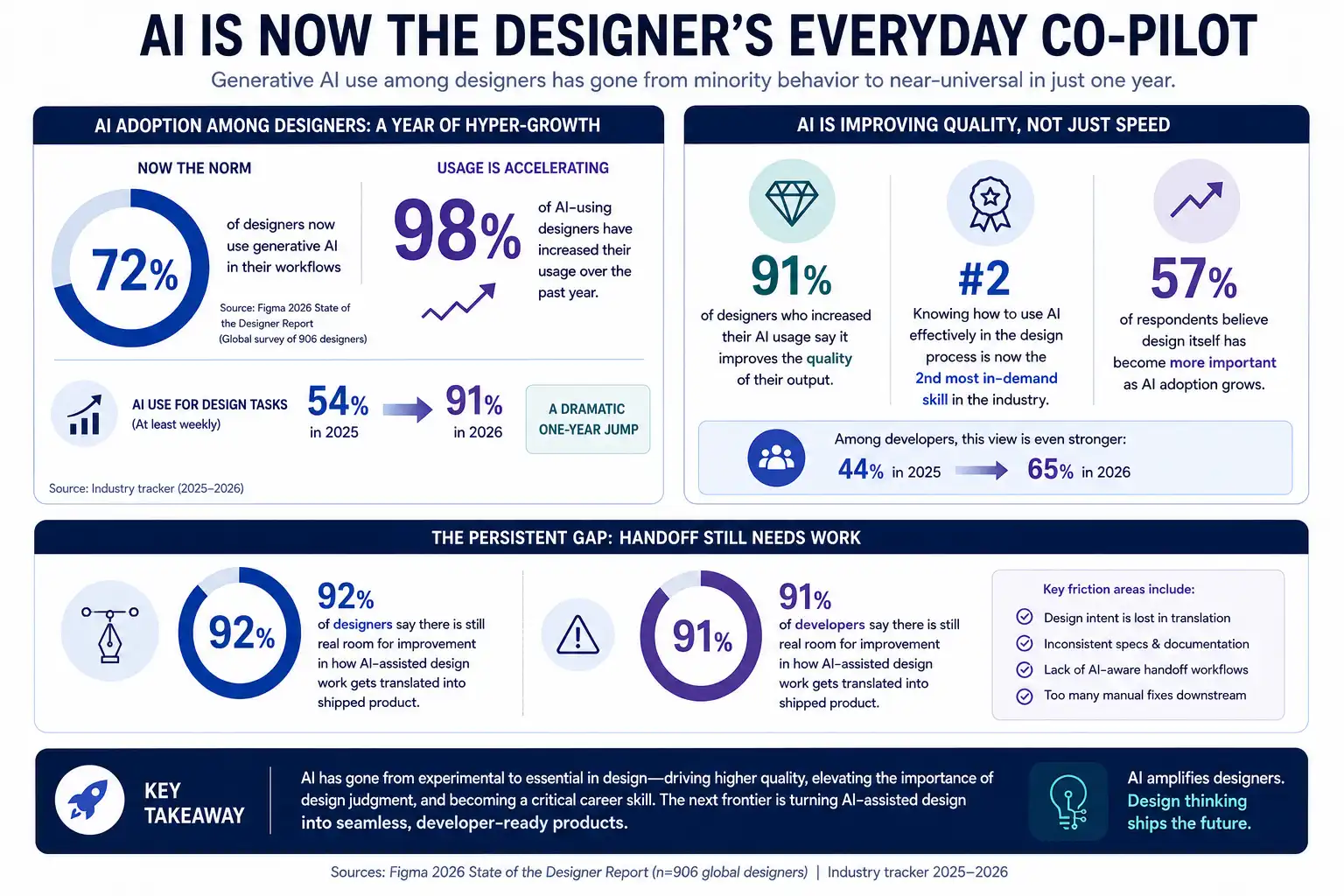
This is the fastest-moving number in the entire report. Generative AI use among designers has gone from a minority behaviour to a near-universal one in a very short window. Figma’s 2026 State of the Designer report, based on a global survey of 906 designers, found 72 percent now use generative AI in their workflows, with 98 percent of that group having increased their usage over the past year. A separate industry tracker found AI use for design tasks at least weekly climbed from 54 percent in 2025 to 91 percent in 2026, a genuinely dramatic one-year jump.
State of UI/UX Design in India: Crucially, the value of that AI use is not purely about speed anymore. Ninety-one percent of designers who increased their AI usage say it improves the quality of their output, not just how quickly they produce it, and knowing how to use AI effectively in the design process now ranks as the second most in-demand skill in the industry. Fifty-seven percent of respondents believe design itself has become more important as AI adoption grows, and that view is even stronger among developers, up from 44 percent in 2025 to 65 percent in 2026, suggesting AI adoption is elevating the perceived value of design judgment rather than diminishing it. One caution worth flagging honestly: handoff between designers and developers remains a persistent weak point even as AI adoption climbs, with 92 percent of designers and 91 percent of developers saying there is still real room for improvement in how AI-assisted design work gets translated into shipped product.
Mobile-First Statistics

India’s internet usage pattern makes mobile-first design a genuine business requirement rather than a design preference. India crossed 850 million active internet users in 2025, and more than 80 percent of them browse, shop, and make decisions exclusively on smartphones. The average Indian smartphone user now spends over 4.5 hours a day on their device, and affordable data plans have pushed internet access deep into Tier 2 and Tier 3 cities, meaning a user in Bhopal or Patna is just as likely to be browsing on a budget Android device as a user in Mumbai or Bengaluru.
That reality shapes Indian UX design in ways Western-market playbooks often miss. With 22 official languages and hundreds of dialects, a large share of India’s next wave of internet users are vernacular-first rather than English-first, and startups targeting Tier 2 and Tier 3 markets increasingly design in the primary regional language first before adapting to English, not the reverse. Network reliability also varies considerably outside metro areas, which means designing only for high-speed connections creates a real disconnect between the intended product experience and how a large share of Indian users actually encounter it. Skeleton screens, progress indicators, and testing on throttled connections and budget devices have become standard practice for serious Indian product teams rather than an edge-case consideration.
UX Maturity Levels
State of UI/UX Design in India: UX maturity, meaning how deeply user experience thinking is embedded into an organisation’s decision-making rather than bolted on after a product is built, remains an uneven picture across Indian companies. Most maturity models describe a progression from an organisation with no formal UX process, through one that treats UX reactively on individual projects, to one where UX research and design are integrated systematically into strategy and measured with clear ROI metrics against business outcomes.
India’s product-led companies, Flipkart, Razorpay, Swiggy, CRED among them, sit meaningfully further along that curve than the broader market, treating design as a measured, board-visible investment. But a large share of Indian startups and traditional enterprises remain earlier in that progression, engaging design reactively rather than strategically, a gap reflected clearly in hiring patterns, since companies further along the maturity curve are also the ones creating senior design leadership roles like Head of Design and UX Director rather than treating design as an execution-only function reporting into engineering or marketing.
Startup Design Spending
Design spending for Indian startups varies enormously by stage and has historically been one of the first line items cut under budget pressure, despite being one of the factors most directly tied to user retention. Current market data shows real, itemised pricing rather than the opaque quoting that used to characterise this segment. Fully custom UI/UX design work, covering research, wireframing, interactive prototyping, and pixel-perfect implementation, typically costs 1 to 5 lakh rupees for a startup-stage mobile app, while a template-based approach costs meaningfully less but risks a generic result that hurts retention and conversion. For a moderate-complexity app overall, encompassing UX design, UI design, frontend, backend, and QA together, Indian startups should generally budget 12.6 to 25.2 lakh rupees, with design and UX research typically representing 15 to 20 percent of that total build cost.
Also Read: The Future of Enterprise Software: AI Edition (2026 Guide for Business Leaders)
Hidden costs matter here as much as they do in AI development budgets. Revision rounds beyond an agency’s included scope typically run 1,500 to 5,000 rupees per screen per round, and tooling costs for Figma, usability testing platforms like Maze, and analytics tools like Hotjar add another 5,000 to 25,000 rupees a month depending on team size, costs that rarely appear in an initial agency quote but consistently show up on the actual invoice.
Enterprise Design Investment
State of UI/UX Design in India: Larger Indian enterprises, particularly in BFSI, fintech, and established consumer tech, have moved further and faster than most startups in treating design as a measured business investment rather than a cost center. Globally, spending on digital transformation reached 7.5 percent of revenue in 2025 specifically because executives increasingly link interface quality to customer lifetime value, and IDC projects 60 percent of Global 2000 CMOs will be measured on customer-value outcomes by 2027, a shift that pulls UI/UX budgets directly into revenue and retention conversations rather than leaving them as a qualitative usability line item.
In India, this shows up concretely in which design agencies enterprise clients are choosing. Established Indian design studios with over a decade of BFSI and fintech-specific experience report consistent enterprise demand from clients seeking to modernise legacy interfaces and reduce the customer support and conversion costs tied to poor design, a pattern consistent with the broader evidence that organisations investing strategically in design outperform peers on conversion, retention, and development efficiency over time.
Remote Design Trends
Remote work has become a structural feature of the Indian design job market rather than a pandemic-era exception. Current job platforms show hundreds of active remote UI/UX and product design roles at any given time, spanning everything from UX research and strategy roles to pure visual UI execution, with pay bands that vary considerably depending on whether the hiring company is Indian, US-based, or globally distributed.
For Indian designers specifically, remote work with international employers has become one of the clearest paths to income well above domestic salary benchmarks, since a US or European company hiring a remote Indian designer at even a modest premium over local Indian rates still represents substantial savings compared to hiring domestically, while the designer earns meaningfully more than the typical India-based salary bands covered earlier in this report. International employers hiring this way typically plan for at least three to four hours of daily working-hours overlap with their core team, and increasingly rely on Employer of Record arrangements to hire Indian design talent compliantly without setting up a local legal entity, with EOR fees generally running 199 to 599 dollars per employee per month for flat-fee providers.
What This Means Heading Into 2027
Pull the ten pieces of this report together and the pattern is consistent. India’s UI/UX market is growing faster than its talent pipeline can currently fill, which is good news for designers and a real planning constraint for companies hiring. AI has moved from an experimental tool to a core, quality-improving part of the design workflow in the space of about eighteen months, and designers who build genuine fluency with it are increasingly the ones commanding both the highest salaries and the most senior roles, not the ones being displaced. Mobile-first and vernacular-first design are not optional adaptations for the Indian market, they are the baseline requirement given how the vast majority of Indian users actually access the internet. And the gap between companies treating design as a measured, strategic investment and those still treating it reactively remains the clearest dividing line between which organisations are capturing real business value from their design spend and which are still leaving it on the table.
At Cybertize Technologies, this is the landscape we build inside for clients across fintech, D2C, and enterprise SaaS, and staying current on where Indian design talent, tooling, and user behaviour are actually heading is what lets us design interfaces that hold up against both user expectations and business outcomes, not just visual trends.
How big is the UI/UX design market in India right now?
India’s design services market is growing at roughly 18 percent year on year according to NASSCOM data, supported by more than 4,200 registered UI/UX agencies and design studios, within a global UI/UX market projected to grow from 2.91 billion dollars in 2026 to 11.66 billion dollars by 2031.
What is the average UI/UX designer salary in India in 2026?
State of UI/UX Design in India: Salaries vary by experience and city, but fresh graduates typically earn 3 to 6 lakhs per year, mid-career designers with three to five years of experience earn 10 to 20 lakhs, and senior designers with eight or more years of experience earn 18 to 55 lakhs, with Bengaluru consistently paying the highest rates in the country.
How many UI/UX designers does India need by 2027?
Industry estimates put the gap at more than 80,000 additional UI/UX designers needed by 2027 to meet current demand, driven by product companies, D2C brands, and AI-native startups all competing for the same experienced talent pool.
What design tool dominates the Indian and global UI/UX market?
Figma holds roughly 40 to 41 percent global market share in collaborative design and prototyping, with 93 percent adoption among software design organisations and 91 percent of new design teams choosing it as their first tool. India accounts for around 7 percent of Figma’s global user base, the largest concentration outside the United States.
How many designers actually use AI in their workflow now?
Adoption has become close to universal. Seventy-two percent of designers globally use generative AI in their workflows according to Figma’s 2026 State of the Designer report, and separate tracking shows weekly AI use for design tasks climbing from 54 percent in 2025 to 91 percent in 2026.
Cybertize Technologies Private Limited designs UI/UX for clients across fintech, D2C, and enterprise SaaS, grounded in current Indian market data and user behaviour rather than assumptions carried over from Western design playbooks.
Sources
- NASSCOM, India design services market data, cited via DigiFlute 2026 pricing guide
- Mordor Intelligence, UI/UX Market Share, Size and Growth Outlook to 2031
- Felix ITs, UI/UX Designer Salary in India 2026, City-Wise Guide
- SalaryInHand, UI/UX Designer Salary in India 2026
- Omnivoo, UI/UX Designer Salary in India 2026, Benchmarks by Experience and City
- Product Leadership, Job and Hiring Statistics for UX Designers in India
- IIM Skills, UI UX Designer Salary in India 2026
- Figma, State of the Designer 2026 Report
- Figma, 79+ Design Statistics: Tools, Collaboration, and AI in 2026
- TechnoTrenz, Figma Statistics by Market Share, Revenue and Users 2026
- AI Data Insider, Figma Unveils AI Agents and Code-Native Design Tools at Config 2026
- State of AI Design 2026, Tools chapter
- DigitalVia, Mobile-First Website Design India 2026
- HNK Media, UI UX Design Trends India 2026
- DigiFlute, UI UX Design Cost for Startups India 2026: Full Breakdown
- Instabizweb, Mobile App Development Cost in India 2026
- Interaction Design Foundation, What is UX Maturity, 2026
- Solminica, UI/UX Design ROI: How Good Design Directly Increases Revenue
- RemoteStack, Remote Design Jobs in 2026
- The Tribune, Ten Leading UI/UX Design Companies in India to Watch in 2026