Table of Contents
AI software development: Where the Industry Actually Stands
Two years ago, AI in software development was mostly a curiosity, a code-completion plugin a few engineers tried out of interest. That era is over. AI is no longer a feature bolted onto software development. It has become part of the infrastructure that development runs on, and the numbers back that up from every angle, market size, developer behaviour, enterprise spending, and national industry data out of India.
At Cybertize Technologies, we sit inside this shift daily, building software for clients while watching how fast the tools and expectations around us are changing. This report is our attempt to lay out what the data actually says heading into 2027, separate from the noise around AI that shows up in every second LinkedIn post.
Market Size and Growth Heading Into 2027
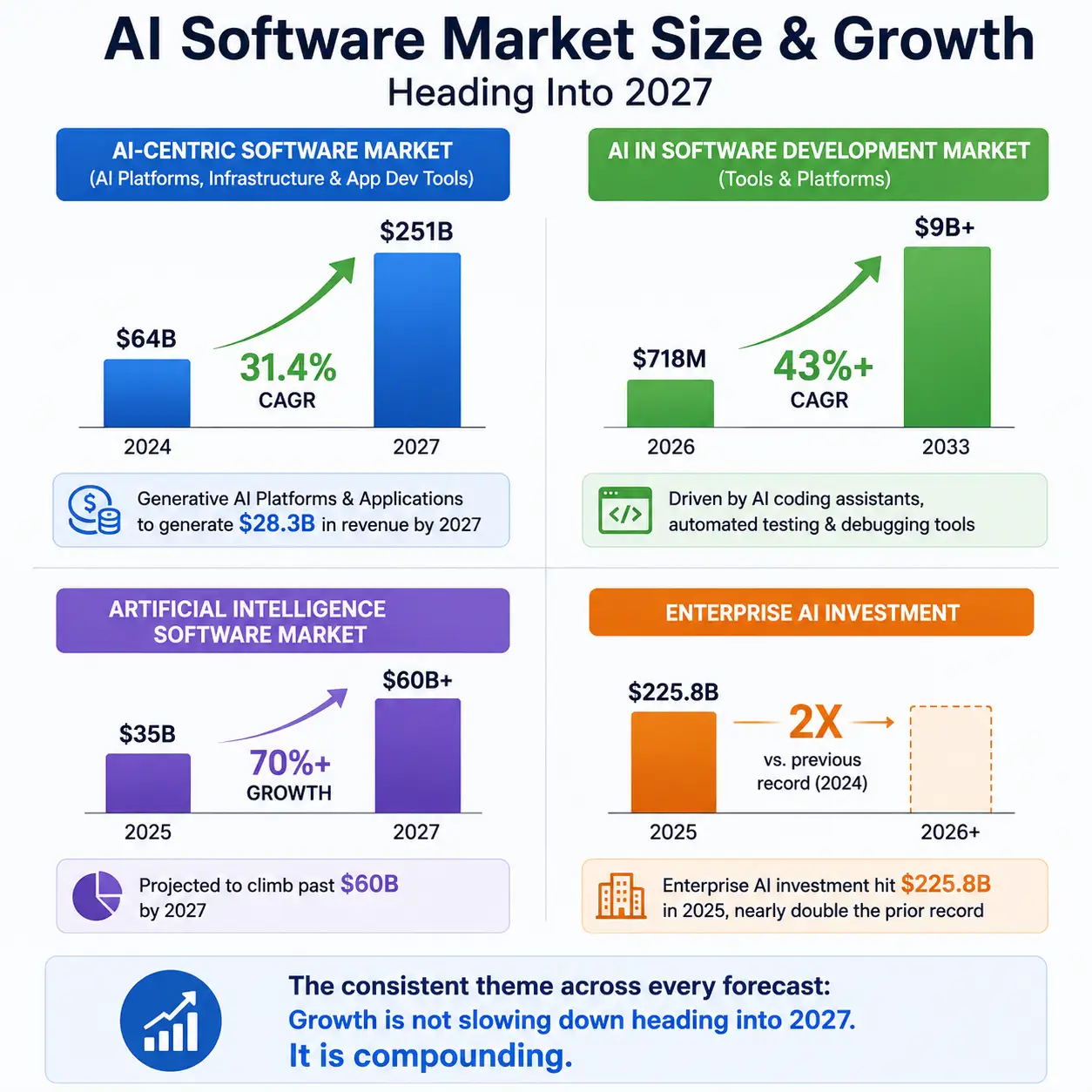
The numbers vary depending on which segment of the market you look at, and that variation itself tells a story. IDC’s forecast for AI-centric software, covering AI platforms, AI system infrastructure, and AI application development tools, projects the worldwide AI software market growing from 64 billion dollars to nearly 251 billion dollars by 2027, a compound annual growth rate of 31.4 percent. Generative AI platforms and applications specifically are forecast to generate 28.3 billion dollars in revenue by 2027 on top of that.
AI software development: Zoom in specifically on the AI-in-software-development segment, the tools and platforms that help teams build software faster, and the growth rate is even steeper. This narrower market is projected to grow from roughly 718 million dollars in 2026 to over 9 billion dollars by 2033, a compound annual growth rate above 43 percent, driven largely by AI-supported coding assistants, automated testing tools, and debugging platforms.
The broader artificial intelligence software market, which includes everything from customer engagement tools to predictive analytics, reached roughly 35 billion dollars in 2025 and is projected to climb past 60 billion dollars by 2027. Enterprise AI investment overall hit 225.8 billion dollars in 2025, nearly double the previous record set just a year earlier, which shows this is not speculative capital anymore. It is committed budget.
The consistent theme across every one of these forecasts is the same. Growth is not slowing down heading into 2027. It is compounding.
Developer Adoption Has Crossed the Mainstream Threshold
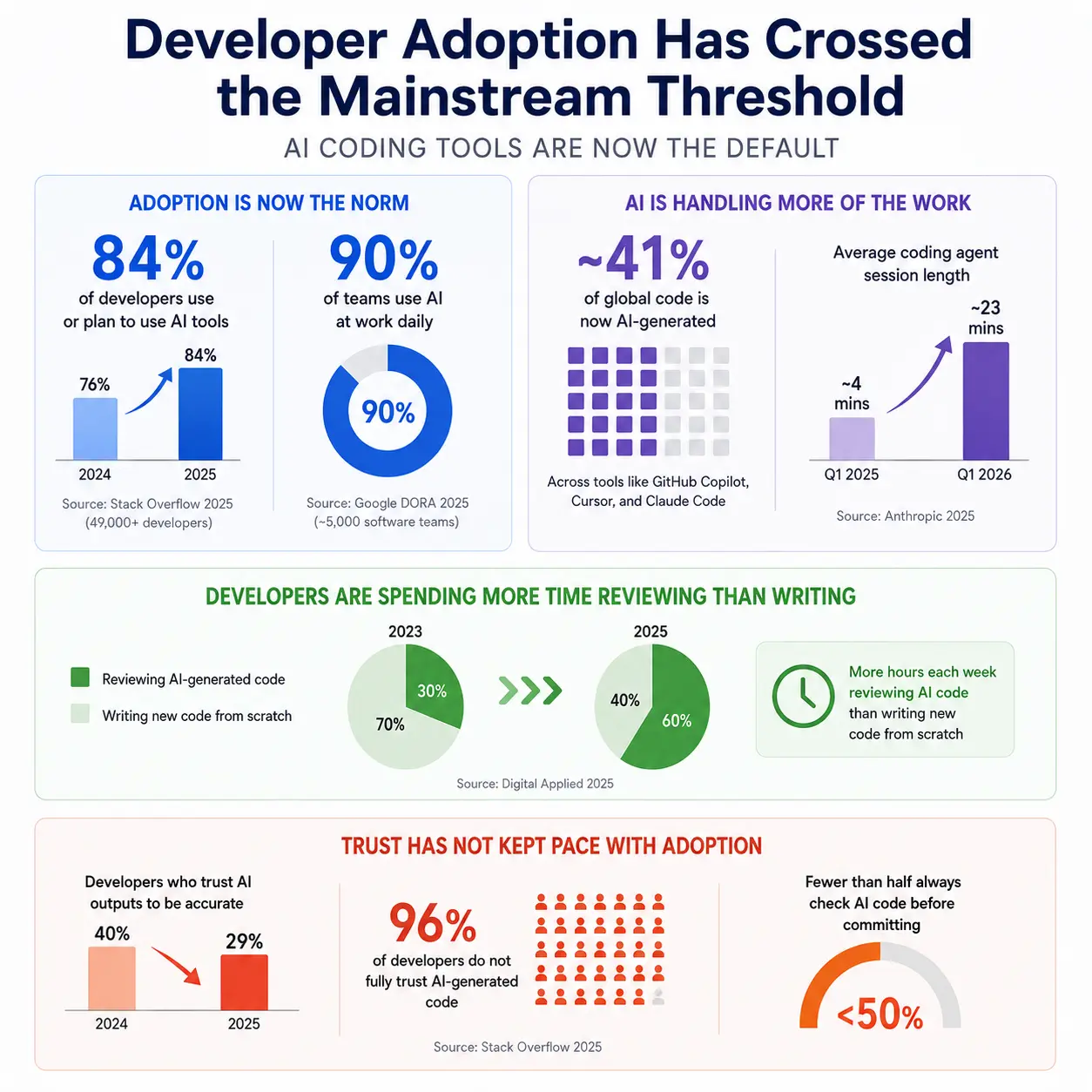
The most striking shift is not in market size numbers. It is in how developers actually work now. Adoption of AI coding tools has gone from a minority behaviour to the default. Stack Overflow’s 2025 survey of over 49,000 developers found 84 percent of developers now use or plan to use AI tools in their development process, up sharply from 76 percent just a year earlier. Google’s DORA 2025 report, surveying around 5,000 software teams, found 90 percent of teams now use AI at work daily.
The depth of that usage is what makes 2027 look different from previous years. Roughly 41 percent of global code is now AI-generated across tools like GitHub Copilot, Cursor, and Claude Code. Anthropic’s own data shows the average coding agent session length grew from about 4 minutes to 23 minutes between the first quarter of 2025 and the first quarter of 2026, meaning agents are increasingly trusted with longer, more complex chunks of work rather than quick autocomplete suggestions.
This has changed what developers spend their time doing. A Digital Applied survey found developers now spend more hours reviewing AI-generated code each week than they spend writing new code from scratch, a complete reversal of the pattern seen just two years ago. Writing code is no longer the bottleneck. Verifying it is.
Trust has not kept pace with adoption, and this gap matters for anyone building AI-assisted workflows into their company. Only around 29 percent of developers trust AI outputs to be accurate, down from 40 percent the year before, and 96 percent of developers say they do not fully trust AI-generated code, yet fewer than half always check it before committing. That gap between usage and trust is quietly becoming one of the defining risk factors of the next two years, and it is exactly the kind of governance problem engineering leaders need to plan for now rather than after a bad incident forces the issue.
The Productivity Picture Is More Complicated Than It Looks
AI software development: Here is where the industry report gets more honest than most vendor marketing. Productivity gains from AI coding tools are real, but they are not universal, and the size of the gain depends heavily on who is using the tool and how.
JetBrains found roughly 89 percent of developers save at least one hour a week using AI tools, with one in five saving eight hours or more. Stack Overflow found just over half of developers report a positive productivity impact. DORA’s 2025 report found over 80 percent of respondents saying AI enhanced their productivity, the strongest reading in that dataset.
But a randomized controlled trial from METR found something that cuts against the general narrative. Among experienced developers working on codebases they already knew well, AI tools actually made them 19 percent slower, not faster. The likely explanation is that experienced developers on familiar code already move efficiently, and the overhead of prompting, reviewing, and correcting AI output can exceed the time saved. The pattern across nearly every credible study is consistent. Gains concentrate among daily users, newer team members, and developers working in unfamiliar codebases. Occasional or poorly integrated use produces marginal or even negative results.
For founders and engineering leaders, the takeaway is not to avoid these tools. It is to stop assuming adoption alone guarantees a return, and to actually measure whether the tool is helping your specific team on your specific codebase.
Where the Money Is Actually Going
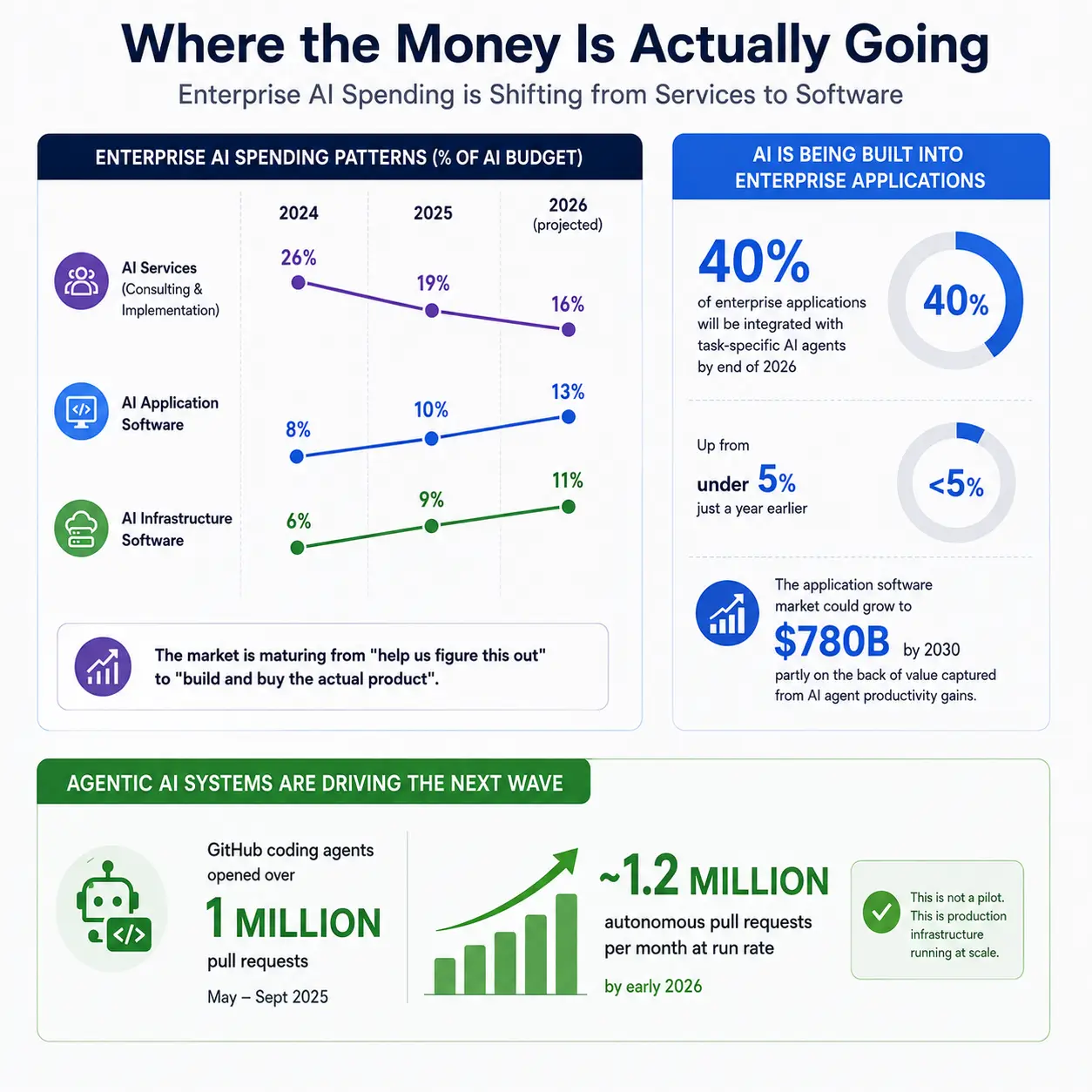
Enterprise spending patterns are shifting in a way that says a lot about where 2027 is headed. AI services spending, meaning consulting and implementation work, fell from 26 percent of AI budgets in 2024 to 19 percent in 2025, and is projected to drop further to 16 percent in 2026. Meanwhile, spending on AI application software and AI infrastructure software is climbing, up from 8 and 6 percent respectively in 2024 to 13 and 11 percent in 2026.
Read plainly, that means the market is maturing past the “help us figure this out” consulting phase and into the “build and buy the actual product” phase. Gartner projects that 40 percent of enterprise applications will be integrated with task-specific AI agents by the end of 2026, up from under 5 percent just a year earlier, and the broader application software market could grow to 780 billion dollars by 2030 partly on the back of value captured from AI agent productivity gains.
Agentic systems, AI that can execute multi-step tasks autonomously rather than just answering questions, are the clearest driver of this next wave. GitHub’s coding agents alone opened over a million pull requests between May and September 2025, reaching roughly 1.2 million autonomous pull requests a month at run rate by early 2026. That is not a pilot anymore. That is production infrastructure running at scale.
India’s Position in AI software development, Heading Into 2027
For a company like Cybertize Technologies operating inside the Indian market, the India-specific data matters as much as the global picture, and 2026 marked a genuine inflection point.
According to NASSCOM’s Strategic Review 2026, India’s tech sector is projected to cross 315 billion dollars in FY26, with IT services contributing 149 billion dollars, business process management 59 billion dollars, engineering R&D 63 billion dollars, and software products 23 billion dollars. NASSCOM estimates AI-related revenues specifically reached approximately 10 to 12 billion dollars in FY2025-26, reflecting how quickly AI has gone from a talking point to an actual revenue line for Indian tech companies.
The shift NASSCOM describes is structural, not incremental. Indian providers are moving away from the traditional labour-intensive, headcount-driven delivery model toward outcome-based and risk-sharing engagements as AI-driven productivity becomes measurable. Direct tech sector employment is still projected to grow, reaching around 6 million people in FY26, up 2.3 percent, which pushes back against the more alarmist predictions of mass job losses. The actual effect, according to an ICRIER survey of 651 IT firms across 10 Indian cities, has been concentrated at the entry level, where AI now performs roughly 37 percent of entry-level tasks, rather than triggering broad layoffs across experience levels.
India is also, notably, outperforming global peers on actual deployment rather than just experimentation. Deloitte’s 2026 State of AI in the Enterprise report found 40 percent of Indian respondents report significant or full AI usage in their operations, compared with a global average of roughly 28 percent. At-scale deployment in India is strongest in product development at 62 percent, followed by strategy and operations at 56 percent and marketing and sales at 55 percent.
IDC forecasts AI spending in India specifically, across software, services, and hardware, to reach 6 billion dollars by 2027, growing at a compound annual rate of 33.7 percent between 2022 and 2027, broadly in line with the pace of the global market.
What This Means Heading Into 2027
Pull all of this together and a few clear conclusions hold across every data source cited in this report.
AI is no longer optional infrastructure for a software business, it is baseline expectation. Both the global spending data and India’s own NASSCOM figures point the same direction, growth is compounding rather than plateauing, and enterprise money is shifting from advisory spending toward actual product and infrastructure investment.
Developer trust has not caught up with developer usage, and that gap is becoming a real governance issue rather than a footnote. Teams that build verification and review discipline into their AI-assisted workflows now will avoid the kind of quality and security problems that are already showing up in survey data around AI-generated code.
Productivity gains are real but uneven. Blanket adoption without measurement is not a strategy, it is a hope. The companies seeing genuine gains are the ones treating AI tool adoption as something to test and measure against their own codebase and team, not something to assume works the same way everywhere.
For India specifically, the opportunity is significant and already materialising, not theoretical. The country is deploying AI at a rate ahead of the global average, and the shift toward outcome-based delivery models rewards companies that can demonstrate real product value rather than just headcount. For a company like Cybertize Technologies, that is exactly the space worth building in, helping founders and businesses turn this moment into working, defensible products rather than partial AI-branded ones.
Cybertize Technologies Private Limited builds software and AI-powered products for founders and businesses across the Indian market, grounded in what the data actually shows rather than industry hype.
Sources
- IDC, Worldwide Artificial Intelligence Software Forecast
- Grand View Research and Persistence Market Research, AI in Software Development Market Size Reports (2026)
- Global Growth Insights, Artificial Intelligence Software Market Size and Growth Forecast (2026)
- MarketsandMarkets, Artificial Intelligence Market Report 2026-2033
- Ventionteams, State of AI 2026 Market Report
- Deloitte Insights, 2026 Software Industry Outlook
- Deloitte India, State of AI in the Enterprise Report (2026)
- Stack Overflow Developer Survey 2025
- JetBrains State of Developer Ecosystem and AI Pulse Survey (2025-2026)
- Google DORA 2025 Report
- METR, randomized controlled trial on AI coding tool productivity
- Digital Applied, AI Coding Tool Adoption 2026 Developer Survey
- Anthropic, coding agent usage data
- GitHub, autonomous coding agent pull request data
- NASSCOM, Technology Sector in India Strategic Review 2026
- NASSCOM AI Adoption Index
- ICRIER, survey of 651 Indian IT firms on generative AI adoption (2026)
- Economic and Political Weekly, Artificial Intelligence and the Future of India’s IT Companies
- IDC, AI Spending Forecast for India (2022-2027)