Table of Contents
Google AI Citability: The Search Result Page Is Not What It Used to Be
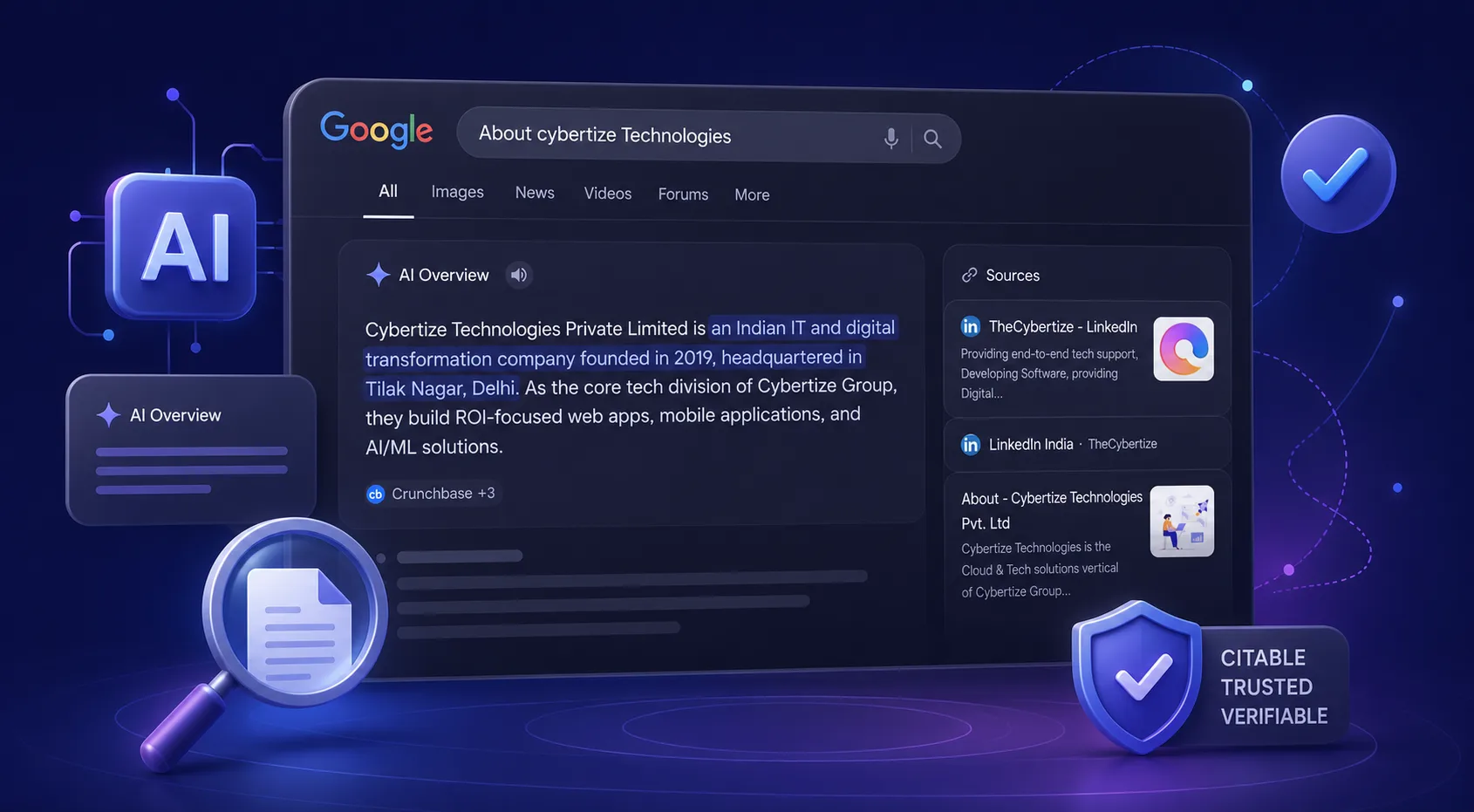
For twenty years, the goal of SEO was simple to describe even if it was hard to execute. Rank in the top ten, ideally the top three, and the clicks would follow. That model is breaking, not because ranking stopped mattering, but because a growing share of searches never make it to a ranked list at all. The answer just appears, generated, summarised, and attributed to a small handful of sources Google or the AI model chose to trust.
Roughly 25 percent of Google searches now trigger an AI Overview, based on a study of nearly 22 million searches conducted in early 2026. When one in four queries gets answered before the user ever scrolls to a link, ranking first below that summary stops being the whole game. The real prize has shifted to something narrower and, in some ways, harder to control: being the source the AI decided to name.
AEO AI Citability: At Cybertize Technologies, we have watched this shift change how we approach content for clients over the past year, including our own work on Rashtra Bharat and other properties. This is a practical look at how Answer Engine Optimization, AEO, actually works, separated from the flood of vendor claims that treat every schema tag as a guaranteed citation.
What Google AI Citability & AEO Actually Means
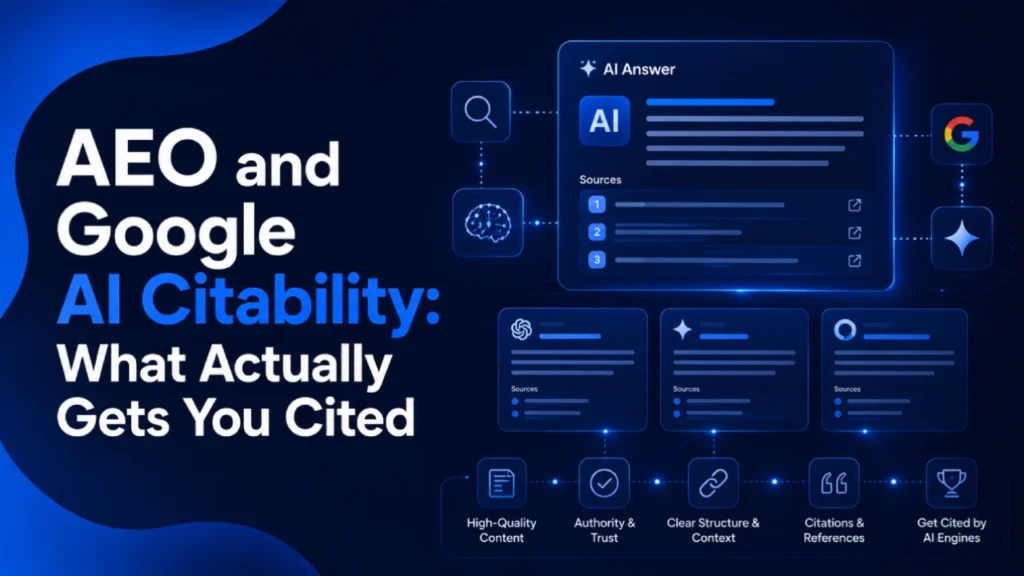
Answer Engine Optimization is the practice of structuring content so AI systems, Google AI Overviews, ChatGPT, Perplexity, and Gemini among them, extract it, trust it, and name it directly in a generated answer. Traditional SEO earns a ranking position. AEO earns a citation inside the answer itself. It is not a replacement for SEO. It is closer to an additional layer built on top of it, because the two disciplines share a foundation, content still needs to be relevant, well-structured, and genuinely useful, but AEO adds a second, narrower filter on top: does the AI trust this page enough to quote it by name.
The stakes here are not small. Pew Research Center found click rates drop by nearly half, from 15 percent without an AI Overview present to 8 percent with one, across a study of 68,000 queries. Ahrefs measured a 34.5 percent click-through drop for position-one rankings specifically once an AI Overview appears above them. But the flip side matters just as much. Sites that do get cited inside an AI Overview see a meaningful click-through boost compared to a standard organic listing, which means an AI citation has effectively become more valuable than the number one organic spot it used to be.
How Google Actually Decides What to Cite
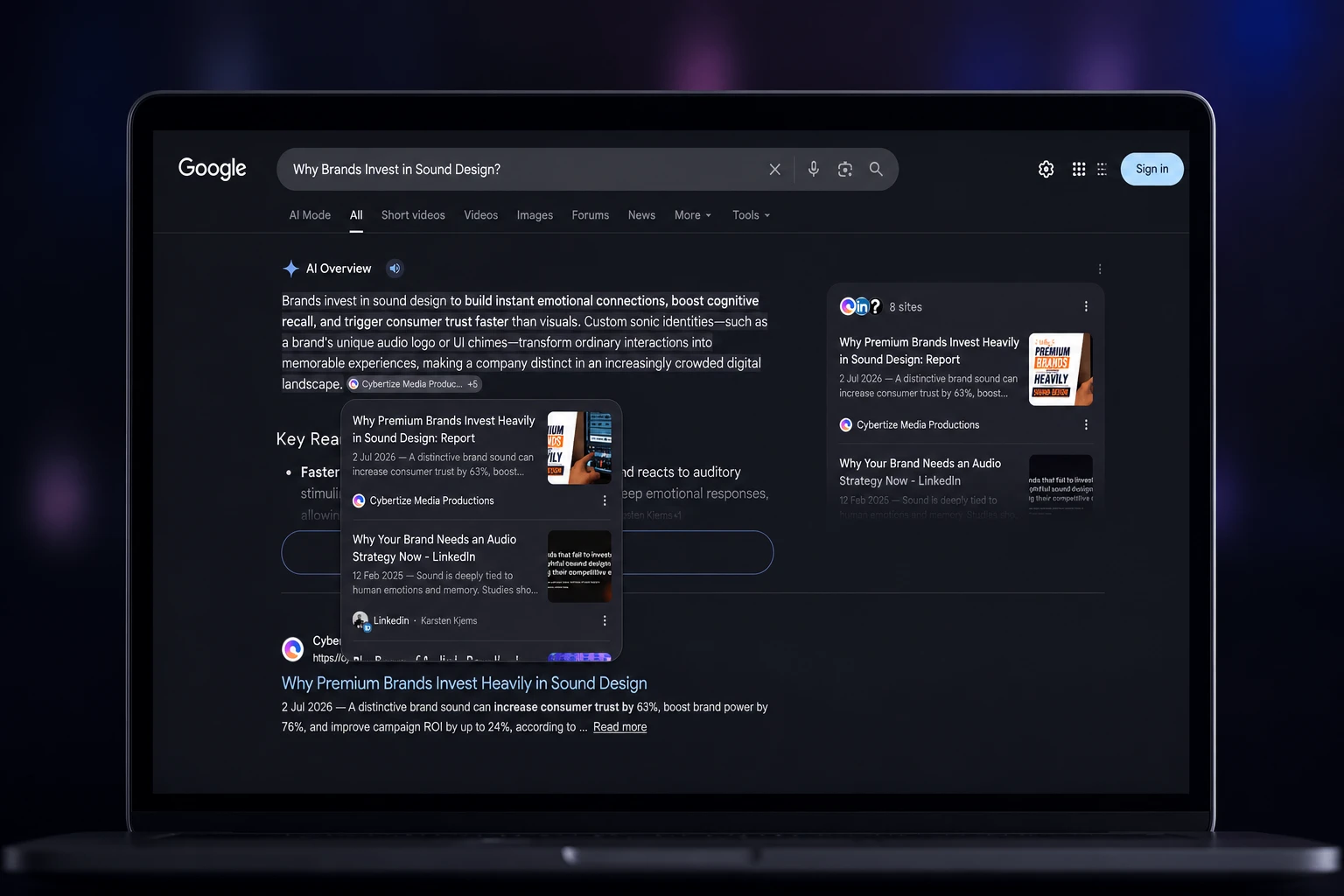
This is where most AEO advice gets sloppy, treating every tactic as equally proven. The honest picture, based on the more careful research available, looks like this.
AGoogle AI Citability: Google AI Overviews draw heavily from pages already ranking well organically, though this dependence is loosening. Research analysing 17 million AI citations found that 38 percent of AI Overview citations came from pages already ranking in Google’s top ten, down sharply from 76 percent in earlier studies. That is a meaningful shift. It means Google’s AI layer is increasingly willing to surface sources that were not already winning the traditional ranking game, provided those sources demonstrate the right qualities elsewhere.
Freshness is one of those qualities, and the data on this point is unusually strong. The same research found AI-cited URLs are roughly 26 percent fresher than typical search results on average. For commercial and evaluation-stage queries specifically, 83 percent of AI citations came from content updated within the past twelve months, and pages that are not refreshed on a regular cadence become roughly three times more likely to lose their citation over time. If your best-performing article on a topic was last touched two years ago, it is quietly losing ground to AI engines even if its Google ranking has not visibly moved.
Position within a page matters more than most content teams assume. One widely cited SparkToro analysis found that 44 percent of citations pull from content sitting within the first 30 percent of a page. Most articles bury their sharpest definitions, statistics, and direct answers in the middle of the piece, assuming a reader will get there. AI systems are less patient than that. If the clearest, most citable version of your answer is not near the top, it is competing at a disadvantage against a page that puts it there.
Where Schema Markup Actually Helps, and Where It Doesn’t
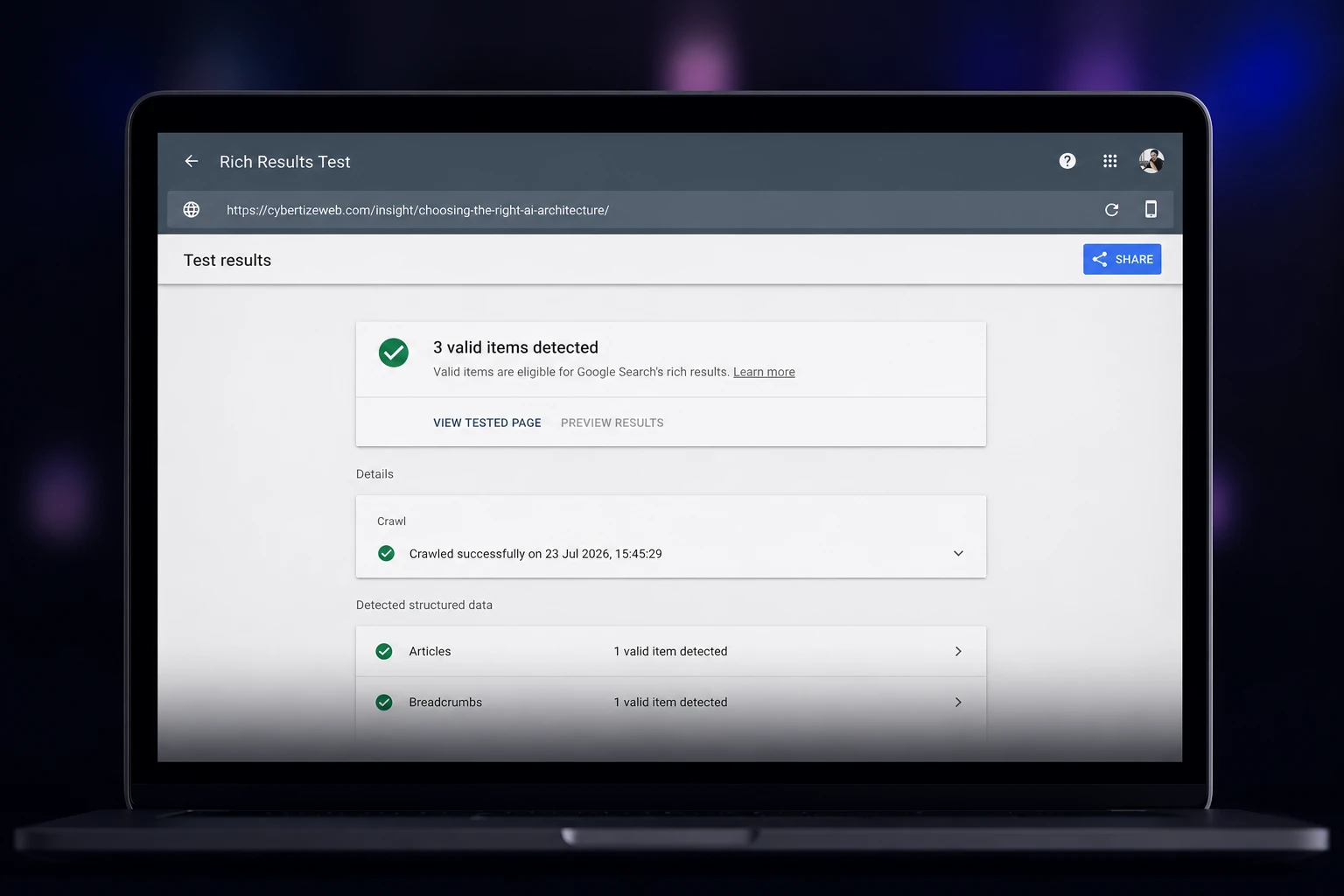
Structured data is probably the most overhyped and underexplained part of the AEO conversation, so it is worth being precise about what the evidence actually supports.
Google removed FAQ rich results from standard search listings in May 2026, which means FAQPage schema no longer earns the visual accordion in traditional blue-link results that it once did. Some corners of the AEO industry took this to mean FAQ schema is dead. That is not accurate. FAQPage remains a valid schema.org type, and Google has been clear that unused or non-visual structured data does not harm a page. For platforms like Bing and Perplexity, FAQ markup still helps AI systems parse question-and-answer content more cleanly. For Google’s own AI Overviews and AI Mode specifically, Google has not confirmed a direct causal link between FAQ schema and citation, but keeping accurate, genuine FAQ content and markup remains a reasonable, low-cost part of a broader strategy.
What the data does show more convincingly is a correlation between structured data generally and citation likelihood. One dataset found roughly 71 percent of pages cited by ChatGPT include structured data, and about 65 percent of pages cited by Google’s AI Mode do too. Microsoft and Google engineers have both confirmed publicly that schema helps their systems understand web content. But correlation is not the same as proof of causation here, since well-structured pages tend to also be well-written, well-ranked pages for other reasons. The honest way to think about schema is that it removes friction that could prevent citation. It rarely creates a citation on its own for content that is not otherwise strong.
The schema types with the clearest, most consistently cited impact are Organization, Article, FAQPage, and HowTo, particularly when paired with sameAs links connecting your entity to external profiles like Wikipedia or Wikidata. One strict rule matters more than any tactic: every property in your schema has to match what is visibly on the page. Schema that claims something the rendered content does not actually show gets flagged as spam, and that risk has grown as AI systems increasingly cross-reference schema claims against the live page itself.
Structure That Actually Earns a Citation
Setting schema aside, the content decisions inside the page matter more than most teams expect. A few patterns show up consistently across the research.
Content that leads each major section with a direct, self-contained answer, roughly 40 to 60 words, before expanding into detail performs better than content that builds up to the answer gradually. AI systems extract and quote in fragments. A page that makes the extractable fragment easy to find gets quoted more often than one that hides its clearest sentence three paragraphs deep.
Specific, citable data points matter enormously. AI engines preferentially cite content that includes a hard statistic, percentage, or figure with a clear source, roughly once every 150 to 200 words, because that kind of specificity adds credibility to the generated answer the AI is producing. A page full of vague claims without numbers gives an AI model far less to work with than one grounded in verifiable facts.
Source diversity across a page’s own citations also plays a role neither Google nor most vendors talk about enough. AI answer engines increasingly draw from a wide spread of domains rather than concentrating on the same handful of sites, and studies show a page’s own domain typically caps out around 15 percent of the citations feeding any single AI answer on a competitive topic. That is not a content quality failure. It is a structural feature of how these systems are built to diversify their sourcing, and it means no single piece of content, however well optimised, guarantees permanent dominance of an answer.
Where AEO Fits for a Founder or Marketer Today
None of this means throwing out existing SEO discipline and chasing AI citations as a separate project. The two are deeply connected, and the practical starting point is the same either way: write content that genuinely, specifically answers the question a real person is asking, back it with real data, keep it current, and structure it so both a human skimming the page and an AI system extracting a fragment can find the answer quickly.
What AEO adds on top is a discipline around freshness, around leading with the direct answer instead of burying it, and around treating schema as a supporting signal rather than a magic switch. Businesses that treat AI citation as a checklist item to tick off once will lose ground to the ones treating it as an ongoing editorial habit, refreshed on a real schedule and measured against actual citation appearances rather than rankings alone.
At Cybertize Technologies, this is now baked into how we approach content and structured data for clients, because being ranked and being cited have quietly become two different jobs, and increasingly, the second one is the one that gets read.
Cybertize Technologies Private Limited helps businesses structure content and technical infrastructure for visibility across both traditional search and AI answer engines.
Sources
- Contently, What Is Answer Engine Optimization, 2026 Definition Guide
- Frase, Answer Engine Optimization Complete Guide 2026
- AirOps, 2026 State of AI Search Report
- Evergreen Media, Answer Engine Optimization AI Visibility 2026
- Omnibound, Answer Engine Optimization Statistics 2026
- Stackmatix, Google AI Overview SEO Impact 2026 Data and Statistics
- LoudFace, AEO Guide 2026
- Instant Press, AEO and GEO Statistics for 2026
- Pew Research Center, click-through rate study on AI Overviews
- Ahrefs, CTR impact study on AI Overviews across 300,000 keywords
- SparkToro, content position and AI citation research
- Discoverability, Schema Markup Guide for SEO and AI Search 2026
- Globerunner, Structured Data in 2026, The Schema Markup AI Actually Uses
- Quattr, FAQ Schema in 2026
- Derivatex, How Schema Markup Affects LLM Citation
- AI Growth Agent, Schema Markup for AI Search 2026 Playbook