Table of Contents
Enterprise AI Adoption Report: Adoption Is Not the Problem Anymore
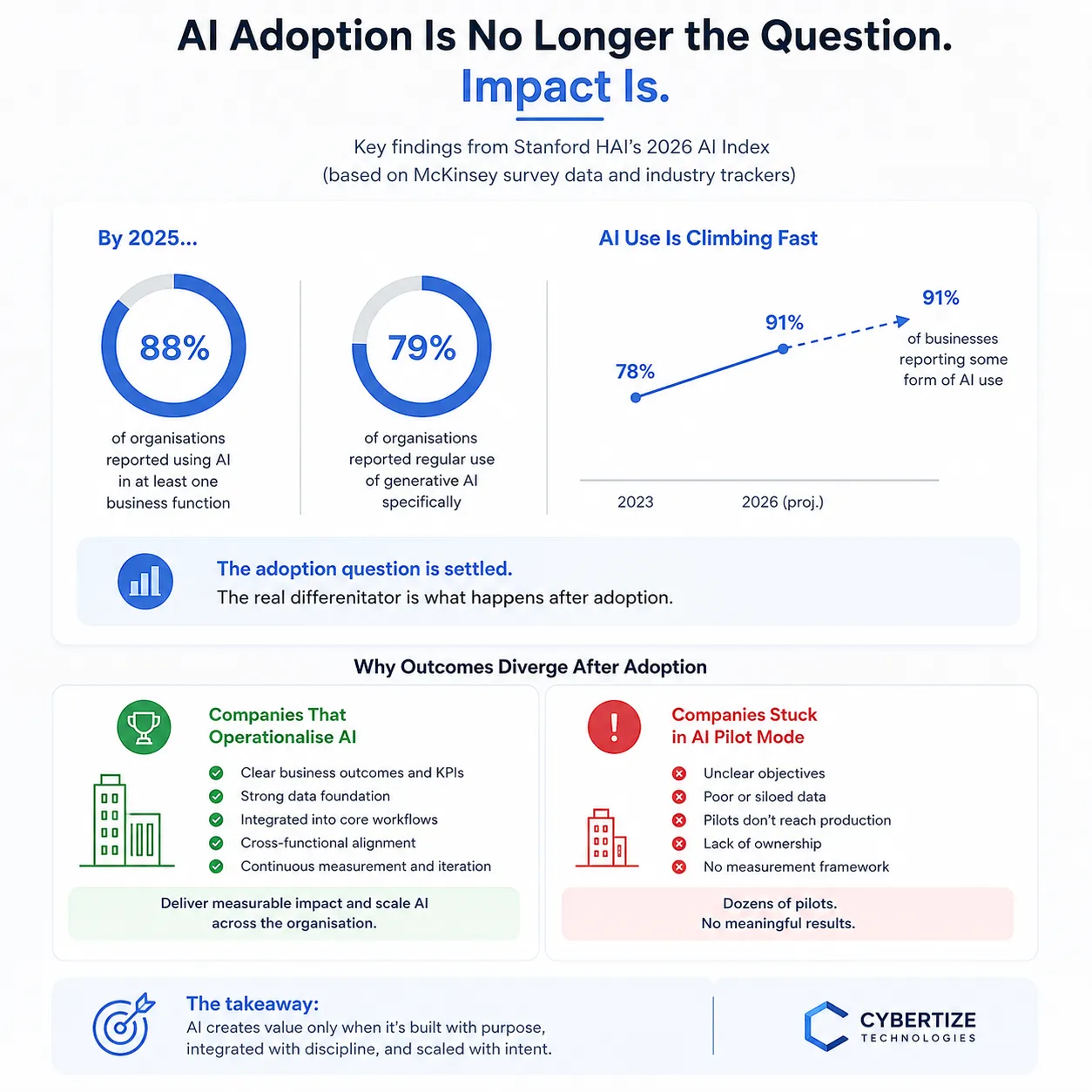
If you had asked in 2023 whether enterprises would embrace AI, the honest answer was uncertain. That question is settled now. According to Stanford HAI’s 2026 AI Index, drawing on McKinsey survey data, 88 percent of organisations reported using AI in at least one business function in 2025, and 79 percent reported regular use of generative AI specifically. Other trackers put the number even higher heading into 2026, with 91 percent of businesses reporting some form of AI use, up from 78 percent just two years earlier.
That is not the interesting number anymore. The interesting number is what happens after adoption, and that is where this report spends most of its time.
At Cybertize Technologies, we work with founders and enterprise teams on both sides of this gap, companies that have genuinely operationalised AI and companies that have a dozen pilots and nothing to show for them. The data below explains why that gap exists and what separates the two groups.
The Real Gap: Adoption Versus Scale
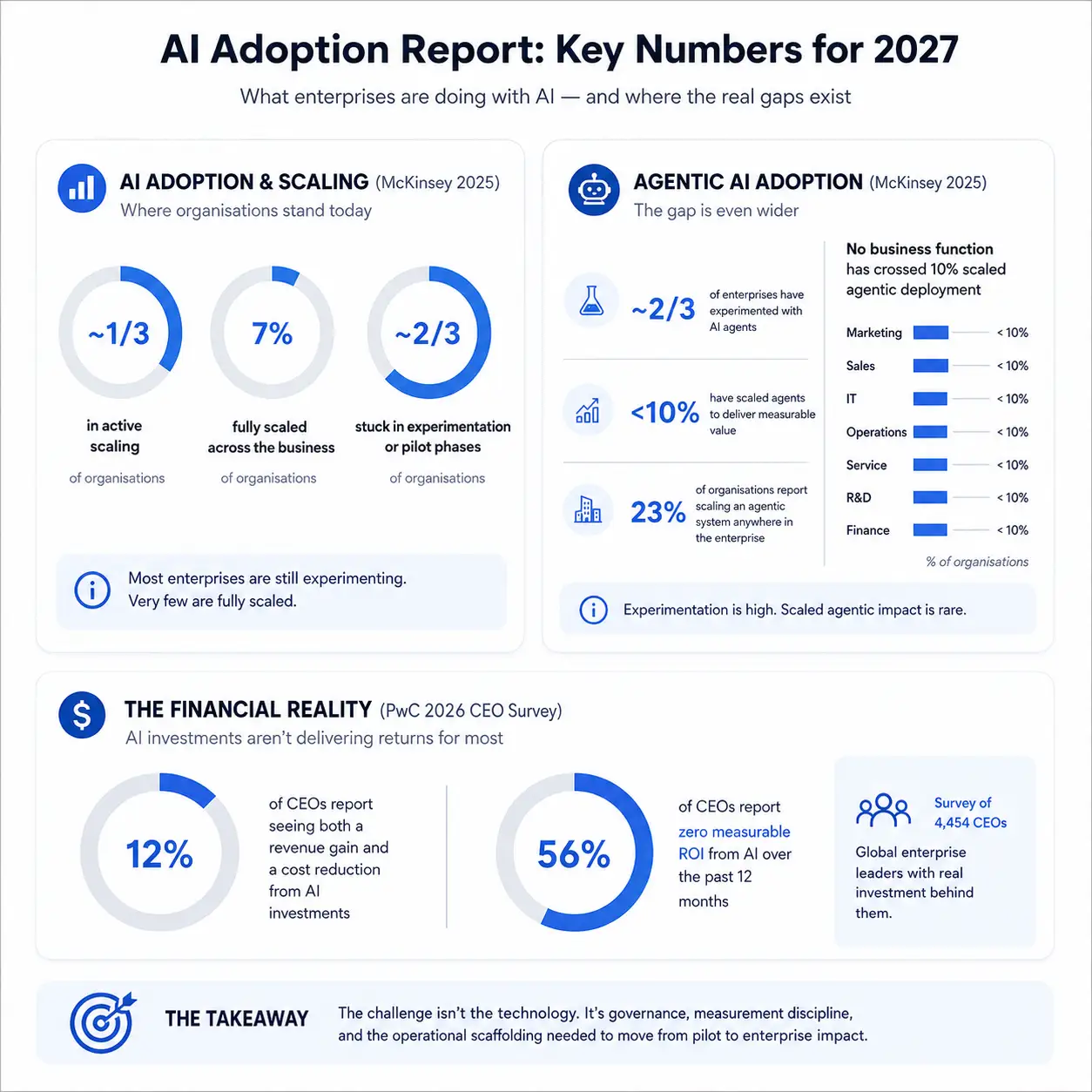
AI Adoption Report: Here is the number every enterprise leader heading into 2027 needs to sit with. McKinsey’s 2025 State of AI survey found that while the large majority of organisations have adopted AI somewhere, only about one third are in active scaling, and just 7 percent report being fully scaled across the business. The rest remain stuck in experimentation or pilot phases, sometimes for years.
Agentic AI, systems capable of executing multi-step tasks with real autonomy, shows the gap even more starkly. Roughly two thirds of enterprises have experimented with AI agents, but fewer than 10 percent have scaled them to deliver measurable value, and no individual business function has crossed 10 percent scaled agentic deployment in McKinsey’s global data. Only 23 percent of organisations report scaling an agentic system anywhere in the enterprise at all.
The financial picture confirms the same pattern. PwC’s 2026 CEO Survey, covering 4,454 executives, found just 12 percent of CEOs report seeing both a revenue gain and a cost reduction from their AI investments. Separately, 56 percent of CEOs report zero measurable ROI from AI over the past twelve months. These are not small or emerging companies struggling with budget. These are enterprise leaders with real investment behind them, still unable to point to a clear financial return.
The reason is rarely the technology itself. It is governance, measurement discipline, and the operational scaffolding needed to move from a working pilot to something the whole business depends on.
Where the Returns Actually Show Up
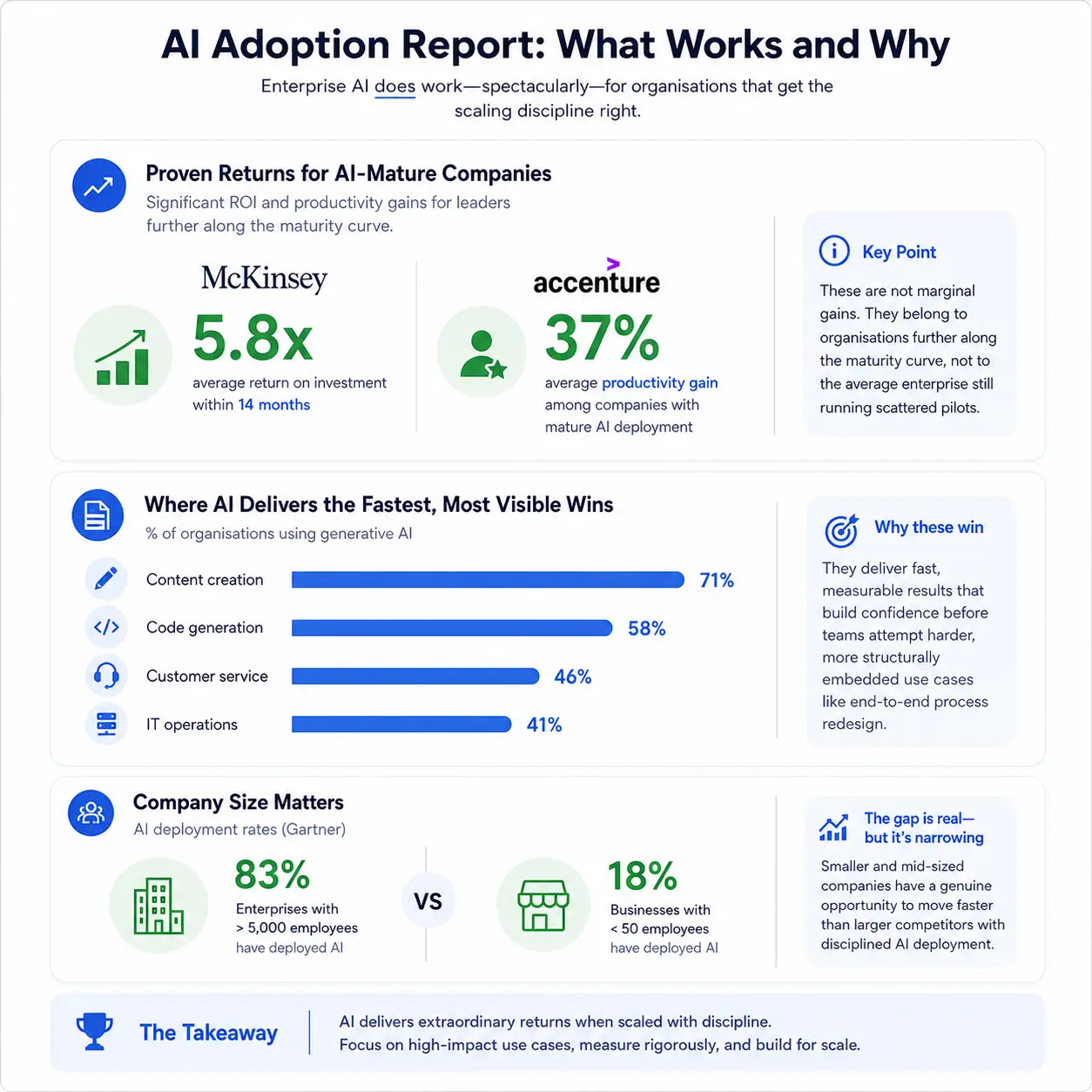
AI Adoption Report: It would be wrong to read this report as saying enterprise AI does not work. It clearly does, for the organisations that get the scaling discipline right. McKinsey reports that AI-mature companies see an average return on investment of 5.8 times within fourteen months. Accenture’s research found an average productivity gain of 37 percent among companies with mature AI deployment. These are not marginal numbers. They are the kind of returns that justify serious continued investment, but they belong specifically to organisations further along the maturity curve, not to the average enterprise still running scattered pilots.
The use cases delivering fastest, most visible wins are consistent across multiple surveys. Content creation, reported by 71 percent of organisations using generative AI, and code generation, at 58 percent, remain the dominant entry points, largely because they deliver fast, measurable results that build internal confidence before teams attempt harder, more structurally embedded use cases like end-to-end process redesign. Customer service and IT operations follow closely behind as the next wave of adoption.
Company size plays a real role too. Gartner data shows 83 percent of enterprises with more than 5,000 employees have deployed AI, compared with just 18 percent of businesses under 50 employees. That gap is narrowing, but slowly, and it means smaller and mid-sized companies, which make up the bulk of the Indian software and services market, have a genuine opportunity to move faster than their larger competitors if they treat AI deployment with the same discipline the leaders show.
Governance Is Becoming the Real Differentiator
Deloitte’s 2026 State of AI in the Enterprise report, based on a survey of over 3,000 global leaders, makes a point that deserves more attention than it gets. Enterprises where senior leadership actively shapes AI governance, rather than delegating it entirely to technical teams, achieve significantly greater business value than those that do not. As AI systems take on more autonomous responsibility, oversight has to become everyone’s job, not a checkbox owned by one team, and that includes deciding where humans stay in the loop, how automated decisions get audited, and what records of system behaviour get retained.
The gap between ambition and governance readiness is wide. Deloitte found only one in five companies has a mature model for governing autonomous AI agents specifically, even as agentic usage is expected to rise sharply over the next two years. Barriers to adoption reinforce the same story from a different angle. Over half of businesses, 52 percent, cite data quality and availability as their biggest obstacle to getting more value from AI, and in the European Union specifically, 70.9 percent of enterprises cite a lack of relevant in-house expertise as the primary reason they have not adopted AI more fully.
Put together, this paints a clear picture for anyone planning an enterprise AI roadmap toward 2027. The technology risk has largely receded. The governance and organisational risk has not, and it is quietly becoming the deciding factor in who actually captures the returns everyone is chasing.
India: Adopting Faster, Governing Slower
AI Adoption Report: For a company like Cybertize Technologies working inside the Indian market, India’s position in this data is worth its own section, because the country is genuinely leading on adoption speed while lagging on the governance side that determines whether that adoption converts into real value.
Deloitte’s India-specific 2026 findings show nearly 40 percent of Indian respondents report significant or full AI usage, compared with a global average of roughly 28 percent, and India ranks first among the fifteen countries surveyed in how actively AI is used in strategic decision-making. At-scale implementation is strongest in product development at 62 percent, strategy and operations at 56 percent, marketing and sales at 55 percent, and supply chain at 48 percent, all functions directly tied to growth and competitiveness rather than back-office efficiency alone.
Separate industry research puts Indian enterprise AI adoption at roughly 80 percent, ahead of the United States at around 59 percent, making India by some measures the world’s most aggressive enterprise AI adopter heading into 2027. But the same research flags the obvious tension in that number. Only about 23 percent of Indian firms report having formal AI ethics or governance frameworks in place, a roughly 57 point gap between how fast companies are adopting AI and how prepared they are to govern it responsibly. Finance and HR functions in India show notably lower scaled implementation than other functions, suggesting the fastest gains are concentrated in growth-facing areas while more sensitive, compliance-heavy functions move more cautiously, which is arguably the right instinct given how thin governance maturity still is.
This gap matters even more given India’s own regulatory direction. The Digital Personal Data Protection Act and its 2025 rules already put real obligations on any organisation processing personal data, and enterprises racing ahead on AI adoption without matching investment in governance are building on a foundation that carries genuine legal exposure, not just an operational one.
What Enterprises Should Actually Do Heading Into 2027
Pull the data together and the direction is clear, even if it is less exciting than the adoption headlines suggest.
Stop measuring success by how many AI initiatives are running and start measuring it by how many have crossed from pilot into scaled, governed production. The 7 percent of organisations that are fully scaled are not succeeding because they ran more pilots than everyone else. They are succeeding because they built the governance, data quality, and measurement discipline to take a working pilot and make it durable.
Prioritise the use cases with the fastest, clearest line to a business outcome first, content and code generation for most organisations, before attempting harder, more structurally embedded transformations. Momentum and internal trust built from an early, visible win make the harder next steps easier to fund and defend.
Treat governance as a leadership responsibility, not a technical afterthought. The data is consistent across multiple independent studies, senior involvement in AI governance correlates directly with greater realised business value, and the gap between agentic experimentation and agentic governance maturity is currently the single largest unmanaged risk in enterprise AI heading into 2027.
For Indian enterprises specifically, the opportunity is real and time sensitive. The country is genuinely ahead on adoption. Whether that advantage compounds or erodes over the next two years depends almost entirely on whether governance investment catches up to adoption speed, and the companies that close that gap early are the ones likely to still be counted among the winners by 2027.
Cybertize Technologies Private Limited helps founders and enterprises design and scale AI-powered products with the governance and measurement discipline needed to move from pilot to production.
Sources
- Stanford HAI, 2026 AI Index Report
- McKinsey & Company, State of AI Survey 2025-2026
- McKinsey & Company, State of Organizations 2026 Survey
- Deloitte, State of AI in the Enterprise 2026 (Global and India editions)
- PwC, Global CEO Survey, January 2026
- Gartner, enterprise AI deployment by company size data
- Accenture, AI productivity gain research
- Azumo, AI Adoption Statistics 2026
- Eurostat 2025, enterprise AI adoption barriers
- Rotascale, State of Enterprise AI India 2026
- Process Excellence Network, AI adoption barriers research
- Government of India, Digital Personal Data Protection Act, 2023, and DPDP Rules 2025