Table of Contents
Introduction
Trying to describe the AI model landscape in one sentence has become close to impossible. Three years ago the story was simple: a handful of labs, a handful of models, and a fairly predictable release cadence. That is no longer true. Model releases happen weekly. Pricing shifts monthly. What counted as a frontier capability in January is a commodity by September. For a company like Cybertize Technologies, building software and AI-powered products for clients across the Indian market, keeping an accurate, current picture of this landscape is not optional, it directly shapes which model, which architecture, and which vendor we recommend to a given client.
This report pulls together the eleven pieces of that landscape that matter most right now: the overall ecosystem, the open versus closed divide, the release timeline, enterprise adoption, pricing, multimodality, context windows, reasoning models, small language models, the foundation model landscape itself, and AI’s growing role in cybersecurity, both as a threat and a defence.
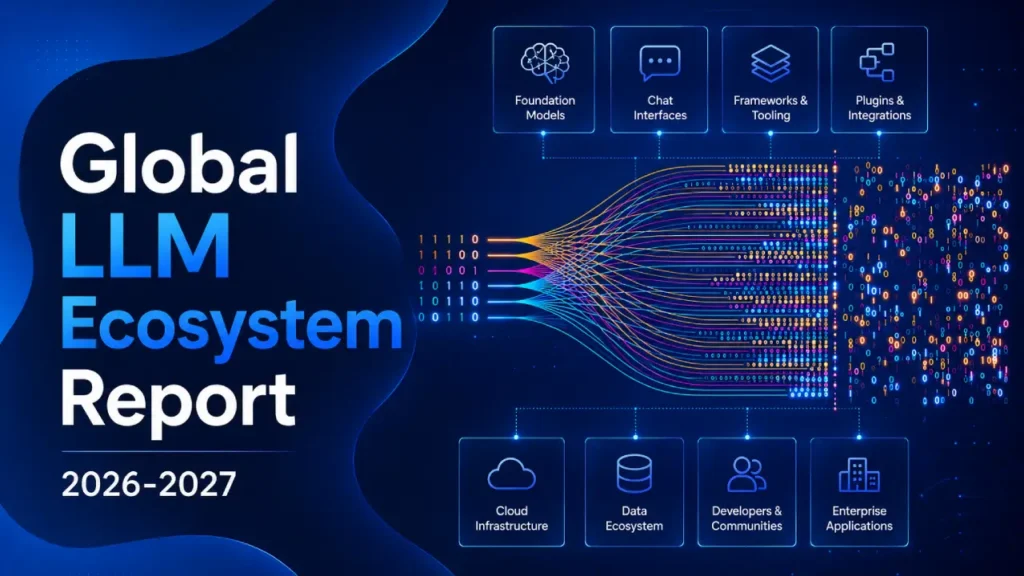
Global LLM Ecosystem Report 2026-2027
The global large language model market was valued at 11.63 billion dollars in 2026 and is projected to grow at a compound annual rate of roughly 35.6 percent through 2040, according to Roots Analysis, reaching close to 180 billion dollars by 2035. Other trackers place the broader generative AI model spending figure even higher for the near term, with Gartner forecasting global AI spending overall to reach 2.52 trillion dollars in 2026, a 44 percent year-over-year jump, and generative AI model spending specifically rising 80.8 percent this year.
Consumer usage remains heavily concentrated at the top. ChatGPT held 53.9 percent of worldwide web-visit share across the seven largest AI chatbots as of May 2026, ahead of Google Gemini at 27.9 percent and Anthropic’s Claude at 9.2 percent, though Claude’s growth rate, up roughly 855 percent year over year, was the fastest of the group by a wide margin. Enterprise spend tells a noticeably different story than consumer traffic. Anthropic now commands roughly 40 percent of enterprise LLM API spend, up from just 12 percent in 2023, a shift driven heavily by dominance in coding tools, with Claude Code alone reaching a 2.5 billion dollar annualised revenue run rate.
Geography matters here too. The United States remains the largest single market for commercial LLM platforms, but India has emerged as Anthropic’s second-largest market behind only the US, a signal of how quickly enterprise and developer AI adoption is scaling outside the traditional US-first pattern.
Open-Weight vs Closed AI Models
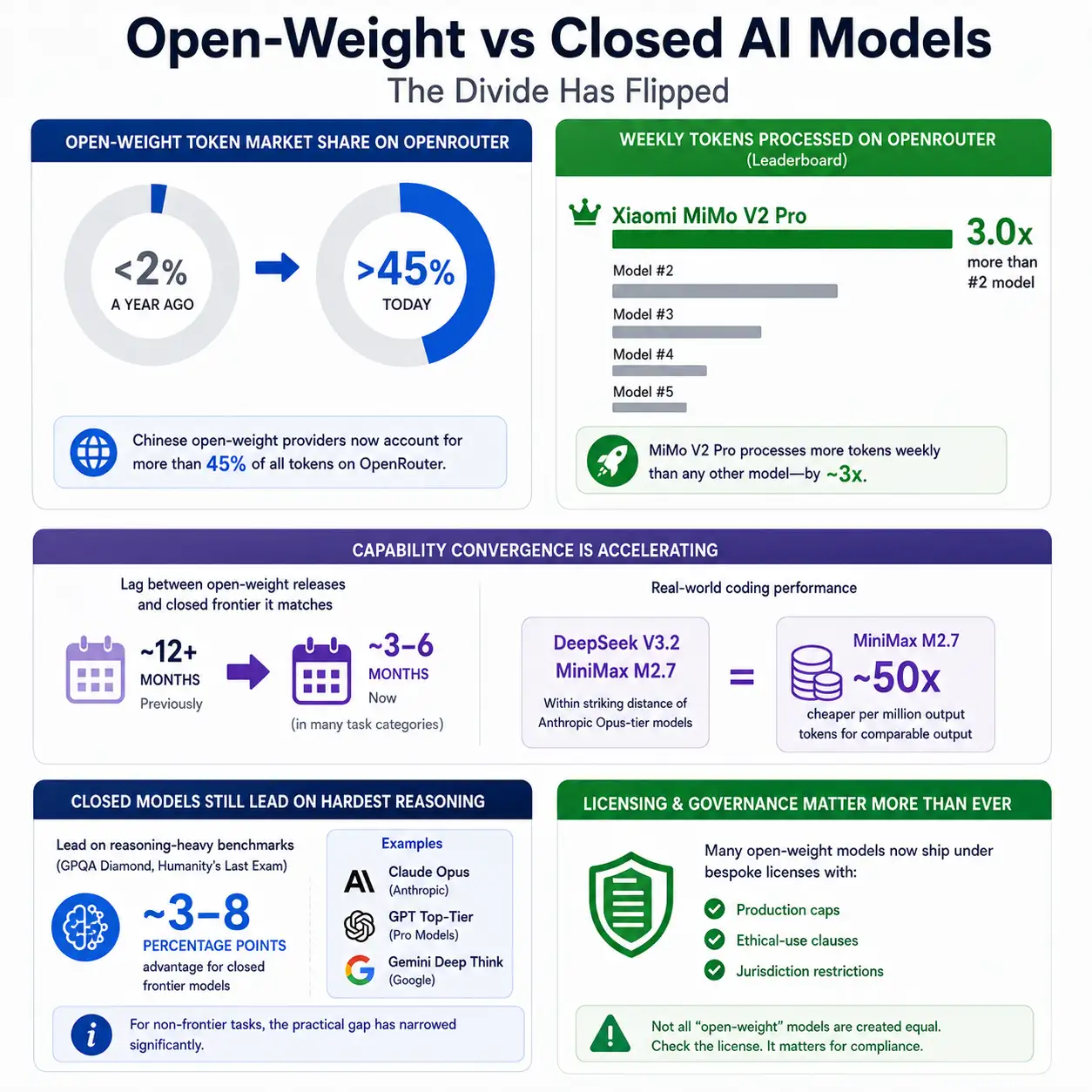
Global LLM Ecosystem Report: This divide has flipped in a way almost nobody predicted even a year ago. Chinese open-weight providers now account for more than 45 percent of all tokens flowing through OpenRouter, a major model aggregator, up from under 2 percent a year earlier. Xiaomi’s MiMo V2 Pro alone processes more tokens weekly than any other model on that leaderboard, by a margin of roughly three times the next closest competitor. Open-weight models used to be understood as the budget option. That framing no longer holds.
Capability convergence is the other half of the story. The lag between an open-weight release and the closed frontier it eventually matches has shrunk from roughly 12 months or more to somewhere between three and six months in many task categories, according to multiple industry trackers. On real-world coding workloads specifically, models like DeepSeek V3.2 and MiniMax M2.7 now sit within striking distance of Anthropic’s Opus-tier models, with MiniMax M2.7 costing roughly 50 times less per million output tokens for comparable output.
Closed models still hold a meaningful edge in one specific area: the hardest reasoning tasks. Models like Claude Opus, GPT’s top-tier Pro models, and Gemini’s Deep Think variant retain a lead of roughly three to eight percentage points on reasoning-heavy benchmarks such as GPQA Diamond and Humanity’s Last Exam. For everything short of the absolute frontier of reasoning difficulty, the practical gap has narrowed to the point where model choice increasingly comes down to licensing, deployment control, and cost rather than raw capability.
That licensing point deserves its own callout, because it is where the real governance risk sits. Several major open-weight releases now ship under bespoke licenses with production caps, ethical-use clauses, or jurisdiction restrictions rather than a simple, permissive open-source license. Any procurement process treating every open-weight model as equivalent to Apache 2.0 is skipping a step that genuinely matters for compliance.
LLM Release Timeline Report
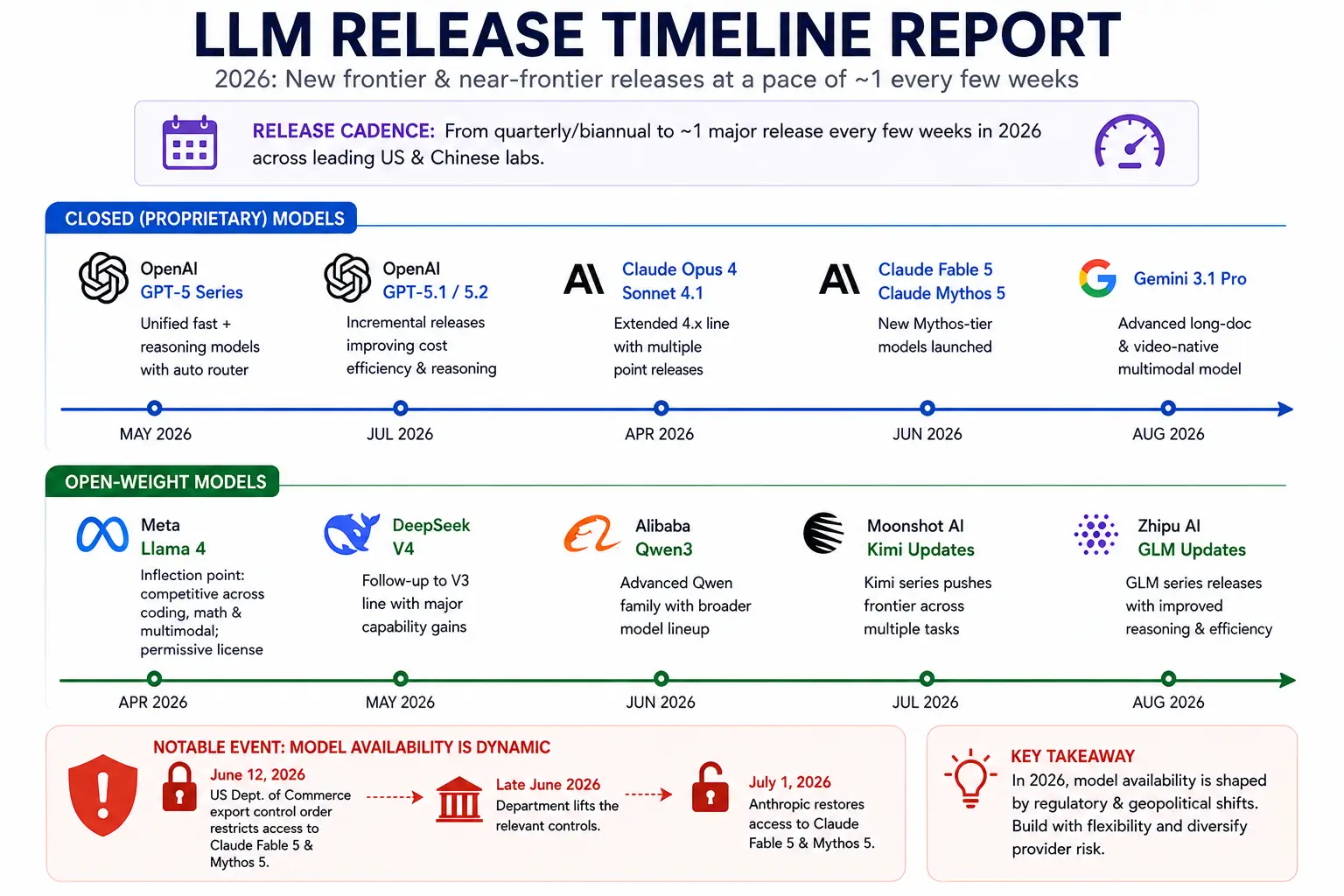
The release cadence itself has become a defining feature of this market, not just a backdrop to it. Where a major model release used to be a quarterly or biannual event, 2026 has seen new frontier and near-frontier releases landing at a pace of roughly one every few weeks across the combined US and Chinese lab ecosystem.
On the closed side, OpenAI’s GPT-5 series established a unified architecture combining a fast-response model with a deeper reasoning variant and an automatic router between them, followed through the year by incremental GPT-5.x releases pushing cost efficiency and reasoning depth further. Anthropic’s Claude Opus and Sonnet 4.x line extended through several point releases across the year, alongside the launch of its new Mythos-tier models, Claude Fable 5 and Claude Mythos 5, in June 2026. Google’s Gemini 3.1 Pro pushed further into long-document and video-native multimodal territory. On the open-weight side, Meta’s Llama 4 marked what several industry analysts described as a genuine inflection point, the first fully open-weight release with competitive reasoning across coding, mathematics, and multimodal tasks under a permissive license. DeepSeek followed its V3 line with V4, Alibaba advanced its Qwen3 family, and Moonshot AI’s Kimi and Zhipu’s GLM releases each pushed the open-weight frontier further across 2026.
One event worth noting for accuracy: Claude Fable 5 and Mythos 5 were briefly taken offline on June 12, 2026, when a US Department of Commerce export control order restricted access, before the Department lifted the relevant controls and Anthropic restored access on July 1, 2026. It is a useful reminder that in the current environment, model availability itself, not just model capability, has become subject to fast-moving regulatory and geopolitical shifts, something founders and enterprises building on any single provider should factor into their planning.
Enterprise LLM Adoption Report
Global LLM Ecosystem Report: Adoption itself is no longer the interesting number, McKinsey and Stanford HAI both put overall enterprise AI usage at roughly 88 to 91 percent of organisations. The interesting number is what happens after adoption, and the data there is more sobering. Only about a third of organisations are in active scaling beyond the pilot stage, and just 7 percent report being fully scaled across the business, according to McKinsey’s 2025-2026 State of AI survey.
The financial return picture reinforces the same gap. PwC’s 2026 Global CEO Survey, covering 4,454 executives, found only 12 percent of CEOs report seeing both a revenue gain and a cost reduction from AI investment, while 56 percent report zero measurable ROI over the past year. Where returns do show up, they are substantial. AI-mature organisations report an average return on investment of 5.8 times within fourteen months, and Accenture’s research found an average productivity gain of 37 percent among companies with mature AI deployment specifically. The gap between the average enterprise and the AI-mature enterprise, not the gap between adopters and non-adopters, is now the defining fault line in this data.
Enterprise spend on LLM API access specifically has grown fast in absolute terms, reaching roughly 8.4 billion dollars by some estimates in 2025 and projected to approach 15 billion dollars by the end of 2026, driven heavily by the shift of coding workloads onto frontier models.
LLM Pricing Intelligence Report
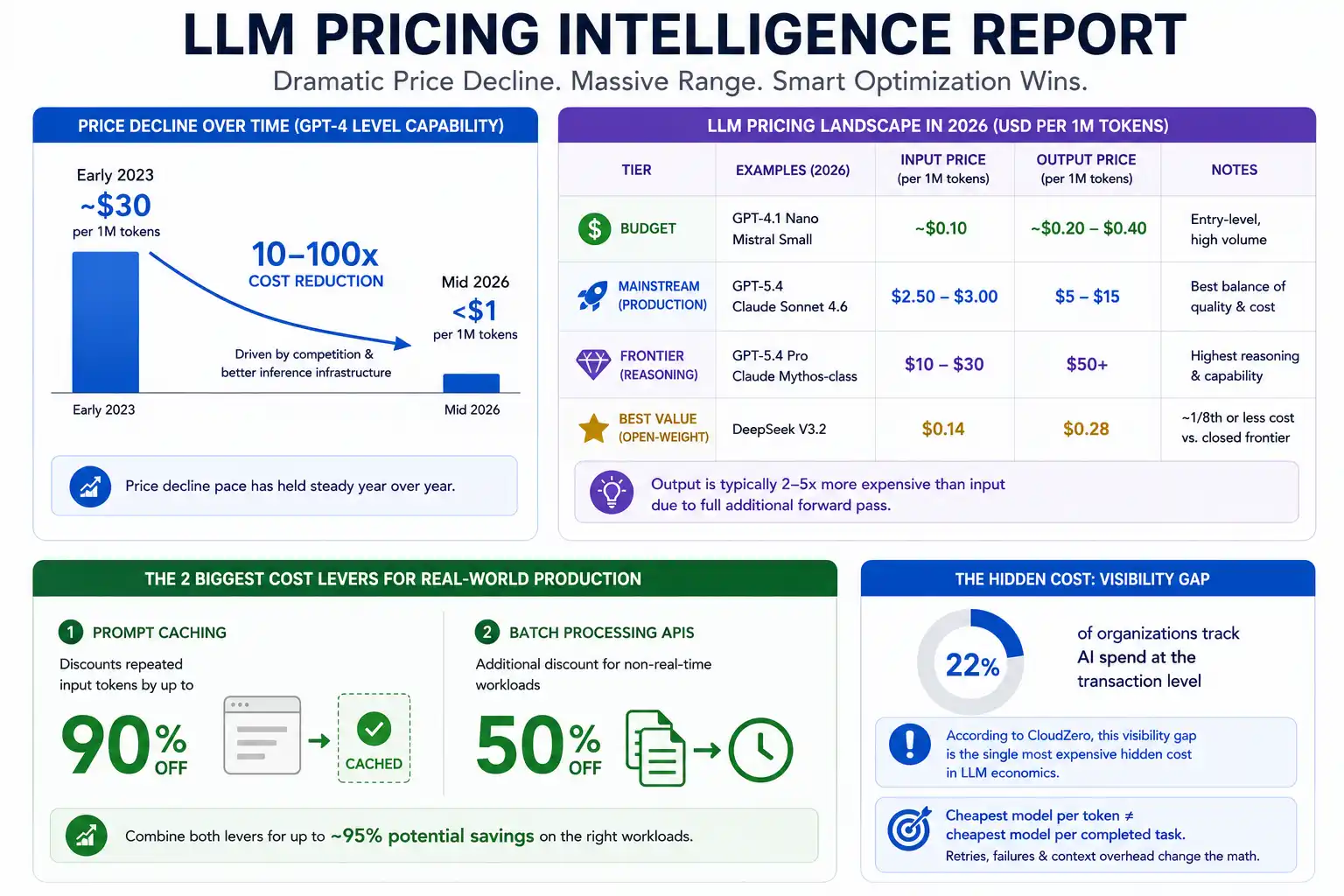
Pricing has fallen faster in this market than in almost any other software category in recent memory. GPT-4-level capability cost roughly 30 dollars per million tokens in early 2023. Equivalent-tier performance is available today for under 1 dollar per million tokens, a 10 to 100 times reduction driven by competition and better inference infrastructure, and that pace of decline has held roughly steady year over year rather than slowing down.
Current 2026 pricing spans an enormous range depending on tier. Budget models like GPT-4.1 Nano and Mistral Small sit around 0.10 dollars per million input tokens. Mainstream production models such as GPT-5.4 or Claude Sonnet 4.6 sit in the 2.50 to 3 dollar per million input token range, with output typically priced two to five times higher than input because it requires a full additional forward pass through the model. Frontier reasoning tiers, GPT-5.4 Pro or Claude’s premium Mythos-class models, run as high as 10 to 30 dollars per million input tokens and 50 dollars or more for output. DeepSeek’s open-weight models remain the standout value option throughout the year, with DeepSeek V3.2 priced around 0.14 dollars input and 0.28 dollars output per million tokens, at times pricing an equivalent task at roughly an eighth or less of the cost of a comparable closed frontier model.
Two cost levers matter more to real production bills than headline pricing. Prompt caching now commonly discounts repeated input tokens by up to 90 percent, and batch processing APIs typically offer a further 50 percent discount for workloads that do not need real-time responses. A CloudZero analysis found that only 22 percent of organisations actually track AI spend at the transaction level, calling that visibility gap the single most expensive hidden cost in LLM economics, since the cheapest model per token is frequently not the cheapest model per completed task once retries and context overhead are factored in.
Multimodal AI Market Report
Multimodal AI, models that natively handle text, images, audio, and video together rather than through separate bolted-on systems, has moved from a novelty feature to a baseline enterprise expectation faster than most other capabilities on this list. By 2026, nearly 60 percent of enterprise AI applications were built using models that combine two or more data modalities, according to Market.us research, up sharply from a much smaller base just two years earlier. The multimodal AI platform market itself is growing at a compound annual rate of roughly 36.6 percent, with North America holding the largest regional share at 43.6 percent, supported by mature cloud infrastructure and early enterprise deployment.
The practical driver behind this shift is straightforward. Multimodal models let a single system handle a support ticket that includes a screenshot, a voice note, and a written complaint together, rather than requiring separate specialised models stitched together by custom engineering. Gemini’s positioning around large documents and native video understanding, and the broader move toward unified multimodal architectures across OpenAI, Anthropic, and the major open-weight labs, all reflect the same underlying demand: enterprises want fewer moving parts and richer context in a single model call, not more specialised point solutions to manage.
Context Window Evolution Report
Global LLM Ecosystem Report: Context window size, how much text, code, or other content a model can consider at once, has expanded dramatically in a short window of time. As of mid-2026, thirteen hosted frontier models ship context windows of 1 million tokens or more, including Claude’s Fable 5 and Opus 4.x line, GPT-5.5, Gemini 3.1 Pro, and DeepSeek V4. Meta’s open-weight Llama 4 Scout advertises the largest window of any model tracked, at 10 million tokens, though that figure is self-hosted rather than a hosted API offering.
The economics of filling that window vary enormously by provider, which is a detail too many teams overlook when comparing headline context figures. Filling the same 1 million token window costs roughly 0.14 dollars on DeepSeek V4 Flash and as much as 10 dollars on Claude’s premium Fable 5 tier, a spread of more than 70 times for functionally the same amount of context. Advertised context length also consistently overstates effective context, meaning the point at which a model reliably uses information buried in the middle of a very long input degrades before the advertised token limit is reached, on every model benchmarked to date. For teams building genuinely long-context applications, that gap between advertised and effective context is a more important planning number than the marketing figure.
New efficiency architectures are starting to close that gap. DeepSeek V4-Pro’s hybrid attention design reportedly runs a 1 million token context using only about 27 percent of the per-token compute and 10 percent of the memory cache required by the previous generation to do the same job, a meaningful efficiency jump that is likely to spread across the industry as competitive pressure pushes every lab toward cheaper long-context inference.
AI Reasoning Models Report
Reasoning models, systems trained to generate extended internal “thinking” steps before producing a final answer, have gone from a research novelty to a standard product category across every major lab in the space of about eighteen months. The shift reflects a genuine change in how these systems are built. Where earlier scaling focused almost entirely on pre-training larger models, 2026’s focus has shifted toward what researchers describe as test-time compute, spending more computation at the moment of answering a specific question rather than only during training. Inference workloads are projected to account for roughly two-thirds of all AI compute in 2026, up from about half in 2025, a direct reflection of how much more computation reasoning models consume per query compared to a standard model.
The practical guidance emerging from this shift is consistent across vendor-neutral analysis. Reasoning models earn their extra cost and latency on genuinely multi-step, verifiable problems, math, code, and multi-step agent planning, where a wrong intermediate step ruins the final answer. They are frequently wasted, in both cost and speed, on simple lookups, rewrites, or high-volume simple tasks that a standard fast model handles just as well. Anthropic’s approach with developer-controlled “extended thinking,” where a team sets an explicit thinking budget per task, has become an influential model for this pattern, bridging the gap between instant response and deep reasoning rather than forcing an all-or-nothing choice. The practical challenge for 2026 and into 2027, according to multiple industry analyses, has shifted from whether labs can build models that reason well to whether enterprises can deploy that reasoning reliably, cost-effectively, and safely at real production scale.
Small Language Models (SLMs) Report
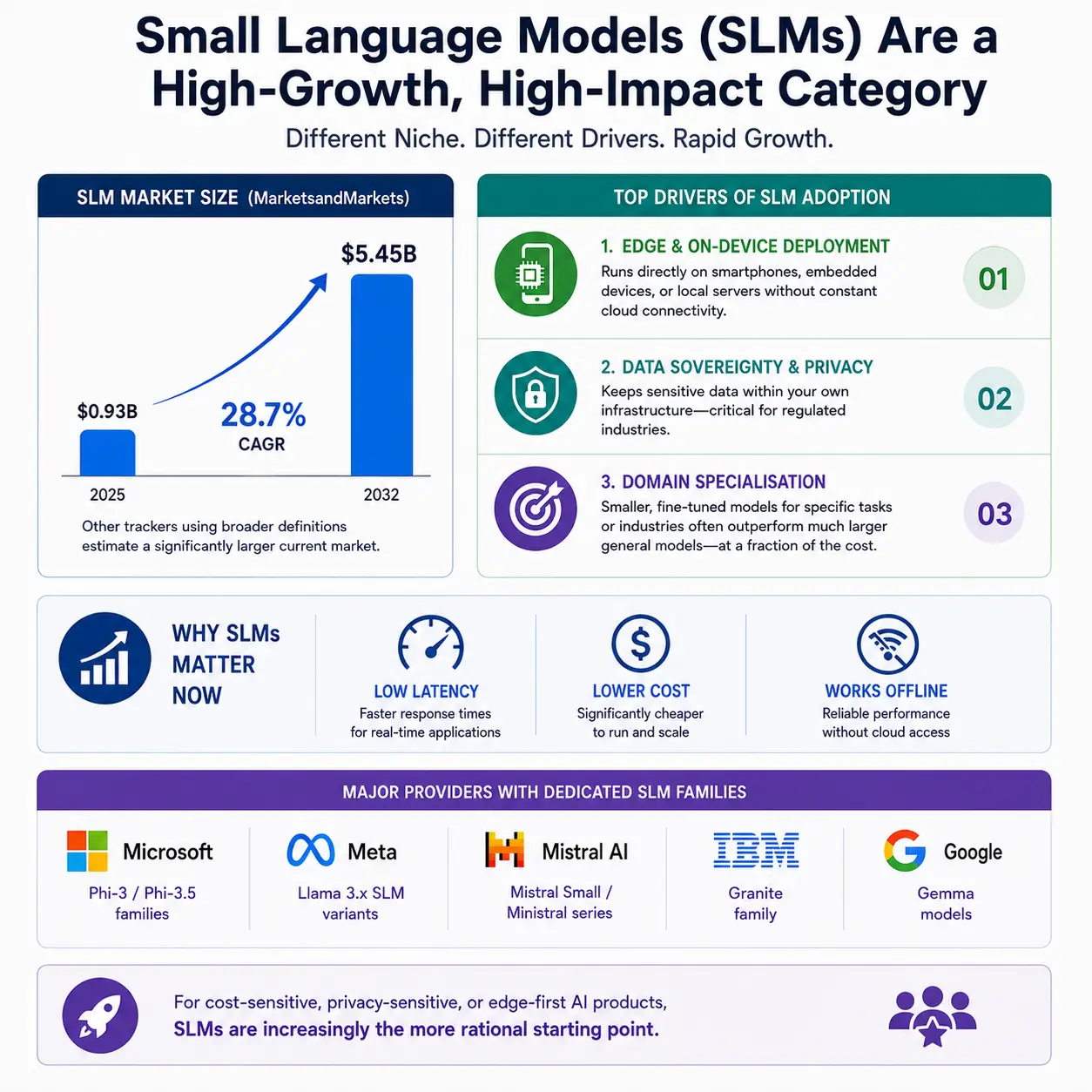
Small Language Models, typically models with parameters numbering in the low billions rather than the hundreds of billions, occupy a genuinely different niche than the frontier race described above, and that niche is growing fast. Market sizing varies by research house, but MarketsandMarkets puts the SLM market at 0.93 billion dollars in 2025, growing to 5.45 billion dollars by 2032 at a compound annual rate of 28.7 percent, while other trackers using a broader market definition put the current size significantly higher.
The drivers behind SLM adoption are distinct from what pushes frontier model adoption. Edge and on-device deployment is the biggest one: SLMs can run directly on a smartphone, an embedded device, or a local server without needing constant cloud connectivity, which matters enormously for latency-sensitive applications and for regulated industries where sending data to an external API is not an option. Data sovereignty and privacy compliance is the second major driver, particularly relevant for healthcare, finance, and legal use cases where an organisation needs to keep sensitive data entirely within its own infrastructure. Domain specialisation is the third, smaller fine-tuned models focused narrowly on one task, one industry, or one language frequently outperform a much larger general-purpose model on that specific task, while costing a fraction as much to run.
Major providers across the industry, Microsoft, Meta, Mistral, IBM, and Google among them, have all released dedicated SLM families over the past two years, treating the category as a genuine product line rather than a scaled-down afterthought to their flagship models. For founders and enterprises building cost-sensitive or privacy-sensitive AI products specifically, SLMs are increasingly the more rational starting point than defaulting straight to a frontier model API.
AI Foundation Model Landscape
Pulling the individual pieces above into one picture, the foundation model landscape now genuinely spans three tiers operating in parallel rather than one dominant tier with also-rans below it. At the top sit the closed frontier labs, OpenAI, Anthropic, and Google, still leading on the hardest reasoning and agentic tasks and commanding the overwhelming majority of enterprise LLM usage globally according to OECD research on AI market concentration. Immediately below sits a fast-closing tier of well-funded open-weight labs, both Western, Meta, Mistral, Cohere, and Chinese, DeepSeek, Alibaba’s Qwen, Moonshot’s Kimi, Zhipu’s GLM, MiniMax, and Xiaomi’s MiMo, that has moved from a budget alternative to genuine production-grade infrastructure for a large share of real-world workloads. Below that sits the SLM tier, purpose-built for edge, privacy, and domain-specific deployment rather than competing on raw capability at all.
The single biggest structural shift underlying all three tiers is the same one showing up in the open-versus-closed data: enterprises are no longer required to choose a single vendor and build their entire AI stack around it. Model routing, choosing a different model for each task based on cost, latency, and required capability, has moved from an advanced optimisation technique to a basic architectural expectation. That shift changes how founders should think about vendor lock-in, and it is a large part of why we now advise Cybertize clients to architect for model flexibility from day one rather than hard-coding a single provider into a product’s core logic.
AI Cybersecurity Landscape
AI has become both the most powerful new tool available to security teams and the most powerful new tool available to attackers, and 2026 is the year that tension became impossible to ignore at the board level. Gartner forecasts that more than 40 percent of all cybersecurity spending will be directly tied to AI-related capabilities by 2027, up from just 8 percent in 2023, a five-fold increase in three years reflecting how fast security budgets are being reallocated toward AI-native defence.
The threat side of this equation has changed in kind, not just in scale. Palo Alto Networks’ 2026 predictions describe a machine-to-human identity ratio of roughly 82 to 1 inside modern enterprises as autonomous AI agents proliferate, creating what the firm calls a crisis of authenticity where a single forged command can trigger a cascade of automated actions before a human ever reviews it. AI-generated deepfakes convincing enough to impersonate executives in real time, AI agents that adapt their attack tactics continuously during a penetration attempt, and identity-based attacks exploiting the sheer number of non-human credentials now active inside enterprise systems all rank among the most cited threats heading into 2027.
The defensive response is shifting from bolt-on AI features toward purpose-built AI-native security platforms. Major vendors including CrowdStrike, Microsoft Security, and Palo Alto Networks reported a 47 percent increase in AI-native platform deployments in a single recent year, with enterprises citing autonomous threat response, reduced analyst workload, and real-time model monitoring as their top adoption drivers. For any organisation deploying agentic AI internally, identity governance for those agents, not just for human users, has moved from a theoretical future concern to what IBM’s own 2026 research describes as a board-level concern today.
Cybertize’s Analysis: What This Means Going Into 2027
Pull the eleven pieces of this report together and a few conclusions hold consistently. The gap between the best closed and best open models has narrowed to months rather than years, and cost has become at least as important a selection criterion as raw capability for most production use cases. Enterprises have solved adoption but not scaling, and the organisations capturing real returns are the ones treating AI deployment with the same operational discipline as any other core infrastructure investment, not as a series of disconnected pilots. Reasoning models, long context, and multimodality have all moved from frontier novelty to standard expectation within roughly two years, a pace of commoditisation that shows no sign of slowing. And AI’s role in cybersecurity has become genuinely bidirectional, the same capabilities that make agentic systems useful to a business make them a target and a vector, and governance has become the deciding factor in whether that risk stays manageable.
At Cybertize Technologies, this is the landscape we build inside every day, and staying current on it, rather than working from what was true even six months ago, is what lets us give founders and enterprise clients architecture advice that actually holds up in production.
Sources
- Roots Analysis, Global Large Language Model Market Size and Industry Trends
- GetPanto, LLM Statistics 2026
- Momentic, Top Generative AI Chatbots and LLMs by Market Share, July 2026
- Hostinger, LLM Statistics 2026: Adoption, Market Growth, and Trust Data
- Business 2.0 News, Top 10 LLM Models by Market Share 2026, citing Menlo Ventures
- LLM-Stats.com, AI Trends July 2026
- Digital Applied, Open-Weight vs Closed-Source AI Models Q2 2026 Gap Analysis
- DeepInfra, Open vs Closed Source AI Models: Intelligence, Price and Speed Compared
- Kingy.ai, State of Open-Weight AI Models
- TechJack Solutions, Best Open-Source AI Models 2026
- CloudZero, LLM API Pricing Comparison 2026
- AI Superior, LLM Cost Comparison 2026
- Morph, LLM Context Window Comparison 2026
- OpsLyft, LLM Pricing Comparison: Cost Per Token Across Every Major Model 2026
- MarketsandMarkets, Small Language Model Market Report
- Grand View Research and Polaris Market Research, Small Language Model Market reports
- Market.us, Multi-Modal AI Platform Market Size Report
- Taskade, AI Reasoning Models Explained: Test-Time Compute 2026
- Zylos Research, AI Reasoning Models 2026
- McKinsey and Company, State of AI Survey 2025-2026
- PwC, Global CEO Survey, January 2026
- Accenture, AI productivity gain research
- OECD, 2025 AI Markets Report
- Gartner, Cybersecurity Spending Forecast
- Palo Alto Networks, 6 Predictions for the AI Economy 2026
- IBM Think, The Trends That Will Shape AI and Tech in 2026
- Practical DevSecOps, AI Security Statistics 2026
- Anthropic, Claude Fable 5 and Mythos 5 access notice