Table of Contents
Cloud Migration Has Entered Its Second, Harder Phase
Cloud Migration Report: For most of the last decade, the cloud migration conversation was about a single question: are you moving, or not. That question is settled. Ninety-four percent of enterprises now use at least one cloud service, up from 89 percent in 2023, and 72 percent of enterprise workloads now run in cloud environments. The conversation in 2026 has moved to a harder, more expensive set of questions: which workloads actually belong in the cloud, what does a realistic budget and timeline actually look like, and why do so many migrations still overrun both.
At Cybertize Technologies, we build and migrate infrastructure for clients across a range of company sizes, and the gap between what a migration is initially budgeted for and what it actually costs is one of the most consistent sources of friction we see in early client conversations. This report lays out the real 2026-2027 benchmark data, cost, timeline, success rates, and the emerging repatriation trend, along with a dedicated section on what this actually looks like for a business operating in India.
Market Size and Growth
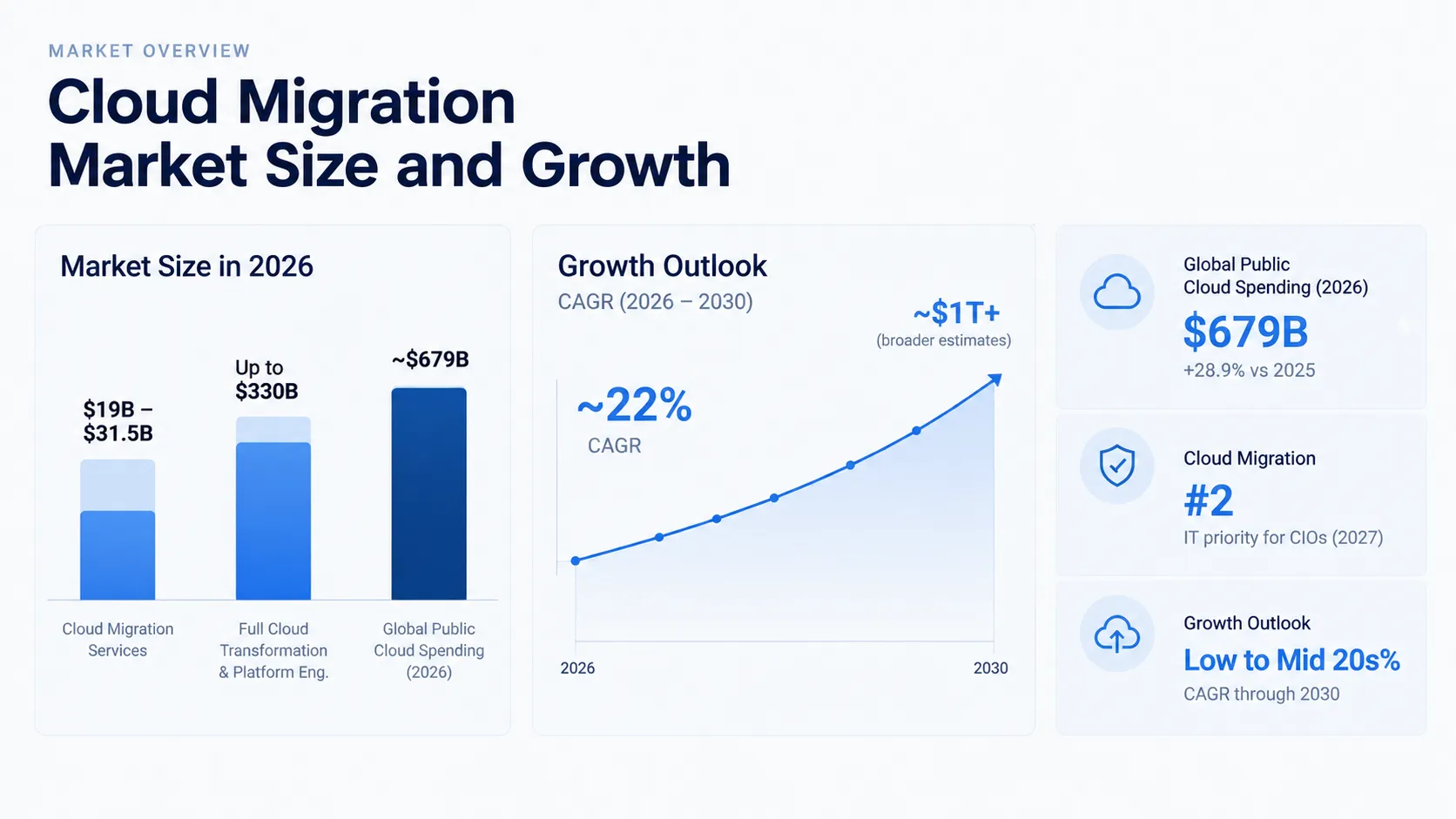
Market sizing for cloud migration varies considerably depending on what a given research firm counts inside the category, and it is worth flagging that variance honestly rather than picking the most dramatic single figure. Estimates for the cloud migration services market specifically in 2026 range from roughly 19 billion to 31.5 billion dollars depending on methodology, while broader definitions that include the full cloud transformation and platform engineering market put the figure as high as 330 billion dollars. What every source agrees on is the growth trajectory: compound annual growth in the low-to-mid twenties percent range through the rest of the decade, with the market projected to approach or exceed 1 trillion dollars in some broader estimates by 2030. Global public cloud spending overall reached roughly 679 billion dollars in 2026, a 28.9 percent increase over 2025, and cloud migration remains the number two IT priority for CIOs heading into 2027, behind only cybersecurity.
Cost Benchmarks by Company Size
Cost is the number every business wants most precisely, and the honest answer is that it scales dramatically with company size and workload complexity rather than following a single formula.
| Organization size | Typical migration cost | Typical timeline |
|---|---|---|
| Small workload / SMB | $20,000-$100,000 | 2-4 months |
| Mid-size enterprise | $200,000-$1.2 million | 4-8 months |
| Large enterprise (5,000+ users, 50+ applications) | $1.2-$4.5 million | 8-18 months |
| Complex, multi-system enterprise program | Multi-million dollar, phased | 18-24 months |
The biggest cost drivers are consistently labor, data movement, integration work, and what industry guides call the double-run period, the overlapping window where an organization pays for both old and new infrastructure simultaneously, not compute and storage pricing itself, which is usually the smaller line item most teams fixate on early in planning. Data transfer, or egress, fees alone account for 6 to 12 percent of total migration cost on average, a cost category many organizations underestimate significantly until the first post-migration invoice arrives. Migration cost overruns remain common even as overall success rates improve: 38 percent of projects exceed their original budget, with the average overrun running 14 to 23 percent above the planned figure depending on which benchmark study is referenced.
Timeline Benchmarks
The average enterprise migration timeline has compressed meaningfully as tooling and methodology have matured, falling from roughly 12 months in 2019 to approximately 8 months by 2025-2026 for a typical large-scale wave, covering assessment through stabilization. That compression correlates directly with lower cost overruns: shorter, better-scoped migration waves consistently overrun their budget less than extended, poorly bounded ones, which is one of the clearer causal patterns in the current benchmark data rather than just a coincidental correlation.
Also Read:
AI-Powered Cybersecurity: Lessons From the OpenAI Security Incident
Budget planning should realistically cover three distinct phases, not just the migration event itself: pre-migration assessment and planning, the migration execution itself, and a post-migration stabilization window of at least three to six months, during which the majority of expected cost savings and performance gains actually materialize. Teams that budget only for the migration event itself and treat stabilization as a rounding error are consistently the ones most surprised by their actual total cost of ownership a year later.
Success and Failure Rates
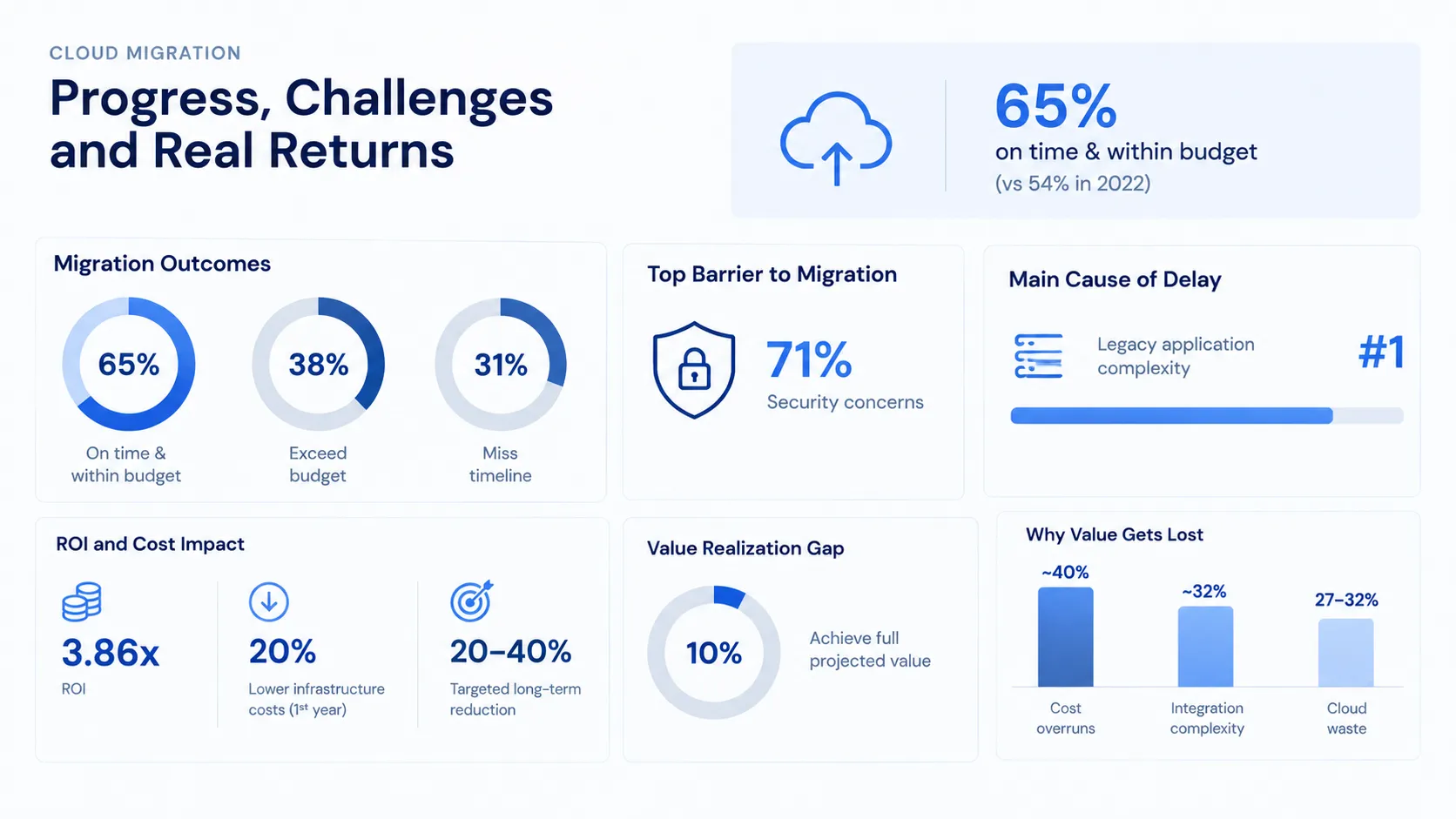
Sixty-five percent of cloud migrations now complete on time and within budget, a meaningful improvement from 54 percent in 2022 as migration tooling, cloud provider support, and organizational experience with this kind of project have all matured. That leaves a real remainder worth taking seriously: 38 percent of migrations still exceed budget and 31 percent miss their planned timeline, with the complexity of legacy applications consistently cited as the number one cause of timeline slippage. Security concerns remain the most commonly cited barrier to migration in the first place, named by 71 percent of organizations as a primary obstacle.
The return-on-investment picture is genuinely strong for well-executed migrations but comes with an important caveat most vendor marketing leaves out. Aggregate industry analysis puts average cloud migration ROI at roughly 3.86 dollars returned per dollar spent, and organizations report an average 20 percent reduction in infrastructure costs within the first year post-migration, with many enterprises targeting 20 to 40 percent reductions over a longer horizon. But McKinsey’s own research found only about 10 percent of cloud transformations achieve their full projected value, with the gap between projected and realized returns driven primarily by cost overruns, integration complexity, and unmanaged cloud waste, which itself averages 27 to 32 percent of total cloud spend across organizations that have not implemented real cost governance.
The Repatriation Counter-Trend
This is the most genuinely contested data point in the current cloud landscape, and it deserves to be presented with real nuance rather than picking one dramatic headline. Multiple 2026 surveys report a striking figure: 86 percent of CIOs say they plan to move at least some workloads from public cloud back to private infrastructure or on-premises environments, the highest rate ever recorded, driven primarily by unpredictable billing, rising egress costs, data sovereignty requirements, and the specific economics of AI infrastructure workloads. Enterprises that migrated aggressively during the 2015 to 2020 wave are increasingly pulling predictable, high-compute workloads back onto owned or leased infrastructure after several years of actual invoice data revealed costs that did not match original projections.
Also Read:
AI in UI/UX Design Report 2026-2027: Tools, Data, Benchmarks
But a credible counter-argument belongs in this report too, because the repatriation narrative is genuinely more contested than most single-source coverage suggests. AWS, Azure, and Google Cloud all reported double-digit revenue growth through their most recent quarterly earnings, a trajectory that is difficult to reconcile with a genuinely massive repatriation wave happening simultaneously. All three hyperscalers have also expanded their own hybrid offerings, AWS Outposts, Azure Arc, Google Distributed Cloud, specifically to support workloads moving toward a hybrid model rather than treating repatriation purely as customer loss. The most balanced read of the current data is that true full repatriation, abandoning the cloud entirely, remains rare, while selective, workload-specific rebalancing toward hybrid architecture, keeping unpredictable or compliance-sensitive workloads on owned infrastructure while leaving elastic, variable-demand workloads in public cloud, is genuinely accelerating and represents where the real 2026-2027 trend actually sits.
FinOps and Cost Governance
Flexera’s 2026 State of the Cloud report found estimated wasted cloud spend rose to 29 percent, the highest level in five years, even as overall cloud adoption and spending continue climbing. That combination, rising spend and rising waste simultaneously, is exactly why FinOps, the discipline of tying cloud cost directly to business outcomes and giving engineering teams real-time visibility into what their architecture decisions actually cost, has moved from an optional best practice to a genuine strategic requirement referenced across nearly every current migration guide. Only about 14 percent of organizations report having a mature FinOps practice in place currently, according to NTT DATA’s 2026 research, which means the gap between organizations managing cloud cost deliberately and those discovering it after the fact remains wide heading into 2027.
Provider Landscape
The three major hyperscalers remain firmly dominant, though the gap between them has narrowed slightly over recent quarters. As of the most recent Synergy Research figures, Amazon Web Services holds roughly 29 percent of the global cloud infrastructure market, Microsoft Azure 20 percent, and Google Cloud 13 percent, together accounting for 63 percent of a quarterly market worth 106.9 billion dollars. Eighty-two percent of enterprises now run a multi-cloud strategy, using two or more providers simultaneously, both for negotiating leverage and to avoid single-vendor dependency, a pattern reinforced further by the emergence of specialized “neocloud” providers offering AI-native infrastructure and more transparent pricing models specifically positioned to address the cost unpredictability driving the repatriation trend discussed above.
What This Looks Like in India
For a company like Cybertize Technologies operating inside the Indian market, cloud migration carries specific regional realities that a generic global cost guide consistently misses. India’s cloud computing market is projected to reach 17.8 billion dollars by 2027, growing at a 24 percent compound annual rate, a pace ahead of the broader global average, and regional infrastructure has matured enough that AWS Mumbai, Azure Pune, and Google Cloud Delhi regions now let Indian businesses keep data physically within the country, directly relevant for RBI compliance in financial services and for obligations under the Digital Personal Data Protection Act more broadly.
Real Indian cost examples look meaningfully different from the dollar-denominated global benchmarks above. A simple rehost, moving an on-premise server to a cloud instance with minimal code changes, can run as low as a few thousand rupees a month for a small business workload, against five to twenty lakh rupees in upfront hardware cost plus fifty thousand to two lakh rupees a year in maintenance for an equivalent on-premise server. That cost asymmetry is a large part of why cloud adoption among Indian SMBs specifically has accelerated so sharply, since the capex-to-opex shift removes a meaningful upfront barrier that used to make cloud migration feel like a large-enterprise-only decision.
The AWS-popularized “6 Rs” framework, rehost, replatform, refactor, repurchase, retire, and retain, remains the standard planning lens used across Indian migration guides, with the right choice depending heavily on application architecture and business value rather than defaulting to the fastest or cheapest option. The most consistent warning across current India-specific guidance is the same one that trips up global enterprises: planning a migration budget using US pricing assumptions borrowed from a generic guide, rather than Mumbai region-specific pricing, RBI and DPDP compliance overhead, and the real hidden costs, egress fees, support tiers, reserved instance planning, that only become visible on the first full month’s invoice after go-live.
What This Means Heading Into 2027
Pull this data together and a consistent, practical picture holds. Migration tooling and organizational experience have genuinely matured, timelines have compressed, and success rates have improved, but the fundamentals that separate a well-executed migration from an overrun one have not changed: realistic budgeting across all three phases, not just the migration event; disciplined scoping using a framework like the 6 Rs rather than defaulting to lift-and-shift for everything; and cost governance built in from the start rather than discovered through a painful invoice six months after go-live. The repatriation trend, real but more nuanced than the most dramatic headlines suggest, reinforces the same underlying lesson: the winning strategy heading into 2027 is not “cloud” or “not cloud” as a single binary choice, but a deliberate, workload-by-workload decision about where each piece of infrastructure genuinely belongs.
At Cybertize Technologies, this is the exact planning discipline we bring to migration projects for clients, because the data in this report is consistent on one point above every other: the migrations that stay on budget and on timeline are the ones that treated cost governance and realistic scoping as part of the architecture from day one, not as cleanup work after the fact.
Cybertize Technologies Private Limited plans and executes cloud migrations with realistic cost governance and workload-specific scoping built in from day one, for clients navigating both global and India-specific compliance requirements.
Sources
- Auvik, Cloud Migration Statistics: What to Know for 2026
- Cloudaware, Cloud Migration Costs: Savings, Benefits and Enterprise Cost Guide
- TechBlocks, Cloud Migration Trends and Statistics 2026 for Enterprises
- MedhaCloud, 50 Cloud Migration Statistics for 2026, and 55 Cloud Computing Statistics for 2026
- Softobiz, Cloud Migration ROI Statistics: 2026 Report
- DataStackHub, Cloud Migration Cost Statistics for 2025-2026, and 50 Cloud Migration Statistics for 2025-2026
- IT-Premium, Cloud Migration for Business in 2026: Statistics, Costs, and Step-by-Step Strategy
- HyScaler, Cloud Repatriation in 2026: Why Enterprises Are Moving Back from the Cloud
- CloudMinister, Cloud Repatriation in 2026: AWS to Servers
- Northflank, What Is Cloud Repatriation and Why Are Companies Doing It in 2026?
- Digital Chiefs, Cloud Repatriation 2026 Is a Statistical Illusion
- SquareOps, Cloud Repatriation Strategy Guide 2026
- Qovery, AWS vs Azure vs GCP for Cloud Migration: How to Actually Choose in 2026
- Synergy Research Group, Q3 2025 global cloud infrastructure market share data
- JK Tech Hub, Cloud Migration Guide for Indian Businesses 2026
- Rajesh R Nair, Cloud Migration Cost India 2026: AWS vs Azure vs Google Cloud Guide
- Flexera, State of the Cloud Report 2026
- McKinsey, cloud transformation value realization research, June 2025
- Gartner, cloud IT priority and workload forecast data