Cloud Migration Services by Platform
AWS Migration Services
End-to-end migration to Amazon Web Services, including EC2 right-sizing, RDS database migration, S3 storage architecture, and AWS Application Migration Service (MGN) for large-scale server lifts. AWS remains the largest cloud provider in India by market share at roughly 32%, making it the default target for most of our migration assessments.
Learn More
Azure Migration Services
Migration to Microsoft Azure using Azure Migrate, Azure Database Migration Service, and Azure Site Recovery, the natural fit for businesses already running on Microsoft 365, Active Directory, or .NET-based enterprise systems. Azure holds roughly 28% share of the Indian cloud market.
Get Started
Google Cloud (GCP) Migration Services
Migration to Google Cloud Platform using Migrate to Virtual Machines and BigQuery-based data migration, typically chosen by teams already invested in Google’s data and AI tooling ecosystem.
Multi-Cloud & Hybrid Cloud Migration
For businesses that don’t want single-vendor lock-in, or need to keep regulated data on-premise while running customer-facing workloads on public cloud, we design and execute migrations across two or more providers with a unified operational model.
Cloud Migration Services by Strategy
Lift-and-Shift (Rehost) Migration
The fastest path to the cloud: moving applications and VMs to cloud infrastructure with minimal code changes. Fast, but worth entering with eyes open: lift-and-shift alone leaves a meaningful share of potential cost savings on the table compared to re-architecting for cloud-native patterns, so we always flag which workloads are good rehost candidates versus which ones you’re better off replatforming from day one.
Replatforming & Application Refactoring
For applications where lift-and-shift isn’t enough, we re-architect for cloud-native patterns: converting monolithic applications to containerized microservices, moving from self-managed databases to managed services, and redesigning for autoscaling instead of fixed-capacity servers. This is where the real cost and performance gains show up, usually 20 to 30% or more in infrastructure savings once workloads are actually cloud-native rather than “technically running on a cloud VM.”
Database Migration Services
Database migration is where most cloud migrations quietly go wrong. We handle schema conversion, data validation, minimal-downtime replication, and a tested cutover plan with rollback capability, for PostgreSQL, MySQL, MongoDB, Oracle, and SQL Server workloads.
Data Center Exit & Legacy System Migration
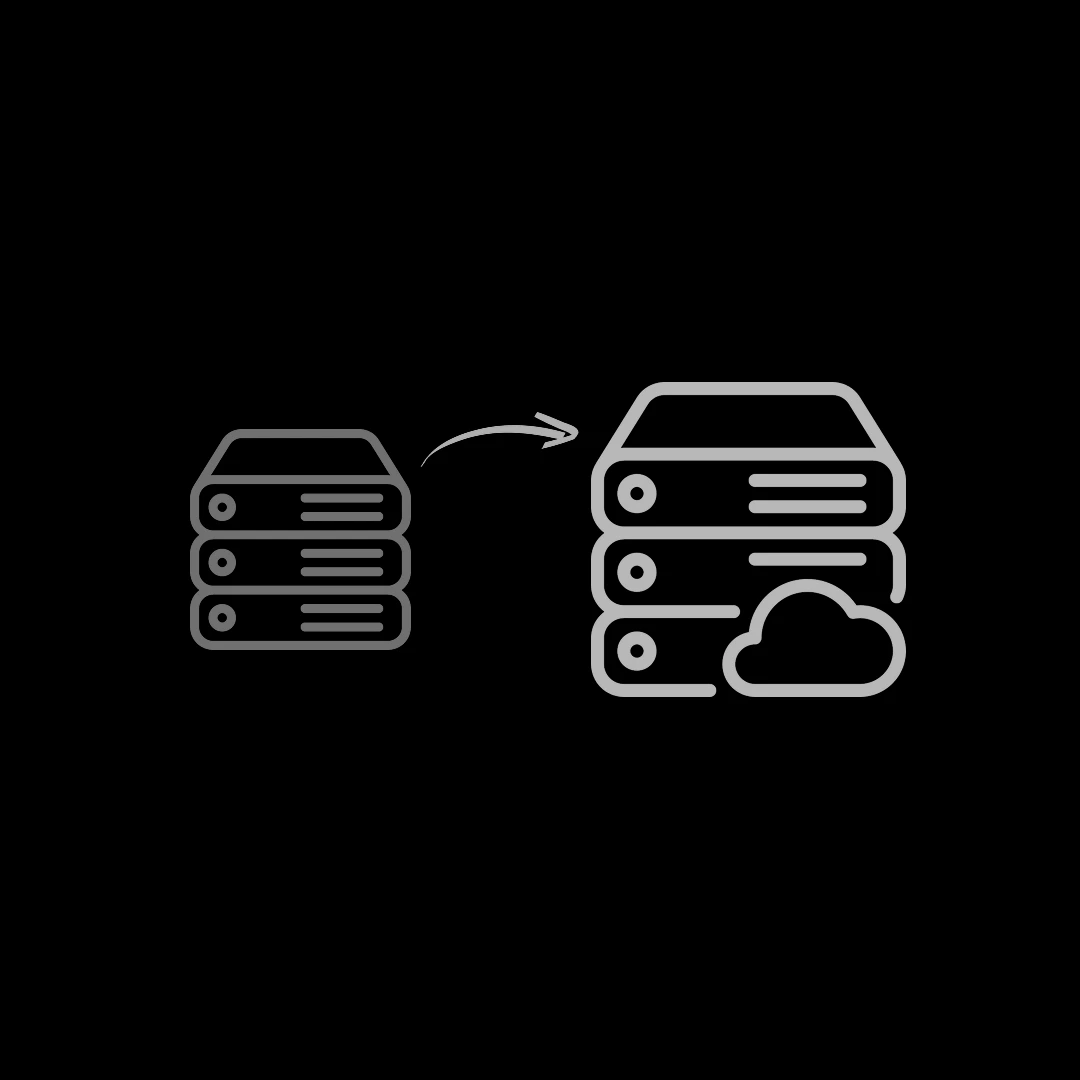
For businesses still running physical servers on-site, we plan the full data center exit: application inventory, dependency mapping, phased workload migration, and decommissioning, timed to avoid a hard cutover on a single high-risk weekend. On-premise infrastructure in India typically carries purchase costs in the range of ₹5 to ₹20 lakh per server plus ₹50,000 to ₹2 lakh in annual maintenance, costs that disappear entirely once workloads move to consumption-based cloud pricing.
SaaS & Server Migration to Cloud
For businesses running self-hosted applications that need to become scalable, multi-tenant SaaS products, we handle both the infrastructure migration and the architectural changes needed to serve multiple customers securely from shared cloud infrastructure.
Zero (or Near-Zero) Downtime Cutover
The actual cutover is where migrations are won or lost publicly. We plan phased traffic shifting (DNS-based, load-balancer-based, or blue-green), parallel-run periods where old and new environments both serve traffic before full cutover, and a documented, rehearsed rollback procedure, so a migration issue is a contained event instead of a customer-facing outage.
Post-Migration Cloud Optimization
Migration doesn’t end at cutover. We audit the new environment for right-sizing, unused resources, and Reserved Instance or Savings Plan opportunities in the weeks after go-live, because the biggest waste in cloud spend usually shows up only once real production traffic hits the new environment.
Cloud Disaster Recovery & Business Continuity
As part of migration, we design your Recovery Time Objective (RTO) and Recovery Point Objective (RPO) into the new architecture from the start, including cross-region backup, automated failover for critical services, and a disaster recovery runbook your team can actually execute under pressure.
Security, Compliance & Data Residency
Cloud migration is also a data governance decision. We design IAM policies, network segmentation, and encryption-at-rest/in-transit as part of the migration itself, and for Indian entities, we architect specifically around the Digital Personal Data Protection (DPDP) Act’s data localization requirements for sensitive personal data, using in-India cloud regions available across AWS, Azure, and GCP.
Cloud Migration Services by Industry
Fintech & BFSI Cloud Migration. Compliance-heavy migrations with audit-ready security architecture, representing roughly a quarter of global cloud migration spend, the largest single industry segment.
Healthcare Cloud Migration. HIPAA-aware architecture, encrypted patient data handling, and compliant backup strategy for healthtech platforms and hospital systems.
E-commerce Cloud Migration. Autoscaling architecture built for traffic-spike events (sales, festive-season surges) without the fixed-capacity limitations of on-premise infrastructure.
Manufacturing & ERP Cloud Migration. Migrating legacy ERP and inventory management systems to cloud infrastructure without disrupting active production and supply chain operations.
SaaS & B2B Product Cloud Migration. Migration paired with multi-tenant architecture design, for product companies scaling from single-customer deployments to shared cloud infrastructure.
Government & Public Sector Cloud Migration. Data residency-compliant migration for public sector entities, architected around India’s data localization requirements from the ground up.
Where We Deliver Cloud Migration Services
Cloud Migration Services in Delhi NCR
Direct, on-ground delivery for businesses across Delhi, Gurugram, and Noida, with in-person infrastructure assessments available where needed.
Cloud Migration Services in Mumbai
Support for Mumbai’s dense fintech and BFSI ecosystem, where compliance-ready cloud architecture is typically a non-negotiable requirement from day one.
Cloud Migration Services in Gujarat
Migration support for Gujarat’s manufacturing, trading, and growing SaaS ecosystem, including legacy ERP modernization for established manufacturing businesses.
Cloud Migration Services in Indore
Cloud migration for Indore’s expanding IT and services sector, priced and scoped for the mid-market business reality of a growing but cost-conscious tier-2 tech hub.
Cloud Migration Services in Bangalore
Delivery for Bangalore’s product and SaaS-heavy market, where clients most often need re-architecture and cloud-native replatforming rather than a simple lift-and-shift.
Cloud Migration Services Provider USA
Direct engagement for US-based businesses, with migration planning and cutover execution scheduled around US business hours and compliance frameworks (SOC 2, HIPAA) where applicable.
Cloud Migration Consultant UAE
Migration consulting for UAE-based businesses, with timezone overlap that keeps coordination responsive across both our Indian and US teams, useful for UAE companies operating with international stakeholders on either side.
AWS vs Azure vs GCP: Which Should You Migrate To?
There’s no universally “best” provider, only the best fit for your existing stack, team, and compliance needs. AWS holds the largest share of the Indian cloud market at roughly 32%, making it the default choice when there’s no strong existing preference and the widest ecosystem of managed services. Azure is typically the stronger fit if you’re already running Microsoft 365, Active Directory, or .NET applications, since the integration overhead is lower. GCP tends to make the most sense for teams already using Google’s data and AI/ML tooling. We include a platform comparison scoped to your actual workload as part of every readiness assessment, rather than defaulting to whichever provider we prefer working with.
Cloud Migration vs. Cloud-Native Development: Which Do You Need?
If you have an existing application generating real usage and revenue, migration, moving it to the cloud with the right amount of re-architecture, is almost always the faster, lower-risk path. Cloud-native development from scratch only makes sense when the existing application’s architecture is so fundamentally incompatible with cloud infrastructure that rebuilding is genuinely cheaper than migrating and refactoring. We’ll tell you honestly which situation you’re in during the assessment, rather than defaulting to whichever engagement is larger.
How We Work: Engagement Models
Fixed-Scope Migration Project. A defined application portfolio migrated on a fixed timeline, typically 6 to 20 weeks depending on portfolio size and complexity.
Phased Data Center Exit. For larger legacy environments, a multi-phase migration roadmap executed over months, with each phase independently scoped and validated before the next begins.
Cloud Modernization Retainer. Ongoing engagement combining migration with application refactoring, for businesses that want to modernize as they move rather than move and modernize separately.
Migration Assessment Only. A time-boxed readiness assessment and migration roadmap, for teams that want a clear plan and cost estimate before committing to execution, with no obligation to execute it with us.
Engagements are quoted in INR for Indian entities and USD for US and UAE clients, scoped after the initial readiness assessment, since a five-server rehost and a full data center exit with 40 interdependent applications are not priced the same way.
Common Technical Challenges We Plan Around
Application dependency blind spots. A large share of migration rework happens because an application’s dependencies (a hardcoded internal IP, a shared file system, a scheduled batch job nobody documented) weren’t discovered until mid-migration. We do dependency discovery before scoping, not during execution.
Network latency assumptions breaking silently. Applications built assuming same-datacenter latency between app server and database can slow down significantly once that database sits in a different availability zone or region. We test latency-sensitive paths before cutover, not after users complain.
Underestimated data transfer time and cost. Large databases and file stores take longer to migrate than teams expect, and cross-region data transfer has real egress costs. We calculate both during assessment so the migration timeline and budget reflect reality.
Security misconfiguration during the move. A significant share of post-migration incidents trace back to overly permissive IAM roles or open security groups set up “temporarily” during migration and never locked back down. We treat security configuration as part of the migration deliverable, not a follow-up task.
No tested rollback path. The single biggest reason a migration turns into a visible outage is teams cutting over without a rehearsed way to go back. Every cutover plan we write includes a rollback procedure that’s actually been tested, not just documented.
Why Cybertize Technologies
We plan the assessment as carefully as the migration. Given that roughly three-quarters of cloud migrations run over budget industry-wide, our process is built specifically to front-load dependency mapping and cost modeling before execution starts, not after problems appear mid-migration.
We build applications too, so we know what actually breaks in transit. Because Cybertize also delivers Node.js and Next.js application development, we understand exactly how a hardcoded connection string, a synchronous file read, or a caching assumption behaves when it suddenly sits on different infrastructure, and we catch it in assessment instead of in production.
Presence across India, the US, and UAE. With teams operating out of Delhi, Mumbai, Gujarat, Indore, and Bangalore, alongside a US presence, we run migration engagements with overlapping working hours for Indian and North American clients, and UAE-based engagements benefit from timezone overlap with both regions.
No lock-in migration. Every engagement is documented with architecture diagrams and Infrastructure-as-Code your team owns outright, so your cloud environment is portable and auditable, not dependent on us to operate.
Assessment before quote, always. We don’t price a migration blind. The readiness assessment comes first, and the migration plan and cost estimate come out of what we actually find in your environment.
Start With an Assessment, Not a Commitment
You don’t need to decide on a cloud provider or a migration date before talking to us. The first step is a structured readiness assessment: what’s in your current environment, what it depends on, what it will cost to move, and what could go wrong if it’s rushed. From there, you decide on timeline and scope.
[Talk to a Cloud Migration Consultant →]