Table of Contents
Two True Numbers That Contradict Each Other
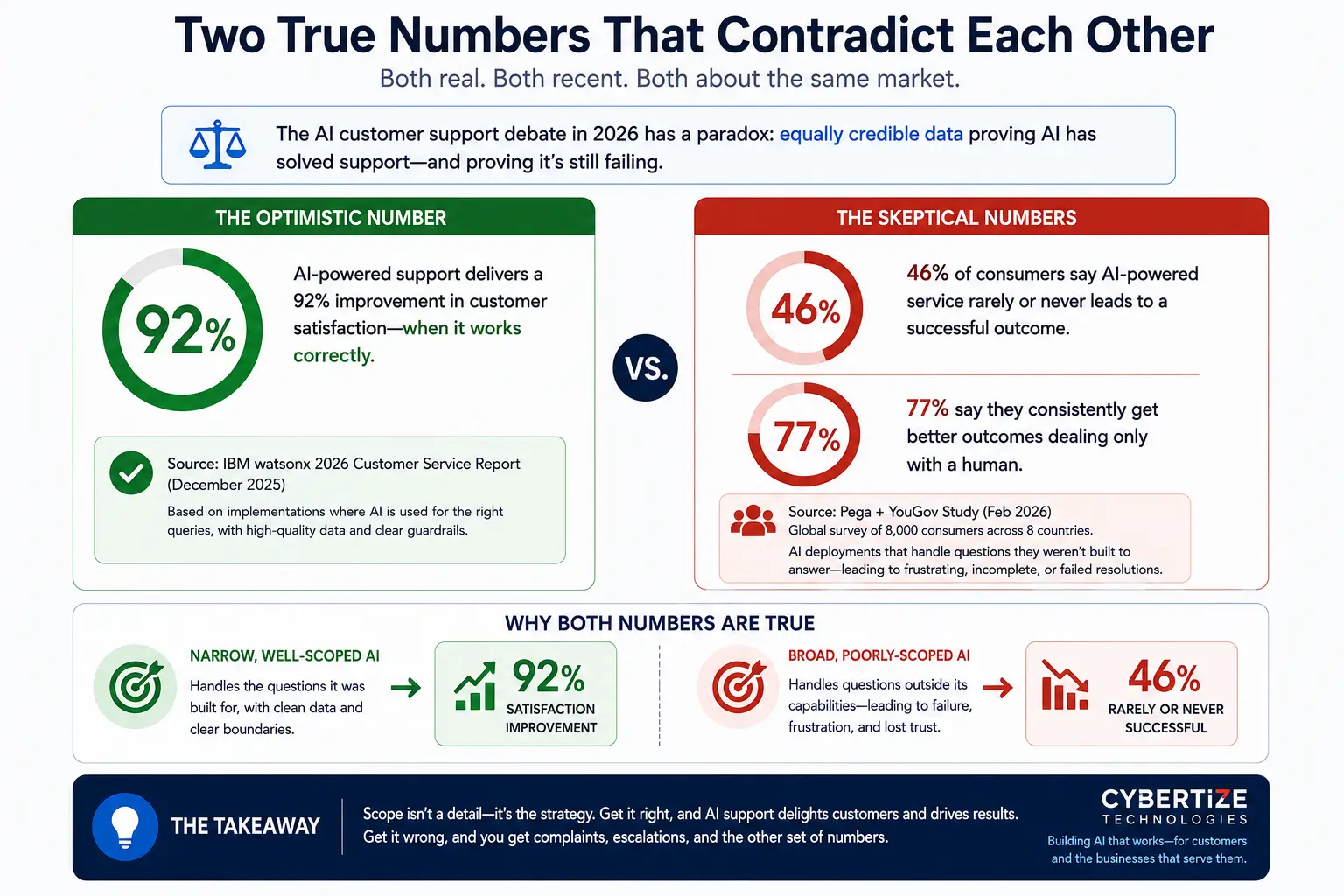
Here is a genuinely strange thing about the AI customer support debate in 2026. You can find a credible, well-sourced statistic proving AI has essentially solved customer service, and a credible, well-sourced statistic proving the opposite, often published in the same week by researchers looking at the same market.
One says AI-powered support delivers a 92 percent improvement in customer satisfaction when it works correctly. Another, from a Pega and YouGov study conducted in February 2026, found 46 percent of consumers say AI-powered service rarely or never leads to a successful outcome, and 77 percent say they consistently get better outcomes dealing only with a human. Both numbers are real. They are just measuring different things. The 92 percent figure captures what happens when AI is deployed narrowly, on well-scoped queries it was actually built to handle. The 46 percent figure captures what happens when AI gets deployed broadly, fielding questions it was never equipped to answer and failing in ways the customer notices and remembers.
At Cybertize Technologies, this is close to the most common mistake we see when clients build a support chatbot. They treat scope as an afterthought instead of the entire design decision. Get the scope right and the AI numbers genuinely impress. Get it wrong and you get the other set of numbers.
AI Chatbot vs Human Support: Where AI Genuinely Wins
Speed is not a close contest. Klarna’s AI assistant cut average issue resolution time from 11 minutes to 2 minutes, an 82 percent improvement, while keeping customer satisfaction scores comparable to its human agents. H&M reported a 70 percent reduction in response time using generative AI compared to human agents. Freshworks’ Freddy AI cut first response time from 12 minutes down to 12 seconds in one deployment. There is no human equivalent to a response that starts before the customer finishes typing.
Cost tells an equally lopsided story. AI-resolved tickets average roughly 0.62 dollars per resolution against 7.40 dollars for a human-handled ticket, according to a McKinsey sample cited in recent customer service AI research, with chat-based AI resolutions running as low as 0.41 dollars. Other industry trackers put the ratio slightly differently but consistently in the same range, AI interactions costing somewhere between a tenth and a twentieth of a comparable human interaction. Companies report an average return of 3.50 dollars for every dollar invested in AI customer service, and the global AI customer service market itself has grown to roughly 15.12 billion dollars in 2026, expanding at close to 26 percent a year.
Volume and consistency round out AI’s clearest advantages. AI chatbots can now handle up to 80 percent of routine, repetitive tasks and inquiries, freeing human agents to spend most of their time on the complex cases that actually need judgment. For simple, well-defined categories like order status, password resets, or return initiation, resolution rates without any human involvement commonly land between 50 and 92 percent depending on the industry and implementation quality, and 74 percent of customers say they actively prefer a chatbot for exactly these kinds of simple questions.
Where Humans Still Matter More
The gap reappears sharply once you move past simple, well-defined categories. Billing disputes see only a 17 percent resolution rate with a chatbot compared to 58 percent for a human agent, a difference too large to explain away as a temporary technology gap. These are precisely the situations where a customer is often already frustrated, the case involves account-specific nuance a script cannot anticipate, and getting it wrong costs real trust rather than just a few extra minutes.
Consumer sentiment reflects this divide clearly and consistently across multiple independent studies. Seventy-nine percent of Americans say they prefer human customer service over AI, according to SurveyMonkey research, and 63 percent do not believe AI could ever fully replace humans in customer service. Only 2 percent of consumers, in the Pega and YouGov study, said they want to interact exclusively with AI chatbots. Trust itself has also been sliding rather than climbing, dropping from 62 percent in 2023 to 59 percent in 2025 by one tracker’s measure, with the share of consumers calling AI “very untrustworthy” more than doubling from 5 to 12 percent over the same period.
There is a governance issue sitting quietly underneath all of this too. Hallucination-related complaints account for a genuinely small share of AI-handled tickets, roughly 0.34 percent by one industry estimate, but 71 percent of customer experience leaders still rank hallucination risk among their top three governance concerns, because each individual incident tends to be public, screenshot-able, and disproportionately damaging to trust relative to how rarely it actually happens.
The Adoption Gap Nobody Talks About Enough
AI Chatbot vs Human Support: Here is the pattern that matters most for anyone actually planning a support strategy right now, not the AI-versus-human debate itself, but the gap between piloting AI and actually running it in production. Sixty-four percent of enterprise customer experience teams ran an agentic AI pilot in 2026, but only 27 percent had even one channel fully in production, according to Gartner CX research. Separately, nearly 9 in 10 contact centers report using AI in some capacity, yet only 25 percent report it fully integrated into daily operations.
That gap explains a lot of the contradictory sentiment data floating around. A huge number of companies have an AI chatbot live somewhere on their website. A much smaller number have actually done the harder work, defining scope precisely, integrating the AI into billing and account systems so it can act rather than just retrieve information, and building the escalation path that hands a frustrated or complex case to a human quickly rather than trapping the customer in a loop. The companies in that smaller group are the ones generating the impressive resolution numbers. The rest are generating the frustration numbers, often with the exact same underlying technology.
What This Means for India’s BPO and Support Industry
For a company like Cybertize Technologies operating inside the Indian market, this shift carries weight beyond the usual customer experience conversation, because India’s outsourcing and BPO sector sits directly in the path of it.
The disruption is real and already measurable, not a future hypothetical. India’s top IT firms added just 17 net employees across the first nine months of fiscal 2026, a near-total collapse in entry-level hiring compared to the thousands added in prior years. The characteristics that made call center and support work easy to offshore in the first place, repetition, predictability, and scale, are the same characteristics that make it highly suitable for automation now. Some warnings have been stark. Venture capitalist Vinod Khosla predicted India’s IT services and BPO sectors could shrink dramatically within five years as AI systems increasingly outperform human agents on cost and speed for routine work.
But the picture is not uniformly bleak, and the more grounded industry analysis points toward restructuring rather than collapse. Both India and the Philippines actually added jobs through 2025, over 120,000 in India alone, even as automation accelerated, and leading Indian BPO providers are already repositioning into higher-value, AI-adjacent work, including data annotation, AI training and evaluation, and AI-augmented customer operations rather than pure headcount-driven service delivery. Gartner projects conversational AI will reduce global contact center labour costs by roughly 80 billion dollars in 2026 specifically, which is exactly the cost pressure driving that repositioning, and India’s deep, English-fluent, technically capable talent pool is well suited to the more complex, judgment-heavy work that remains squarely human even as routine tier-one volume shifts to AI.
The honest read for Indian support and BPO businesses right now is that the roles most at risk are the ones that were always closest to a script. The roles most protected, and increasingly the ones commanding a premium, are empathy-driven, judgment-heavy, and require the kind of cultural and contextual understanding that a well-trained agent still delivers better than any model in 2026.
Building the Right Blend, Not Picking a Winner
AI Chatbot vs Human Support: None of the data above supports treating AI versus human support as a competition with one final winner. It supports something more specific: match the tool to the task, and be honest about which is which. AI handles order status, password resets, simple returns, and any high-volume, well-defined query faster and dramatically cheaper than a human ever will, and customers increasingly prefer it for exactly those cases. Humans remain clearly better for billing disputes, emotionally charged situations, and anything involving account-specific nuance a script was never built to anticipate, and the resolution-rate gap on those categories is currently too wide to close with better prompting alone.
The businesses winning this transition, in India and everywhere else, are not the ones racing to replace agents wholesale or the ones refusing to deploy AI at all. They are the ones doing the less glamorous work of scoping AI deployment precisely, building real backend integration so the AI can actually act rather than just talk, and designing a fast, low-friction handoff to a human the moment a case exceeds what AI should be handling. That is a harder project than switching on a chatbot widget, but it is the difference between landing in the group generating the 92 percent satisfaction numbers and the group generating the 46 percent frustration numbers.
At Cybertize Technologies, this scoping discipline is exactly where we spend most of our time with clients building support automation, because the technology to do this well already exists. What is usually missing is the deliberate decision about where the line between AI and human actually belongs.
Sources
- ChatBot.com, Key Chatbot Statistics You Should Follow in 2026
- eesel AI, AI vs Human Customer Support in 2026: Costs, CSAT, and What Works
- ChatMaxima, AI Customer Support Statistics: 30 Numbers You Need to Know 2026
- Brilo AI, AI Chatbot Statistics 2026
- SurveyMonkey, Customer Service Statistics 2026: Humans vs AI Trends
- Digital Applied, Customer Service AI Agent Statistics 2026
- Lorikeet, 30 AI Customer Service Statistics for 2026
- Ringly, 45+ AI Customer Service Statistics for 2026
- Docuyond, AI Chat Agent vs Human Support in 2026
- Notch, AI Customer Support Resolution Rate Benchmarks 2026
- Pega and YouGov, February 2026 consumer AI trust survey
- Outsource Accelerator, AI Threatens Millions of BPO Jobs in India and Philippines
- Fusion CX, Call Center Employment Trends 2026
- The Octopus Tech, Call Center Outsourcing in 2026: Trends, AI and Benchmarks
- Unity Connect, Tech Investor Warns AI Could Disrupt India’s IT and BPO Model Within Five Years
- StoryAntra, Will AI Replace BPO Jobs, 2026 India and Philippines analysis