Table of Contents
Should You Build In-House or Outsource Development?
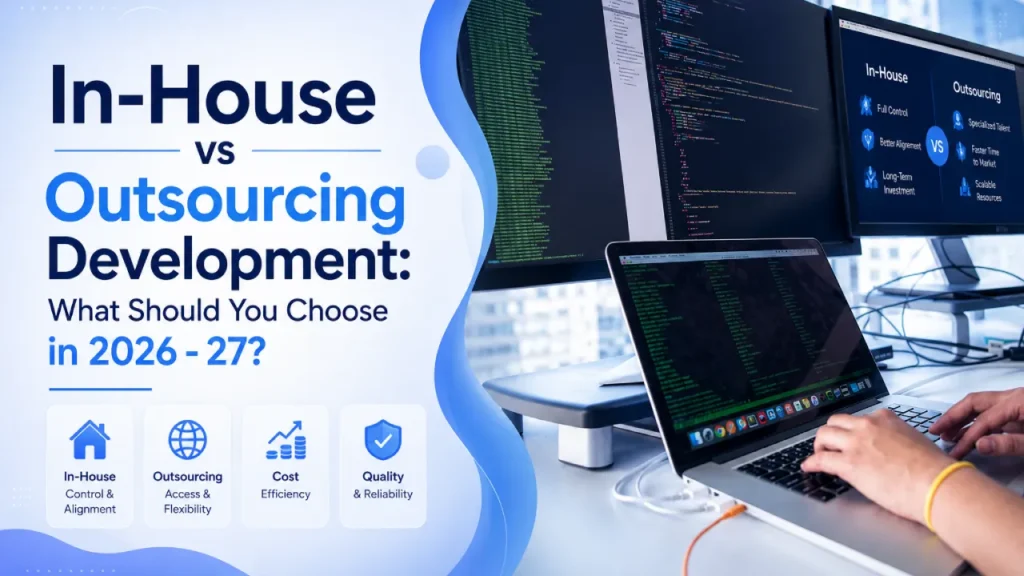
In-House vs Outsourcing Development: If you run a business today, you have probably asked yourself this question at least once. Maybe you are staring at a hiring budget that keeps growing. Maybe you have a product idea sitting on a whiteboard because you do not have the engineers to build it. Or maybe you already have an in-house team, but they are drowning, and every new feature takes three times longer than it should.
This is not a small decision. It affects your speed, your cost structure, and honestly, your sanity as a founder or a decision maker. At Cybertize Technologies, we have sat on both sides of this table. We have worked with startups building their first product and with enterprises trying to modernise systems that are older than some of their employees. So this is not theory. This is what we actually see happening in 2026.
Let us break it down properly, without the sales pitch.
In-House vs Outsourcing Development: What “In-House” Actually Means
In-house development means you hire engineers directly. They are on your payroll, they sit in your Slack channels every day, and they live and breathe your product roadmap. There is no translation layer between what you want and what gets built.
This works beautifully when:
- Your product is your core business, not a support function
- You are handling sensitive data where compliance cannot be outsourced casually
- You need people who understand your customers deeply, over years, not weeks
- You are building something so unique that hiring specialists for it makes more sense than training a vendor team
The catch is cost and time. Hiring a single senior developer in the US today can take anywhere from six to twelve weeks between sourcing, interviewing and closing. And that is before onboarding. You are also paying for benefits, equipment, office space if you have one, and the inevitable slow ramp-up period.
What “Outsourcing” Actually Means
Outsourcing means you bring in an external company or team to build software for you. This could be a full project handoff, a dedicated team working like an extension of yours, or specific specialists filling a skill gap you do not have internally.
The reasons companies choose this route have shifted a bit in the last couple of years. It used to be almost entirely about saving money. Now it is increasingly about accessing skills that simply are not available in-house, especially in AI, cloud-native architecture, and cybersecurity. According to Freshcode’s 2026 industry data, a large share of employers still cannot fill specialised technical roles domestically, and that gap takes years to close, not months.
The numbers on cost are hard to ignore too. Outsourcing firms report savings between 40 to 70 percent on total development cost compared to running an equivalent in-house team, largely driven by the difference in hourly rates between regions. A developer in the US typically costs between 100 to 150 dollars an hour, while the same skill level in India can run between 25 to 50 dollars an hour.
The Real Trade-Offs, Not the Textbook Ones
Every article on this topic gives you a generic pros and cons list. We want to give you the version that actually matters when you are making the call.
Speed to Market
If you need to launch in weeks, not months, outsourcing almost always wins. A good outsourcing partner already has the team assembled, the processes defined, and the tools ready. You are not starting from zero. Industry estimates put the time-to-market improvement from outsourcing at 30 to 50 percent compared to building an in-house team from scratch.
Cost Over Time
In-house looks expensive on paper and outsourcing looks cheap, but this flips depending on your timeline. For a long-term, five-plus year product that is central to your business, in-house often becomes more cost-effective once you account for onboarding, retraining vendors, and knowledge transfer friction. For a project with a defined scope and end date, outsourcing almost always wins on cost.
Control and Communication
This is where in-house genuinely shines. Your team is in the room. Decisions happen fast. There is no time zone gap, no waiting for a status update email. If your product requires constant, fast pivoting based on user feedback, having engineers who are fully embedded matters more than people usually admit.
Talent Access
Here is something most companies underestimate. Hiring AI or machine learning specialists domestically is brutally competitive right now, and salaries have climbed accordingly. Outsourcing opens the door to talent pools in regions like India, Eastern Europe and Latin America, where deep technical expertise exists at a fraction of the domestic cost. India alone accounts for more than half of the global software outsourcing market, backed by a workforce of over five million IT professionals.
The Boomerang Problem
Here is a fact that does not get talked about enough. A notable share of companies that outsourced work have brought it back in-house within the last five years. This usually happens when the outsourced relationship was treated as a one-time transaction instead of a real partnership, or when there was no proper knowledge transfer built into the contract. This is not an argument against outsourcing. It is an argument for choosing a partner who documents everything, communicates clearly, and treats your product like their own.
The Hybrid Model Is Winning in 2026
In-House vs Outsourcing Development: Here is the honest truth. Most companies are no longer picking a side. The dominant pattern we see now, and one supported by current industry data, is a hybrid approach. Core product architecture and business-critical decisions stay with a small in-house team, while execution capacity, specialised modules, QA, or scaling work gets outsourced to a trusted partner.
Think of it this way. A healthcare company might keep its patient-facing platform fully in-house because compliance and trust are non-negotiable, while outsourcing its analytics dashboard or reporting modules to free up internal bandwidth. A SaaS startup might outsource its MVP build entirely to move fast and validate the market, then hire an in-house team once product-market fit is proven and the roadmap becomes long-term.
Roughly two-thirds of companies today lean toward outsourcing significant parts of their development lifecycle, and Agile practices are now standard across both models, used by the vast majority of teams regardless of where the work is happening. AI and cloud-native demands are accelerating this shift further, with a large majority of new enterprise applications expected to include some form of AI functionality going forward.
So, Which One Should You Actually Choose?
We know you wanted a straight answer, so here it is, as straight as this decision allows.
Choose in-house if: software is your product, not a support function, you are handling highly sensitive data with strict compliance needs, and you have the runway to invest in hiring and retention over years, not months.
Choose outsourcing if: you need to move fast, you are validating an idea before committing to full-time hires, or you need specialised skills like AI, cloud architecture or cybersecurity that would take too long to build internally.
Choose hybrid if: you already have some internal capability but need extra hands for specific modules, peak workloads, or emerging technology projects, and you want to keep strategic control while adding execution speed.
In-House vs Outsourcing Development: At Cybertize Technologies, we do not push one model over another because it suits our business. We sit down, understand your product stage, your budget, and your timeline, and recommend what genuinely makes sense, even if that means telling you to hire in-house instead of working with us. That is the kind of honesty that builds long-term partnerships, and it is why our clients keep coming back for the next phase of their product, not just the first one.
If you are stuck weighing this decision right now, talk to us. We have built products both ways, and we can help you figure out which path actually fits where your business is today.
Written and researched by the team at Cybertize Technologies Private Limited, a software development and digital transformation company helping startups and enterprises build custom software, AI solutions, and scalable digital products.