Table of Contents
RAG vs Fine-Tuning: The Question That Decides More Than Model Choice
For a business leader evaluating or scaling an AI system in 2026, the most consequential architectural decision is rarely which model to deploy or which vendor to partner with. It is whether the system’s knowledge should live in retrieved documents or in the model’s own trained weights, RAG versus fine-tuning, and that decision shapes cost, accuracy, maintainability, and regulatory defensibility for years after it is made, far more durably than any specific model choice does.
At Cybertize Technologies, this is one of the first architectural conversations we have with any enterprise client building a serious AI product, and it deserves more rigor than the “just use RAG” or “just fine-tune” advice that circulates casually online. This report lays out the current benchmark data, the real cost curves at enterprise scale, and the hybrid pattern that has become standard practice in regulated industries specifically because neither approach alone proved sufficient.
Also Read: Choosing the Right AI Architecture for Your Startup | Complete Details
What Each Approach Actually Changes
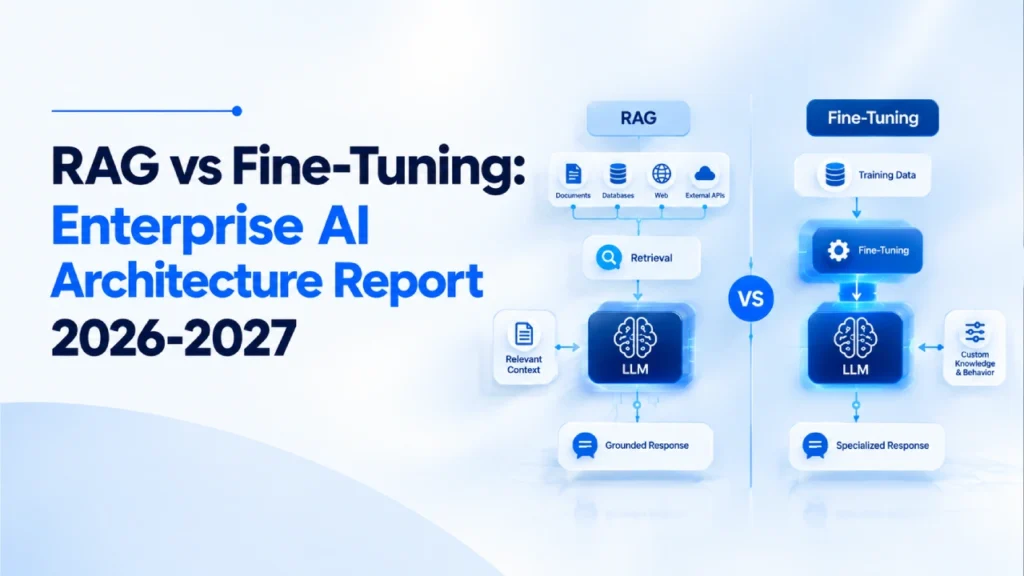
The core technical distinction is worth stating precisely before any comparison, because conflating the two leads directly to the most common and costly mistake in this space. RAG changes what a model retrieves, injecting external, current information into the model’s context at the moment of a query without altering the model itself. Fine-tuning changes how a model behaves, adjusting its internal weights through additional training so it defaults to a particular style, format, or reasoning pattern without needing that pattern explained in every prompt. One is a knowledge layer. The other is a behavior layer. Current technical guidance is blunt about the most common failure mode here: fine-tuning is not a search index, and teams that fine-tune specifically to fix a knowledge gap consistently find themselves repeating expensive training runs every time the underlying facts change, when RAG would have solved the same problem with a document update instead.
Enterprise Adoption: The Numbers stating RAG vs Fine-Tuning report
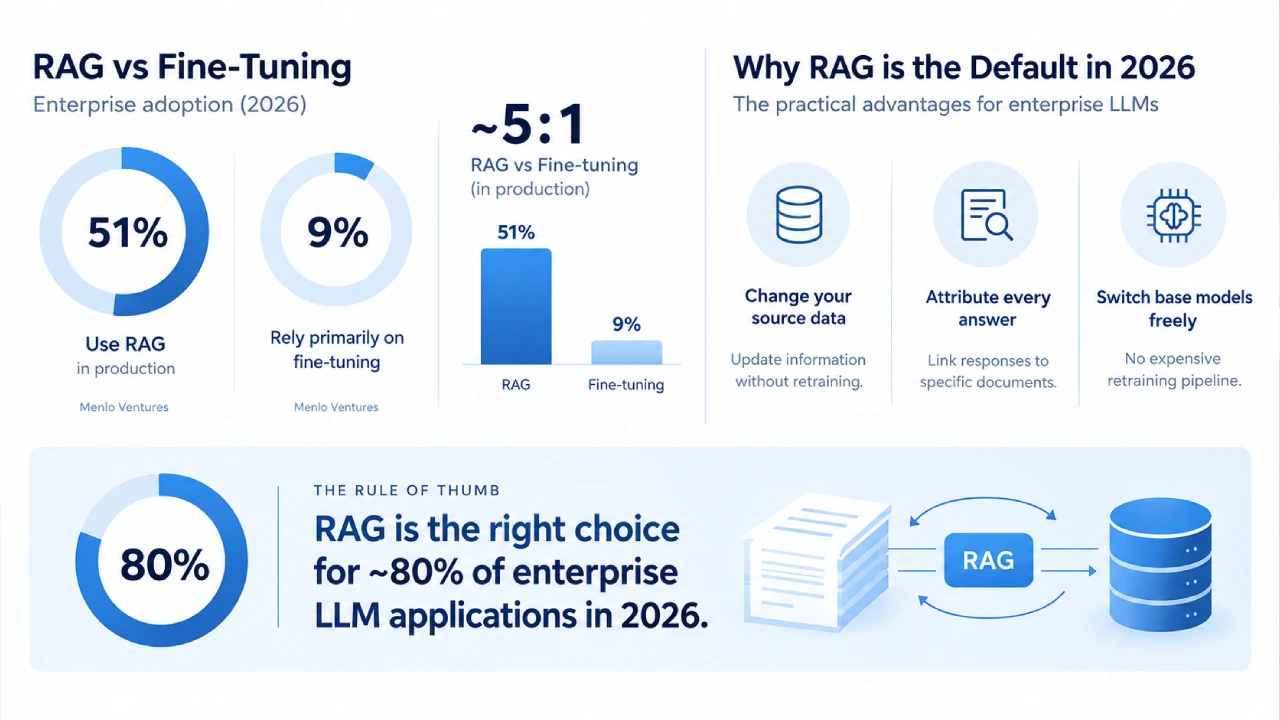
Menlo Ventures’ State of Generative AI in the Enterprise research found 51 percent of enterprise AI deployments use RAG in production, while only 9 percent rely primarily on fine-tuning, a roughly 5-to-1 imbalance that current 2026 technical guidance treats as the correct default rather than an accident of early tooling availability. Multiple independent sources converge on the same practical rule of thumb: RAG is the correct first choice for roughly 80 percent of enterprise LLM applications in 2026, specifically because it lets an organization change its source data without retraining, attribute every answer back to a specific document, and switch the underlying base model freely without re-running an expensive training pipeline.
Also Read: State of MCP Security 2026, Enterprise Risks, Vulnerabilities and Controls
The Accuracy and Hallucination Data
This is where the benchmark evidence is most clear-cut, and most enterprise decision-makers underweight it relative to the more intuitive-sounding “fine-tuning teaches the model more” argument. Stanford HAI’s 2025 evaluation across 12 enterprise knowledge tasks found RAG outperformed fine-tuned variants of the same underlying base model on factual recall by 28 to 41 percent, while reducing hallucination rates by roughly 35 percent, a substantial, reproducible gap rather than a marginal edge case finding. Separate production-focused analysis found that RAG implementations constrained by properly quality-thresholded retrieved documents can push hallucination rates below 2 percent, against fine-tuned models that, even when correct most of the time, tend to confidently generate plausible-sounding wrong answers specifically in the cases where their training data was thin.
Fine-tuning does retain a clear, specific advantage in one category worth stating directly: classification tasks requiring deep domain expertise, where the goal is consistent categorization behavior rather than open-ended factual recall. A controlled benchmark across Llama2-13B, GPT-3.5, and GPT-4 on an agriculture-domain dataset found a base model scoring 75 percent accuracy, fine-tuning alone lifting that roughly 6 percentage points, and a combined fine-tuning-plus-RAG approach adding a further 5 points on top, additive, separable gains rather than the two approaches competing for the same accuracy budget.
The Cost Math at Enterprise Scale
Cost is where the real-world decision usually gets made, and the honest answer depends heavily on query volume rather than favoring one approach universally. RAG’s cost profile scales with retrieval volume and context length, every query carries an embedding generation and retrieval cost on top of the base model call, typically a 1.3 to 1.8 times multiplier over a plain base-model call once embedding and retrieval latency are factored in, a far smaller penalty than the “RAG is expensive” narrative that has persisted since 2023 suggests. Fine-tuning shifts the cost structure the opposite direction, higher upfront investment in training and data preparation, but a stable, often lower per-query cost at genuinely high volume once that upfront cost is amortized.
A quantified decision framework referenced across multiple 2026 technical guides frames this directly by monthly query volume: below roughly 10 million queries a month, RAG is reliably cheaper. Between 10 and 50 million, the two approaches warrant a direct evaluation against the specific workload. Above 50 million, fine-tuning or a hybrid architecture typically wins on total cost of ownership. For most mid-sized enterprise deployments, which sit well below that 10 million monthly query threshold, RAG remains the cheaper option in practice regardless of which approach performs marginally better on a narrow benchmark.
| Query Volume (monthly) | Typical Winner on Cost |
|---|---|
| Under 10 million | RAG |
| 10-50 million | Evaluate both against specific workload |
| 50-100 million | Fine-tuning or hybrid |
| Over 100 million | Fine-tuning or hybrid |
One cost detail that gets underweighted in most comparisons: for fine-tuning projects specifically, data curation, not GPU training time, represents 60 to 70 percent of total project cost, far exceeding the compute spend itself. Teams budgeting a fine-tuning project around GPU hours alone are consistently the ones surprised by the real final invoice.
Also Read: AI Agent Development Report for Business Market & Technology 2026-2027
GraphRAG, Agentic RAG, and the New RAG Variants
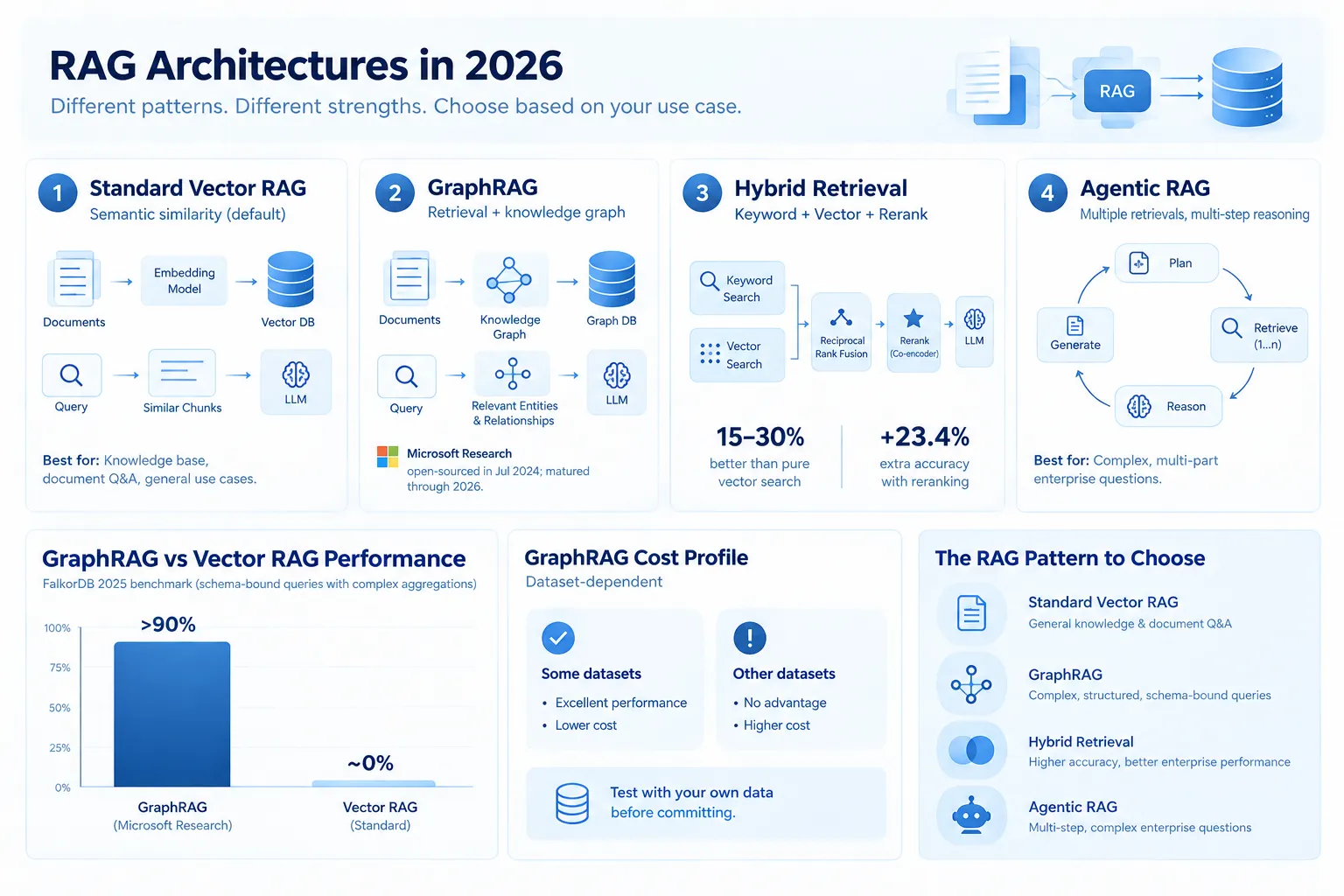
RAG vs Fine-Tuning: RAG itself has fragmented into several distinct architectural patterns through 2026, and choosing among them matters as much as choosing RAG over fine-tuning in the first place. Standard vector-based RAG, retrieving semantically similar text chunks, remains the default for most knowledge-base and document Q&A use cases. GraphRAG, which Microsoft Research open-sourced in July 2024 and which matured considerably through 2026, combines retrieval with a knowledge graph so the system retrieves structurally related information rather than just semantically similar text, and the performance gap on the right workload is dramatic: a 2025 FalkorDB benchmark found GraphRAG scoring over 90 percent accuracy on schema-bound queries involving complex aggregations, against near 0 percent for standard vector RAG on the identical task. That gap is not universal, however; GraphRAG’s own cost profile is dataset-dependent, performing excellently and cheaply on some document sets while showing no advantage, and meaningfully higher cost, on others, which makes workload-specific testing essential before committing to the architecture rather than assuming it universally outperforms simpler retrieval.
Hybrid retrieval, combining keyword and dense vector search merged through reciprocal rank fusion, outperforms pure vector search on enterprise tasks by 15 to 30 percent, and adding a cross-encoder reranking pass on top of that contributes a further 23.4 percent retrieval accuracy improvement, gains that compound with whichever base retrieval architecture an organization chooses rather than competing with it. Agentic RAG, where a system makes multiple retrieval calls across a multi-step reasoning loop rather than retrieving once per query, has emerged as the pattern of choice specifically for complex, multi-part enterprise questions that a single retrieval pass cannot adequately answer.
Does a Longer Context Window Replace RAG when comparing RAG vs Fine-Tuning?
This question comes up constantly given how far context windows have grown, and the honest 2026 answer is more nuanced than either “yes, long context wins” or “no, RAG is still essential” alone. For a genuinely bounded knowledge base, roughly 200,000 to 1 million tokens that rarely changes, long-context prompting combined with prompt caching has become cheaper than RAG in many 2026 deployments, since caching discounts on repeated prefix tokens commonly reach 90 percent. But three real problems persist even with frontier context windows exceeding a million tokens: per-token cost still scales linearly with context length regardless of caching discounts, latency increases meaningfully as context grows, and models continue to struggle finding specific relevant facts buried in the middle of a very long context, the well-documented “lost in the middle” problem. For large, frequently updated, or genuinely dynamic knowledge corpora, which describes the large majority of real enterprise use cases, RAG with precise, well-tuned retrieval continues to win on both cost and accuracy over simply stuffing an ever-larger context window.
The Hybrid Pattern: Where Production Systems Actually Land
The RAFT approach, Retrieval-Augmented Fine-Tuning, developed through research including work from UC Berkeley, demonstrated that hybrid systems combining retrieval and fine-tuning consistently outperform either approach in isolation across multiple benchmarks, and this is no longer a research curiosity. It is described across current enterprise guidance as the production standard specifically in regulated industries by 2026. The pattern works consistently across the sources reviewed for this report: fine-tune the base model for task-specific behavior, output format, domain reasoning style, consistent tone, then layer a RAG pipeline on top of that fine-tuned model for dynamic, current knowledge retrieval at inference time. This stacks the genuine strengths of each approach rather than forcing a tradeoff, live facts from retrieval, locked, consistent behavior from fine-tuning, and often meaningfully lower inference cost than a frontier general-purpose model would charge for the equivalent task, since a smaller, fine-tuned model handling a narrower job can frequently match a much larger model’s output quality on that specific task.
One widely cited 2025 benchmark study found a genuinely useful data point about how enterprise teams actually arrive at this hybrid pattern in practice: 78 percent of teams that initially fine-tuned switched to RAG within nine months once they hit a data-refresh problem fine-tuning could not solve, while the remaining 22 percent kept fine-tuning specifically for narrow behavior-shaping tasks that RAG genuinely cannot address on its own. That migration pattern, not a one-time upfront decision, is the realistic shape most enterprise AI architecture actually takes as it matures.
A Practical Decision Framework
Pull the data in this report into something directly usable and the decision collapses into a small number of concrete questions. If the knowledge your system needs is dynamic, proprietary, or larger than a practical context window, start with RAG, specifically hybrid retrieval with a reranker layered on top, since it delivers updates in minutes, citable sources for every answer, and zero retraining cost when the underlying facts change. If your knowledge base is genuinely bounded and stable, long-context prompting with prompt caching may now be cheaper than building a full RAG pipeline. If the model already gets the facts right but writes in the wrong voice, format, or structure, fine-tuning through a parameter-efficient method like LoRA or QLoRA is the right tool, since style, structure, and format adherence respond well to small, targeted training adapters in a way factual knowledge does not. If your workload involves genuinely multi-hop reasoning over entities and their relationships, “who did what, when, to whom,” GraphRAG is worth the additional build complexity specifically because flat vector search measurably fails at exactly this kind of query. And if you need both reliable knowledge grounding and strict, consistent behavior, which describes most serious regulated-industry production deployments, build the hybrid: fine-tune for behavior, retrieve for knowledge, and expect that combination to outperform either approach alone, consistent with every benchmark referenced in this report.
| Need | Recommended Approach |
|---|---|
| Dynamic, proprietary, or large knowledge base | RAG (hybrid retrieval + reranker) |
| Bounded knowledge under ~1M tokens, rarely changes | Long-context + prompt caching |
| Correct facts, wrong voice or format | Fine-tuning (LoRA / QLoRA) |
| Multi-hop reasoning over entities and relationships | GraphRAG |
| Knowledge grounding AND strict behavior | Hybrid (fine-tuned base + RAG) |
| Domain-specific classification tasks | Fine-tuning |
Concluding the RAG vs Fine-Tuning Report: What This Means Heading Into 2027
The data in this report supports a clear, if less dramatic, conclusion than either side of the RAG-versus-fine-tuning debate typically argues. RAG remains the correct default starting point for the large majority of enterprise AI applications in 2026, backed by real, reproducible accuracy and hallucination-reduction benchmarks, not just lower upfront cost. Fine-tuning retains a genuine, specific role, classification tasks, consistent behavior and format, narrow domain reasoning, that RAG cannot replicate on its own. And the architecture pattern increasingly defining serious, regulated-industry production systems heading into 2027 is neither approach alone, but the hybrid combination that uses each for what it is actually good at. Enterprises still treating this as a single binary choice, rather than a workload-specific architecture decision that may itself evolve as a product matures, are working from a framing the data no longer supports.
At Cybertize Technologies, this is exactly the evaluation we walk enterprise clients through before committing to an AI architecture, because the migration pattern in this report, the 78 percent of teams that fine-tuned first and added RAG later, is an expensive detour that a clear-eyed workload assessment up front can avoid entirely.
Cybertize Technologies Private Limited designs enterprise AI architecture based on workload-specific benchmark data, not a one-size-fits-all default, including hybrid RAG and fine-tuning systems for regulated industries.
Sources
- Menlo Ventures, State of Generative AI in the Enterprise Report
- Stanford HAI, 2025 evaluation of RAG versus fine-tuning across 12 enterprise knowledge tasks
- Actian, Should You Use RAG or Fine-Tune Your LLM?
- MetaCTO, RAG vs. Fine-Tuning vs. Other LLM Techniques: A 2026 Decision Guide
- Winder.AI, RAG vs Fine-Tuning in 2026: A Decision Framework for LLM Teams
- Kunal Ganglani, Fine-Tuning vs RAG vs Prompt Engineering: Decision Framework 2026
- SculptSoft, RAG vs. Fine-Tuning for Enterprise AI: The 2026 Decision Guide
- BelSoft Solutions, Fine-Tuning vs RAG: How Do You Choose the Right Architecture for Enterprise AI?
- Heym, RAG vs Fine-Tuning: When to Use Each in 2026, citing Galileo AI’s 2025 enterprise LLM benchmark report
- Tricky Wombat, RAG Beats Fine-Tuning for Most Enterprise Use Cases, citing FalkorDB’s 2025 GraphRAG benchmark and Microsoft Research’s GraphRAG release
- RAGLeap, RAG vs Fine-Tuning: What Actually Works for Business AI in 2026
- arXiv, RAGRouter-Bench: A Dataset and Benchmark for Adaptive RAG Routing
- UC Berkeley, RAFT: Retrieval-Augmented Fine-Tuning research