Our RAG Development Services:
1. Custom RAG Pipeline Development
End-to-end RAG architecture: document ingestion from PDFs, wikis, databases, and internal tools, chunking strategy suited to your actual content structure, embedding generation, vector storage, retrieval logic, and prompt engineering for the generation step, built around your specific data and use case rather than a generic LangChain tutorial pattern wired together and shipped as-is.
2. Enterprise Knowledge Base & Internal Search
RAG systems that let employees ask plain-English questions against internal documentation, policy manuals, technical wikis, and historical records, and get a grounded, cited answer instead of forty minutes searching across five different internal tools. This is currently the single largest RAG application category, accounting for roughly a third of enterprise RAG deployments.
3. RAG-Powered Customer Support & Chatbots
Customer-facing and internal support chatbots grounded in your actual product documentation, help center content, and support ticket history, so responses are accurate and specific rather than generic, with a clear fallback path to a human agent when the retrieved context genuinely doesn’t cover the question.
4. Vector Database Implementation
Architecture and implementation using Pinecone, Weaviate, Qdrant, Milvus, or pgvector for teams already on PostgreSQL, including index design, hybrid search (combining dense vector search with keyword/BM25 retrieval), and metadata filtering. Cloud-based vector infrastructure dominates current deployments at roughly 82% market share, and hybrid retrieval, combining semantic and keyword search, has become the standard architecture at around 55% adoption, because pure vector search alone consistently struggles with exact terminology, product codes, and domain-specific jargon.
5. Agentic RAG & Multi-Step Reasoning Systems
RAG systems extended with agentic capability: multi-step retrieval where the system decides it needs more context before answering, tool use for calling internal APIs or running calculations, and query decomposition for complex questions that a single retrieval pass can’t answer well.
6. Graph RAG & Knowledge Graph-Augmented Retrieval
For domains where relationships between entities matter as much as the raw text (legal case law, regulatory compliance, complex product catalogs), we implement Graph RAG architectures that combine vector retrieval with a structured knowledge graph, improving accuracy on multi-hop questions that pure vector similarity search handles poorly.
7. Multimodal RAG
Retrieval systems that work across text, images, tables, and scanned PDFs, using multimodal embeddings so a system can answer questions that require pulling information out of a chart, a scanned form, or a technical diagram, not just plain text paragraphs.
8. RAG Evaluation & Accuracy Optimization
Building the evaluation harness most RAG deployments skip: retrieval precision and recall measurement, hallucination and faithfulness scoring, and systematic testing against real user questions, since a large majority of RAG quality failures in production trace back to unmeasured retrieval problems (bad chunking, duplicate or stale content, missing metadata) rather than the underlying language model.
9. RAG Security, Access Control & Data Governance
Document-level and field-level access control so a RAG system never retrieves and surfaces information a specific user isn’t authorized to see, PII detection and redaction in retrieved content, and audit logging for regulated industries where “the AI showed the wrong person the wrong data” is a compliance incident, not just a bug.
10. RAG vs. Fine-Tuning Strategy Consulting
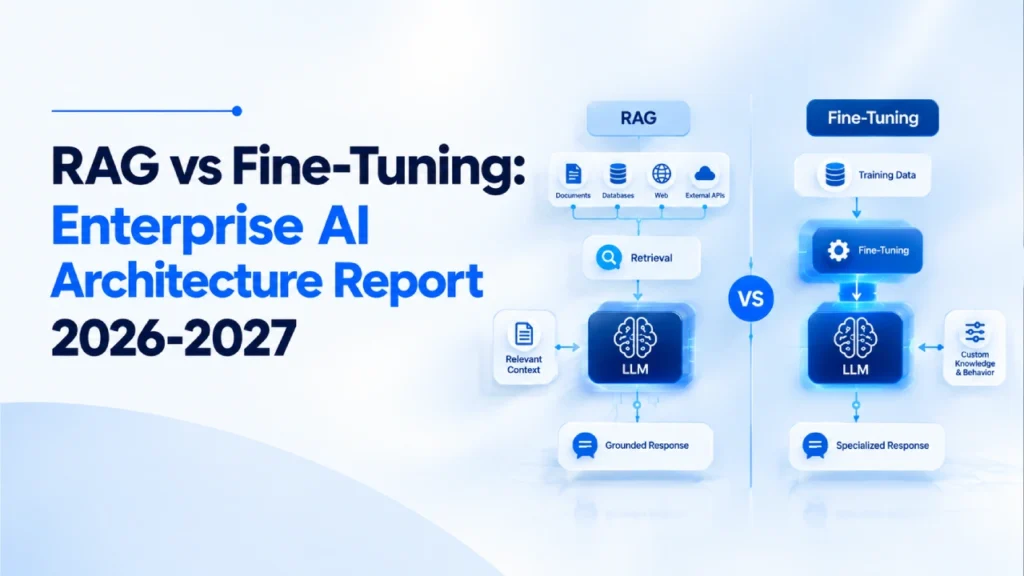
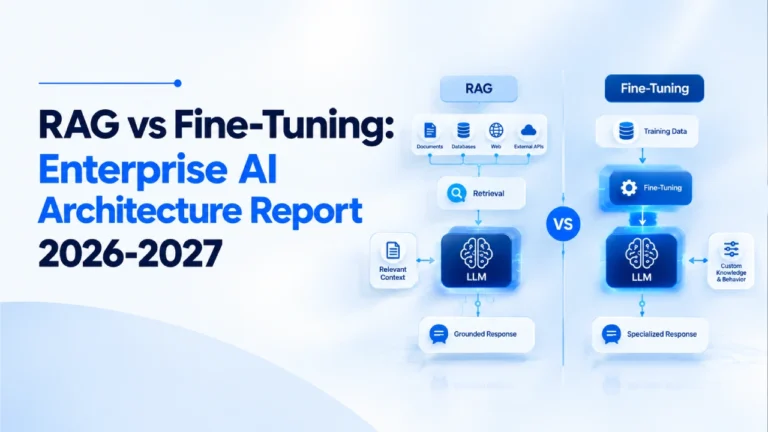
Honest technical advisory on when RAG is the right architecture versus when fine-tuning, or a combination of both, better fits your actual problem. RAG is almost always the faster, cheaper, more maintainable choice for knowledge that changes over time; fine-tuning has a narrower, specific role for teaching a model a style, format, or specialized behavior rather than facts.
11. RAG Integration With Existing Systems
Connecting RAG pipelines to your CRM, ERP, ticketing system, or internal tools via API, so retrieval draws on live operational data, not just a static document dump that goes stale the week after launch.
12. Managed RAG & MLOps Support
Ongoing pipeline monitoring, embedding model updates, retrieval quality tracking, and index maintenance as your document corpus grows and changes, since a RAG system’s accuracy degrades quietly over time without active maintenance, in ways that are easy to miss until users stop trusting the answers.
Hire RAG Developers: Engagement Models
Hire Dedicated RAG Developers
Add one or more RAG developers or ML engineers to your team on an ongoing basis, working under your direction as an extension of your engineering team, for businesses building RAG capability as a core, continuously evolving product feature.
RAG Proof-of-Concept & Pilot
A time-boxed engagement to build a working RAG prototype against a representative slice of your actual data, so you can validate accuracy and feasibility before committing budget to a full production build. Most of our new RAG engagements start here, deliberately, because retrieval quality on your specific data is something you have to actually test, not something we can promise in a proposal.
Outsource RAG Development (Fixed-Scope Project)
Full ownership of design, development, and deployment for a defined RAG system, the right model when the use case and data sources are well understood and you need a production system delivered on a fixed timeline.
RAG Development Company as Ongoing AI Partner
For organizations planning to expand RAG across multiple internal and customer-facing use cases over time, we operate as a continuous AI development partner, covering new use cases, evaluation, and infrastructure scaling under one relationship rather than restarting vendor selection for every new project.
Where RAG Systems Actually Fail (And How We Plan Around It)
Naive chunking that destroys context. Splitting documents into fixed-size chunks without respecting semantic boundaries is one of the most common, and most fixable, sources of poor retrieval quality. We design chunking strategy around your actual document structure, not a default chunk size copied from a tutorial.
Retrieval that looks fine in a demo and falls apart on real questions. A RAG system tested only on the questions the team already knows the answer to will look deceptively good. We build evaluation sets from real, messy user questions before calling anything production-ready.
Stale or duplicate content confusing the retriever. Outdated documents, near-duplicate versions of the same policy, and missing metadata all degrade retrieval accuracy in ways that are hard to notice until a user gets a confidently wrong answer. We build content hygiene and metadata filtering into the pipeline rather than treating the document corpus as a fixed, static input.
Hallucination that retrieval alone doesn’t fully solve. Grounding a model in retrieved context reduces hallucination significantly but doesn’t eliminate it if the generation step isn’t explicitly constrained to cite and stay within the retrieved material. We design prompts and, where needed, output verification specifically to catch and reduce this.
Vector database costs that scale faster than anyone expected. Embedding and storing large document corpora at scale carries real infrastructure cost. We architect for this upfront, including when a smaller, well-tuned model and index is genuinely a better choice than the largest, most expensive option available.
No plan for what happens when retrieval finds nothing relevant. A RAG system that generates a fluent answer even when nothing relevant was retrieved is often worse than a system that says “I don’t have information on that.” We build explicit low-confidence fallback behavior into every RAG system we ship.
How We Work: Engagement Pricing
Engagements are quoted in INR for Indian entities and USD for US and UAE clients, scoped after understanding your data sources, expected query volume, and accuracy requirements. A proof-of-concept against a single document set is a materially smaller engagement than a production, multi-source enterprise knowledge assistant with access control and ongoing evaluation, and we scope accordingly rather than quoting a flat “AI chatbot” rate that doesn’t reflect either.
Why Cybertize Technologies is a Leading RAG Development Agency in India, USA, UK, UAE:
We build the full stack the RAG system has to live inside. Because Cybertize also delivers Node.js, Next.js, and backend API development, we design RAG systems that integrate cleanly into your actual product and infrastructure, rather than handing over a standalone prototype your engineering team has to figure out how to wire in themselves.
We test on your data before we promise an outcome. Retrieval quality depends entirely on your specific documents and questions, which is why most of our RAG engagements start with a proof-of-concept against real data rather than a confident upfront promise about accuracy we haven’t actually verified.
We treat evaluation as core deliverable, not an afterthought. Given that a large share of RAG quality problems trace back to unmeasured retrieval issues rather than the underlying model, every production RAG system we ship includes an evaluation framework, not just a working demo.
Presence across India, the US, and UAE. With teams operating out of Delhi, Mumbai, Gujarat, Indore, and Bangalore, alongside a US presence, we support overlapping working hours for Indian and North American clients, and UAE-based engagements benefit from that same cross-market experience.
Honest about RAG’s limits. We’ll tell you when fine-tuning, a simpler search solution, or no AI system at all is genuinely the better answer to your problem, rather than defaulting to the engagement that’s larger for us.
Start With a Proof-of-Concept, Not a Leap of Faith
Retrieval quality depends on your actual documents and questions, not a generic demo. The most reliable way to know if RAG will genuinely work for your use case is to test it against a real slice of your data before committing to a full build.
[Hire RAG Developers →]