Table of Contents
Why Most Framework Comparisons Get This Wrong
Mobile App Development Trends: Search “Flutter vs React Native” right now and you will find dozens of confident, contradictory answers, and a genuinely useful piece of research from Quash’s 2026 analysis explains exactly why. GitHub stars get presented as market share. npm download counts get treated as a proxy for unique developers. A 2023 Statista developer survey statistic keeps getting relabelled as 2025 or 2026 data without anyone checking the original publication date. Appfigures’ own framework-detection data found React Native had greater presence and more estimated downloads and revenue among the top 10,000 iOS apps, while a separate analysis of newly released apps in the same period found Flutter leading, two genuinely different, non-comparable datasets that get flattened into a single misleading headline constantly.
At Cybertize Technologies, we build native and cross-platform apps for clients across React Native, Flutter, Swift, and Kotlin, and this report is written the way we actually approach a stack decision with a client: with the real, current technical state of each option, honest tradeoffs, and current market data clearly sourced rather than recycled from an outdated survey. This is the complete picture heading into 2027, covering every major path a mobile team can take.
The Mobile App Development in 2026-2027
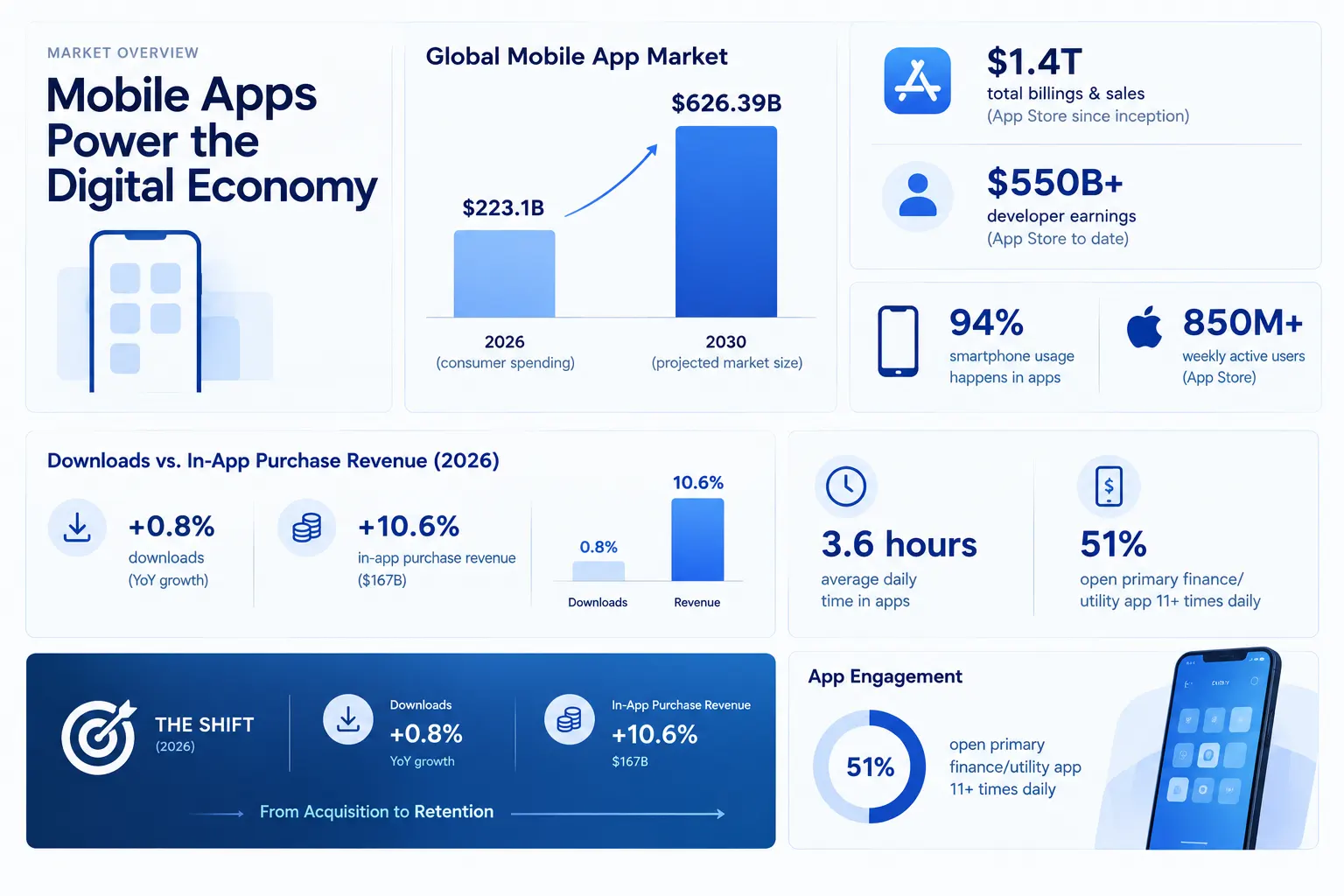
The global mobile application market is on track to reach 626.39 billion dollars by 2030, with 2026 consumer spending alone reaching roughly 223.1 billion dollars including games, and the App Store ecosystem specifically facilitating 1.4 trillion dollars in total billings and sales since its founding, with developers having earned over 550 billion dollars on the platform to date. Ninety-four percent of all smartphone usage now happens inside apps rather than the mobile web, and Apple’s App Store alone reports over 850 million weekly active users.
The more interesting shift for 2026-2027 is not growth, it is where that growth is coming from. Sensor Tower’s 2026 State of Mobile report found downloads grew just 0.8 percent year over year while in-app purchase revenue surged 10.6 percent to 167 billion dollars, a clear signal that the market has moved from an acquisition-first mindset toward retention, engagement depth, and monetization efficiency. Consumers now spend an average of 3.6 hours a day inside mobile apps, and 51 percent of global smartphone users open their primary financial or utility app 11 or more times daily, the kind of engagement intensity that makes technical decisions like framework choice and app performance a genuine business metric, not just an engineering preference.
Native iOS Development: Swift in 2026
Swift remains the only serious choice for native iOS development, but what “native iOS” actually means technically has shifted meaningfully. SwiftUI, Apple’s declarative UI framework, has become the primary layer for new development, with 57 percent of iOS developers now building primarily in SwiftUI and only 22 percent relying on a hybrid approach mixing it with the older UIKit framework. Native iOS development in 2026 specifically means Swift 6 with compile-time data-race safety built directly into the language, the Observation framework handling state management, Live Activities through ActivityKit for real-time lock-screen updates, on-device Apple Intelligence and Foundation Models accessed through App Intents, and passkey authentication through AuthenticationServices, all running against iOS 26 as the current target platform.
Also Read:
SaaS UX Benchmark Report 2026-2027: The UX Trends Shaping Navigation, Onboarding & AI Copilots
That list matters for a reason beyond technical trivia. Every item on it represents a capability that is either unavailable or significantly harder to access from a cross-platform framework, which is exactly why the native-versus-cross-platform decision in 2026 increasingly comes down to a specific question: does your app’s core value depend on deep platform integration, on-device AI reasoning through Apple’s own models, sophisticated background processing, specialized sensor access, or is its interface fundamentally lists, detail pages, and forms that render identically regardless of the underlying framework. For the second category, which covers the large majority of business apps, Swift’s technical depth is more capability than most products actually need to pay for in development time.
Native Android Development: Kotlin and the End of the Java Era
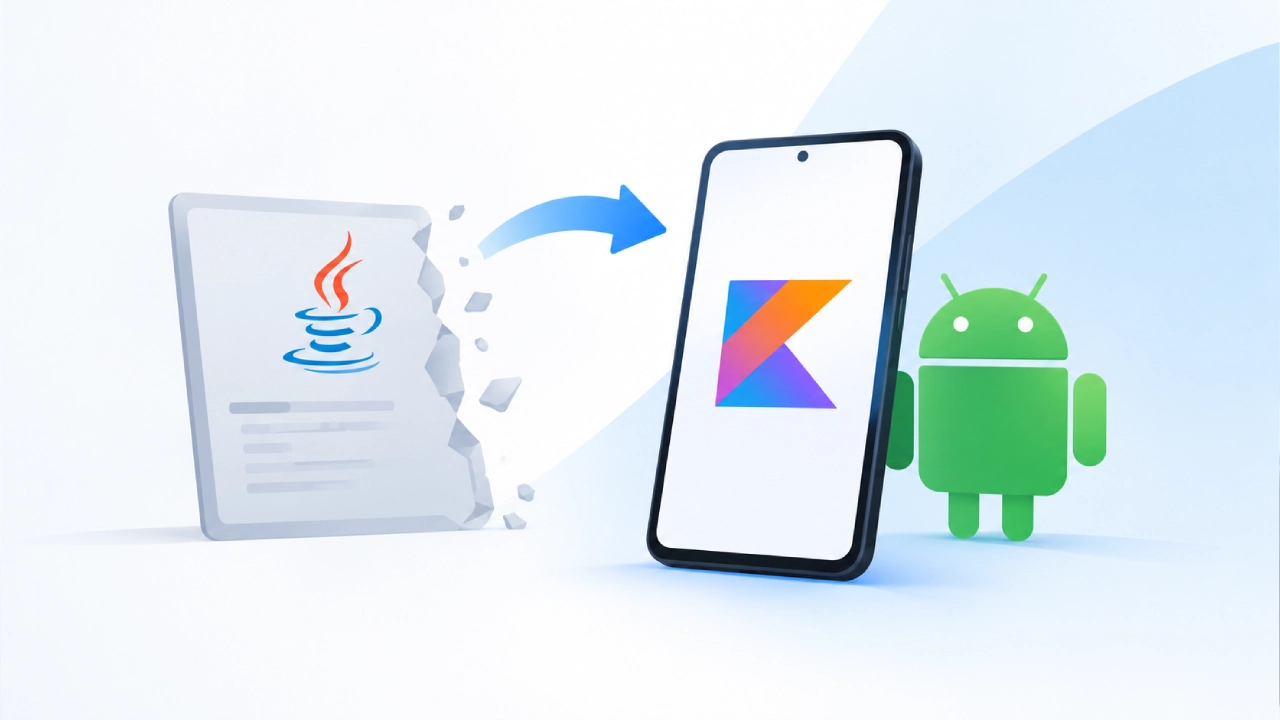
The Java-to-Kotlin transition on Android is no longer a transition. It is complete. Over 95 percent of the top 1,000 Android applications now use Kotlin natively in their codebase, and Kotlin has been Google’s officially preferred language for Android development for several years running. Java remains present primarily in legacy codebases and in specific enterprise contexts where an existing Java backend team extends naturally into Android work, but for any new native Android project in 2026, choosing Java over Kotlin has become close to indefensible from a pure technical standpoint, given Kotlin’s null-safety guarantees, more concise syntax, and full first-party support from Google’s own Android toolchain, including Jetpack Compose, Android’s own declarative UI framework and the direct counterpart to SwiftUI on the Android side.
The more forward-looking development on the Android side is Kotlin Multiplatform, commonly abbreviated KMP, which reached production stability in November 2023 and has continued maturing through 2026 as a genuine third path between fully native and fully cross-platform. KMP lets a team write shared business logic, networking, data models, core application rules, once in Kotlin, while still building fully native UI layers in SwiftUI on iOS and Jetpack Compose on Android. For teams that want native-quality interface polish without maintaining two completely separate business logic implementations, KMP has become, as one 2026 technical guide put it, the hybrid option that does not feel like a compromise, a meaningfully different value proposition than either fully native or fully cross-platform development.
Cross-Platform Development: React Native in 2026
React Native remains the framework most JavaScript and web-background teams reach for first, and its ecosystem momentum in 2026 is genuinely substantial: its core open-source package records up to 10.3 million downloads a week, and React Native 0.87, released August 11, 2026, pushed the framework’s minimum tooling requirements forward to Node.js 22, Android Gradle Plugin 9, and Kotlin 2.0 or higher, with version 0.87.1 as the latest stable release as of late September 2026 and 0.88 in release-candidate testing ahead of a planned October 2026 launch.
React Native’s clearest strength remains team fit. For an organization with an existing React or JavaScript engineering team, React Native lets that team’s existing skills transfer directly into mobile work without a separate hiring track or a lengthy new-language ramp-up period. Independent performance benchmarking puts React Native at roughly 94 percent of native performance for typical business application workloads, a gap that is genuinely imperceptible to end users for the large majority of app categories, list-based interfaces, forms, content consumption, standard e-commerce flows, though it remains a real, measurable gap for graphically intensive or animation-heavy applications specifically.
Cross-Platform Development: Flutter in 2026
Flutter has pulled meaningfully ahead of React Native on developer adoption specifically, holding roughly 46 percent of cross-platform developer share against React Native’s 35 to 38 percent according to the most-cited current benchmarks, though it is worth repeating the caution from earlier in this report: this specific 46-versus-35 figure traces back to a 2023 Statista developer survey, still the most commonly cited data point in current 2026 articles, and should be read as a directionally useful but aging benchmark rather than a live, continuously updated measurement.
What has genuinely moved in 2026 is Flutter’s own technical maturity. Google shipped three stable Flutter releases through the year, 3.41.9 in April, 3.44 at Google I/O in May with Hybrid Composition++ and SwiftPM as the default iOS and macOS build system, and 3.47 in August, which made Impeller, Flutter’s modern rendering engine, the default on desktop platforms as well as mobile. Dart, Flutter’s underlying language, reached version 3.13.4 in September 2026, introducing primary constructors on top of the Dart 3.5 foundation most production Flutter apps still target. Independent performance benchmarking places Flutter at roughly 97 percent of native performance, edging out React Native specifically on animation-heavy and custom-rendering workloads, a direct consequence of Flutter’s architecture, which draws its own UI directly rather than bridging to native platform components the way React Native does.
Flutter’s other genuine structural advantage is platform reach beyond mobile. A single Flutter codebase can target mobile, web, and desktop simultaneously, which is increasingly relevant for products that need a consistent experience across a phone app, a desktop companion tool, and a web dashboard without maintaining three separate frontend codebases.
Choosing the Right Stack: A Practical Framework
Cut through the framework-war noise and the actual decision collapses into a small number of concrete questions, consistent with how current technical guidance across the industry frames it. If the app’s core interface is lists, detail pages, forms, and standard content flows, and both platforms carry roughly equal business weight, cross-platform, either Flutter or React Native, is very likely the right call, and the choice between those two comes down largely to existing team skill, React Native for a JavaScript-native team, Flutter for a team willing to invest in Dart or building from scratch, plus how much the product benefits from Flutter’s additional web and desktop reach. If the product straddles genuinely different needs on each platform, or needs shared business logic with fully native UI polish on both, Kotlin Multiplatform paired with SwiftUI and Jetpack Compose, or a native iOS build alongside a Flutter Android build, is the hybrid path that avoids feeling like a compromise on either side. And if the product’s core value proposition genuinely depends on deep platform-specific capability, advanced AR, specialized hardware access, on-device AI reasoning through Apple’s Foundation Models, background processing intensity beyond what cross-platform frameworks comfortably support, full native development remains the right call regardless of the additional cost and dual-codebase overhead.
| Stack | Best fit | Approx. performance vs. native |
|---|---|---|
| Native (Swift / Kotlin) | Deep platform integration, AR, on-device AI, gaming, trading apps | 100% (baseline) |
| Flutter | Startups, fast iteration, pixel-perfect UI, web/desktop reach | ~97% |
| Kotlin Multiplatform | Shared logic with fully native UI on both platforms | ~99% for shared logic |
| React Native | Existing JavaScript/React teams, web-like component reuse | ~94% |
| Progressive Web App | Content-forward apps, install-friction-sensitive products | ~85-95% |
The Progressive Web App Question
Progressive web apps deserve a place in this report specifically because the 2026 conversation around them has shifted meaningfully from “an inferior fallback” to “the right default for a genuine majority of business apps.” For most business applications without a hard requirement for deep hardware access, advanced camera control, Bluetooth Low Energy, or true AR capability, PWAs now deliver 85 to 95 percent of native performance at a meaningfully lower development and maintenance cost, since a single web-standard codebase avoids the dual release cycles, dual app store submission processes, and dual testing regimes native or even cross-platform mobile development still requires. Spotify’s own PWA launch produced a 73 percent rise in premium subscriptions, a concrete data point worth noting alongside the more commonly cited concern that install friction, requiring a full app store download before a user experiences any value, measurably suppresses conversion for exactly the kind of content-forward or transactional apps PWAs suit best.
The honest caveat, consistent with the native-versus-cross-platform framework above, is the same: PWAs are not a universal replacement. Deep hardware integration, persistent background sensor access, and the kind of agentic AI systems that need OS-level permissions to act on a user’s behalf on their own initiative still clearly favor native development, which is precisely why companies like Amazon and TikTok remain native, deliberately rather than by oversight.
AI-Native and Agentic Apps
This is the single biggest structural shift in mobile development heading into 2027, and it changes the stack conversation in a specific, useful way. An AI agent inside a mobile app does not just answer a question, it plans a multi-step task, selects and calls appropriate tools and APIs, executes actions, and adapts based on results, the same reasoning-and-execution loop increasingly common in enterprise software now arriving inside consumer and business mobile apps directly. A meeting-assistant agent that transcribes a call, identifies action items, creates calendar events, and sends follow-up emails from a single user command is a concrete, already-shipping example of this pattern, not a hypothetical.
The practical implication for framework choice is genuinely counterintuitive to how mobile development used to be reasoned about. For AI-native apps specifically, cross-platform is increasingly the default choice precisely because the AI reasoning logic, not the native UI layer, is the actual differentiator and source of competitive advantage. A beautifully native interface wrapped around a thin, undifferentiated call to a commodity foundation model API provides little durable advantage, since as foundation models improve and API prices continue falling, that “AI wrapper” becomes increasingly indistinguishable from a dozen competitors renting the same underlying model. The more durable AI-native approach, the one current analysis points to as actually building a defensible product, uses ongoing user interaction data to refine a more specialized layer on top of a foundation model, creating a genuine improvement flywheel rather than a static feature. Duolingo is the most commonly cited example of this pattern executed well.
Also Read:
AI Agent Development Guide for Businesses: Avoid Costly AI Mistakes in 2026–2027
App Monetization Trends
Monetization strategy has consolidated around a clear pattern in 2026: over 60 percent of top-grossing apps now use hybrid monetization, combining subscriptions, in-app purchases, and advertising within a single app rather than betting on one revenue model exclusively. This shift followed directly from Apple’s App Tracking Transparency framework materially reducing mobile advertising’s targeting precision, pushing developers to diversify revenue across multiple mechanisms rather than relying heavily on advertising alone. Web-to-app billing has also emerged as a specific, measurable cost lever, offering margin improvements of 25 percent or more compared to routing every transaction through App Store or Play Store commission structures, which typically run 15 to 30 percent against a web transaction’s roughly 2.9 percent plus a small fixed fee.
Cost Benchmarks, Global and India
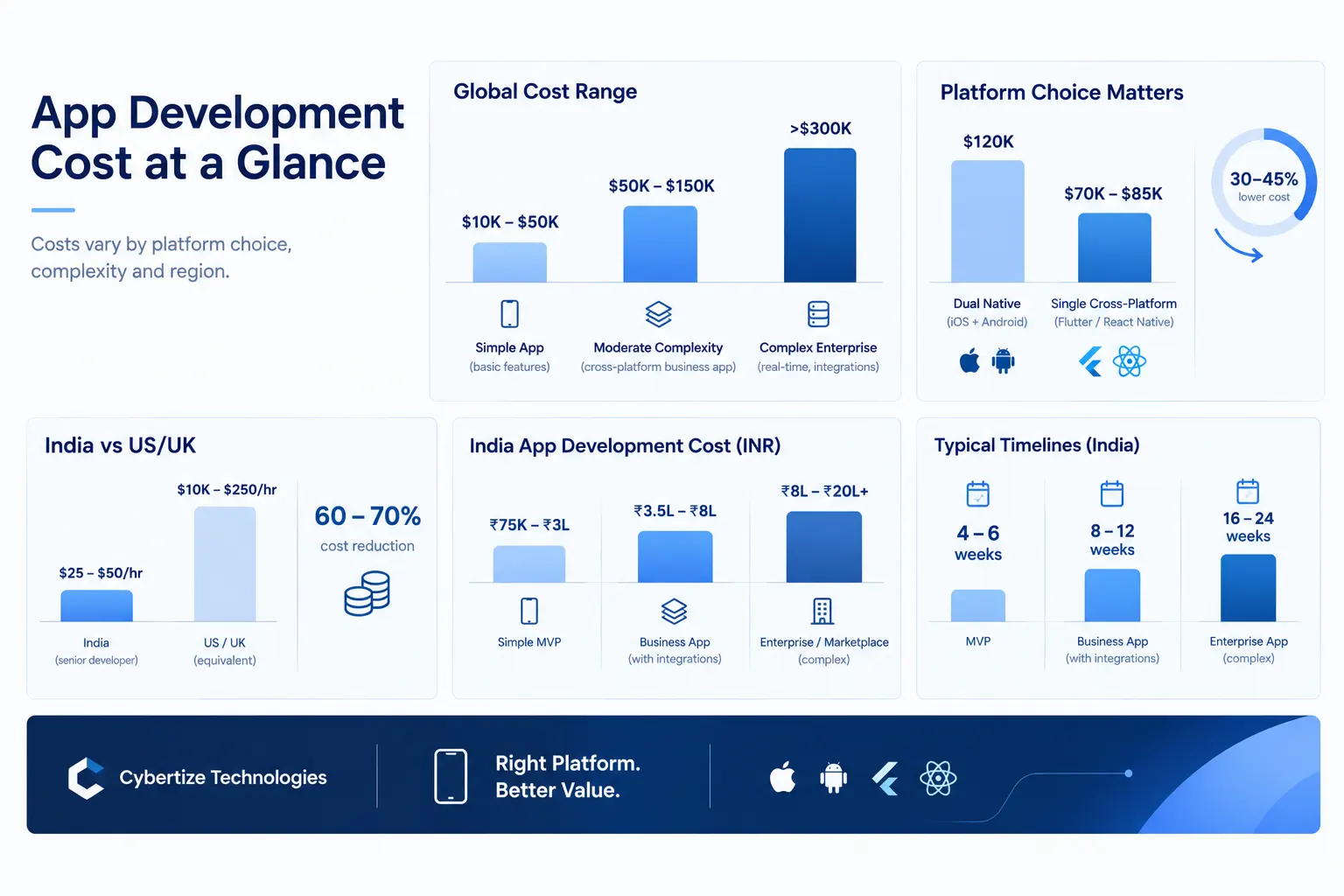
Cost is the number every founder and business leader wants most precisely, and the honest range depends heavily on platform choice and complexity rather than any single figure. Globally, a simple app typically starts around 10,000 to 50,000 dollars, a moderate-complexity cross-platform business app commonly falls between 50,000 and 150,000 dollars, and a complex enterprise application with real-time data, custom backend systems, and advanced integrations can exceed 300,000 dollars. Platform choice remains the single biggest lever on that budget: building separate native iOS and Android apps roughly doubles frontend engineering work compared to a single cross-platform codebase, commonly turning a 120,000 dollar dual-native budget into 70,000 to 85,000 dollars as a single Flutter or React Native build, a 30 to 45 percent reduction that holds consistently across current industry cost guides.
For a company like Cybertize Technologies operating inside the Indian market, the specific India cost data matters directly. App development in India typically runs 10,000 to 300,000-plus dollars depending on complexity, a 60 to 70 percent reduction compared to equivalent US or UK teams, driven by real rate differences: senior Indian developers at established agencies typically bill 25 to 50 dollars an hour, against 100 to 250 dollars an hour for equivalent US talent, a gap reflecting genuine cost-of-living and infrastructure cost differences rather than a difference in code quality or delivery standards. In rupee terms, a simple MVP typically runs 75,000 to 3,00,000 rupees, a medium-complexity cross-platform business app with real API integrations runs 3,50,000 to 8,00,000 rupees, and a complex enterprise or marketplace app runs 8,00,000 to 20,00,000-plus rupees. Timelines follow a similar scaling pattern: a simple MVP typically ships in 4 to 6 weeks, a business app with integrations in 8 to 12 weeks, and a complex enterprise build in 16 to 24 weeks.
Hidden costs matter as much in mobile development as in any other software category covered in this kind of benchmark. Annual maintenance typically runs 15 to 25 percent of original build cost, and Apple Developer Program and Google Play Console fees, backend hosting, and third-party API subscriptions all add real, recurring cost that a first proposal frequently understates or leaves out entirely.
What This Means Heading Into 2027
Pull the technical, market, and cost data in this report together and a few conclusions hold consistently. The framework war between Flutter and React Native is real but measured badly across most public comparisons, and the actual right choice depends far more on existing team skill and specific platform-reach needs than on whichever framework currently has the louder online community. Native development, Swift and Kotlin, remains clearly justified specifically where deep platform integration, on-device AI, or hardware-specific capability is the actual product differentiator, not a default for every app regardless of what it does. Kotlin Multiplatform has matured into a genuine third option worth serious consideration for teams that want native UI polish without maintaining two fully separate application cores. AI-native and agentic capability is reshaping which stack makes sense in a genuinely new way, favoring cross-platform for most AI-driven products since the differentiator lives in the reasoning layer, not the native shell around it. And cost planning, in India as much as anywhere else, needs to account honestly for the full lifecycle, build, App Store and Play Store fees, hosting, and 15 to 25 percent annual maintenance, not just the initial development quote.
At Cybertize Technologies, this is exactly the discipline we bring to every mobile engagement, choosing Swift, Kotlin, Flutter, React Native, or Kotlin Multiplatform based on what a specific product actually needs, backed by current data rather than whichever framework happens to be trending on a given week’s technology roundup.
Cybertize Technologies Private Limited builds native and cross-platform mobile apps across Swift, Kotlin, Flutter, and React Native, choosing the right stack based on what each specific product actually needs.
Sources
- CMARIX, 80+ Essential Mobile App Development Statistics for 2026-27
- TechAhead, Flutter vs React Native in 2026: The Ultimate Showdown for App Development Dominance
- Forasoft, Native vs Cross-Platform App Development in 2026
- AleaIT Solutions, 31+ Best Mobile App Development Frameworks in 2026
- Tech-Insider, Flutter vs React Native: 46% vs 35% Market Share [2026]
- RipenApps, Cross-Platform App Development Statistics: Trends and Market Growth
- Quash, Flutter vs React Native Statistics 2026: Adoption, GitHub, Jobs, Downloads and Developer Survey Data
- EasyComm, Mobile App Development Trends 2026: Tools, Tips and Verdicts
- Gitnux, Mobile App Industry: 2026 Verified Stats and Trends
- GetPanto, Mobile App Statistics 2026: Users, Downloads and Revenue
- Sensor Tower, 2026 State of Mobile Report
- Instinctools, Progressive Web Apps vs Native: PWA Pros and Cons Compared
- SoftwareOrbits, The Future of App Development in 2026
- Foresight Mobile, Mobile App Economy 2026: Monetisation, AI and Foldable Trends
- Progriso, Mobile App Trends 2026: Top 12 Technologies and Features to Watch
- Particle41, Should You Build a Native Mobile App or a Progressive Web App in 2026?
- YouWare, Mobile App Development Trends in 2026
- Solguruz, App Development Cost in India 2026: Full Guide
- Unico Connect, Mobile App Development Cost 2026, Guide and Calculator
- Nevatrix, Mobile App Development Cost in India 2026: Full Pricing Guide
- CodeXcelerate, Mobile App Development Cost in 2026: India Rates, US Rates and Full Breakdown