Table of Contents
MCP Adoption: How MCP Became Infrastructure This Fast
In November 2024, Anthropic released the Model Context Protocol as an open standard for connecting AI assistants to external tools and data, with roughly 100,000 SDK downloads in its first month. Growth from there was not organic luck. It followed a deliberate sequence of adoption decisions by the industry’s largest players: OpenAI adopted MCP in March 2025, Microsoft in July 2025, AWS in November 2025, and in December 2025 Anthropic transferred MCP’s governance to the Linux Foundation, with Anthropic, Block, and OpenAI as founding contributors and Google, Microsoft, AWS, and Cloudflare holding platinum member seats. Each step addressed a specific enterprise hesitation. OpenAI’s adoption proved MCP was not proprietary lock-in. Microsoft’s integration made it enterprise-credible. AWS’s support satisfied compliance teams. Linux Foundation governance removed the single-vendor risk that had made procurement teams nervous.
By March 2026, that sequence had produced 97 million combined monthly SDK downloads across Python and TypeScript, more than 81,000 GitHub stars on the core repository, and first-party MCP support documented across Anthropic, OpenAI, Google, Microsoft, GitHub, Vercel, VS Code, Cursor, and ChatGPT. MCP now has 58 active maintainers and over 2,900 community contributors, a governance structure that increasingly resembles the Cloud Native Computing Foundation, the body behind Kubernetes, rather than a single company’s product.
MCP Adoption Growth Timeline
| Milestone | Date | Figure |
|---|---|---|
| MCP launch | November 2024 | ~100,000 monthly SDK downloads |
| OpenAI adoption | March 2025 | Signals non-proprietary standard |
| Microsoft adoption | July 2025 | Enterprise credibility established |
| AWS adoption | November 2025 | Compliance teams satisfied |
| Linux Foundation governance transfer | December 2025 | Single-vendor risk removed |
| Combined SDK downloads | March 2026 | 97 million per month |
| GitHub repositories tagged mcp-server | May 2026 | 15,926 repositories |
| Core servers repository | May 2026 | 86,148 stars, 10,799 forks |
| Enterprise auth layer standardized | 2026 | OAuth, RBAC, audit logging added |
Registry-indexed public MCP servers now range from roughly 9,600 to 17,500 depending on whether the count comes from the official registry or an independent census, a wide enough spread on its own to make the point that server-count statistics should be read as adoption-intent signals, not proof of production usage.
Industries Adopting MCP
Enterprise adoption clusters most heavily around technical and knowledge-work functions rather than spreading evenly across every industry. Software development leads clearly, with MCP-based use cases in test generation, code review, debugging, vulnerability remediation, technical-debt discovery, and legacy-code understanding. Financial services and healthcare, both regulated industries with strict audit requirements, have moved more cautiously but are showing real traction specifically through platforms with built-in compliance controls, IBM’s MCP gateway tied into its watsonx platform being a notable example aimed squarely at regulated-industry governance needs. Marketing operations represents a newer but genuine adoption wave, with MCP giving marketing teams AI-assisted access to CRM, analytics, and content systems that previously required custom point integrations for every tool.
The common thread across every adopting industry is not the sector itself but the shape of the problem. Organizations maintaining many custom point-to-point integrations between AI systems and internal tools are the ones seeing the clearest MCP payoff, since the protocol replaces an N-times-M integration problem with a single standardized interface.
Use Cases
MCP Adoption: The dominant real-world use cases split fairly cleanly by user type. For software developers, MCP servers most commonly handle code review, test generation, debugging assistance, and connecting coding agents directly to version control and CI systems, reflected in developer search demand where Playwright, Figma, and GitHub rank as the three most searched MCP servers globally, at 82,000, 74,000, and 69,000 monthly searches respectively. For data analysts, data scientists, and knowledge workers, the leading use case is connecting AI assistants directly to internal knowledge bases and documentation systems, an application reaching an estimated 62 percent of current deployments according to one industry analysis, though that particular figure comes from a single vendor report and should be treated as directional rather definitive given the lack of independent verification. For management and operations roles, MCP increasingly underpins AI-assisted reporting and cross-system query workflows that previously required a human to manually pull data from three or four separate tools before an answer could even be assembled.
Server Architectures
Enterprise MCP deployments in 2026 have converged on a small number of recognizable architectural patterns rather than remaining fragmented. The single-tenant pattern, an isolated server dedicated to one internal tool, remains common for straightforward internal use but scales poorly across a large tool estate. The multi-tenant, row-isolated pattern supports SaaS-style deployments where one MCP server serves multiple client organizations with strict data isolation between them. The federated gateway pattern has become the dominant architecture specifically for large enterprises, where a centralized gateway sits in front of many individual MCP servers, handling authentication, audit logging, and routing centrally rather than requiring every downstream server to implement its own security layer. A fourth, edge-cached read-only pattern is emerging for high-request-volume tool discovery scenarios where latency matters more than write access.
Also Read: State of MCP Security 2026, Enterprise Risks, Vulnerabilities and Controls
The gateway pattern deserves particular attention because it solves three problems individual server-level implementation cannot. It centralizes credential policy, so rotating a signing key once at the gateway updates every downstream server immediately. It provides a single, unified audit log across an entire server estate rather than scattered logs per server. And it lets individual MCP servers behind the gateway skip implementing OAuth code entirely, accepting connections only from a trusted gateway IP range, which meaningfully lowers the engineering burden of standing up new internal servers.
Authentication Methods
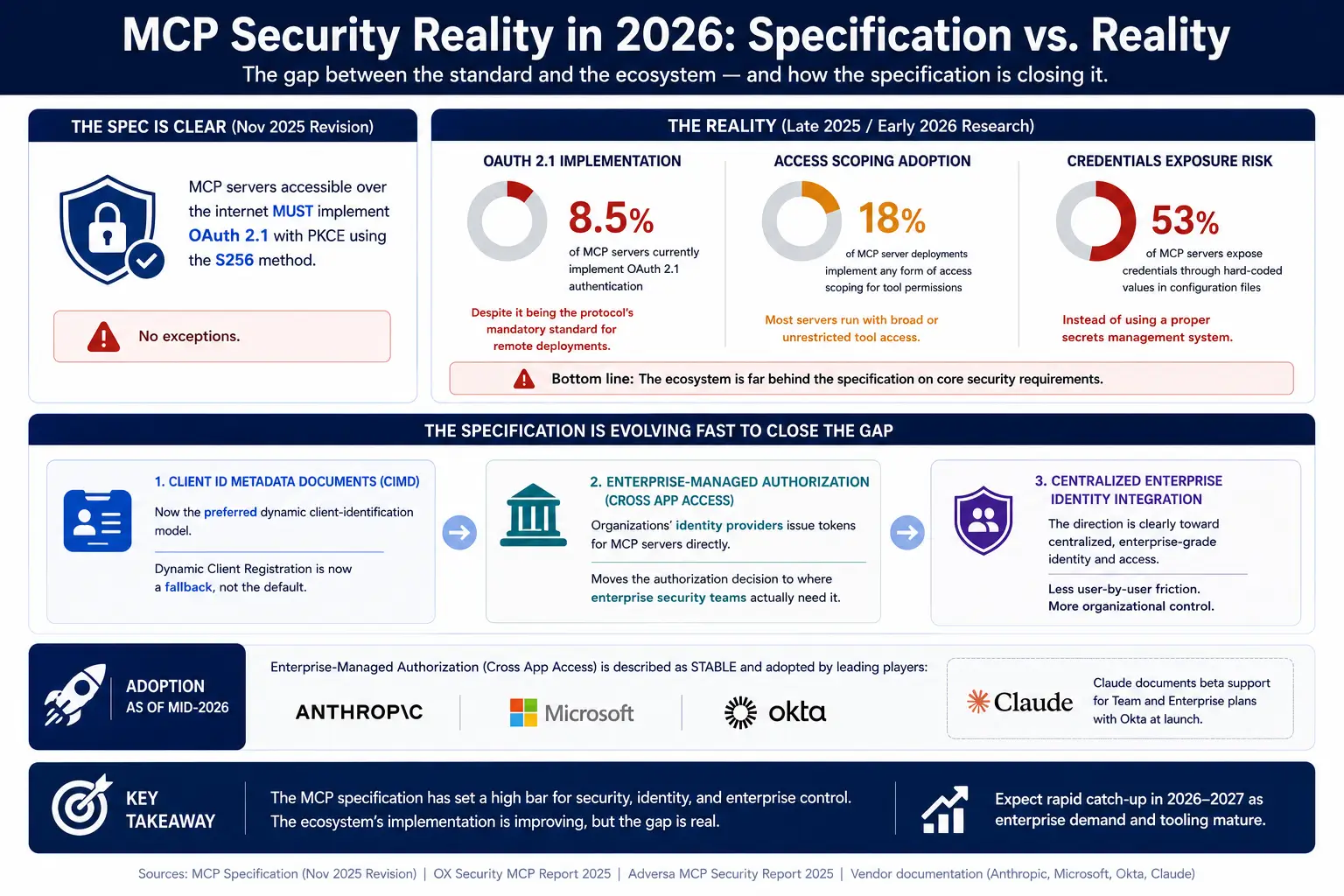
This is where the gap between specification and reality is widest, and worth stating plainly rather than glossing over. As of the MCP specification’s November 2025 revision, any server accessible over the internet is required to implement OAuth 2.1 with PKCE using the S256 method, no exceptions. In practice, only 8.5 percent of MCP servers currently implement OAuth 2.1 authentication despite it being the protocol’s mandatory security standard for remote deployments. Separate research found only 18 percent of MCP server deployments implement any form of access scoping for tool permissions at all, and 53 percent of MCP servers expose credentials through hard-coded values in configuration files rather than a proper secrets management system.
The specification itself has moved fast to close this gap. Client ID Metadata Documents, known as CIMD, have become the preferred dynamic client-identification model, with Dynamic Client Registration as a fallback rather than the default it used to be. Enterprise-Managed Authorization, sometimes called Cross App Access, lets an organization’s identity provider issue tokens for MCP servers directly rather than requiring every individual user to click through a separate OAuth consent screen for each connection, moving the authorization decision to where enterprise security teams actually need it. As of mid-2026, that capability is described as stable and adopted by Anthropic, Microsoft, and Okta among others, with Claude documenting beta support for Team and Enterprise plans with Okta at launch. The direction is clearly toward centralized, enterprise-grade identity integration. The current reality, reflected in that 8.5 percent implementation figure, is that most of the ecosystem has not caught up to the specification yet.
Deployment Models
MCP Adoption: Enterprise deployment splits fairly evenly across a few recognizable models rather than converging on one dominant approach. API and MCP gateways and full self-hosting each account for roughly 30 percent of usage, representing a genuine split between organizations preferring a managed abstraction layer and those wanting complete infrastructure control. Nearly 60 percent of developers report preferring a flexible hybrid approach, combining gateway-based and self-hosted elements rather than committing entirely to one model. Among enterprise respondents specifically, deployment splits between private cloud, SaaS-hosted, and hybrid hosting models, with regulated industries leaning noticeably more toward private cloud and hybrid options given their audit and data residency requirements.
A meaningful architectural shift arrived with the MCP 2026-07-28 specification revision, which removed the requirement for MCP servers to maintain protocol sessions. Under the earlier model, servers needed sticky sessions or a shared session store to scale horizontally. Under the newer stateless model, any request can land on any server instance behind a standard round-robin load balancer, since protocol version, client identity, and capabilities all travel with each individual request. For enterprises running MCP beyond a single developer’s laptop, this materially lowers the cost and complexity of running MCP servers at real scale.
Cloud Providers
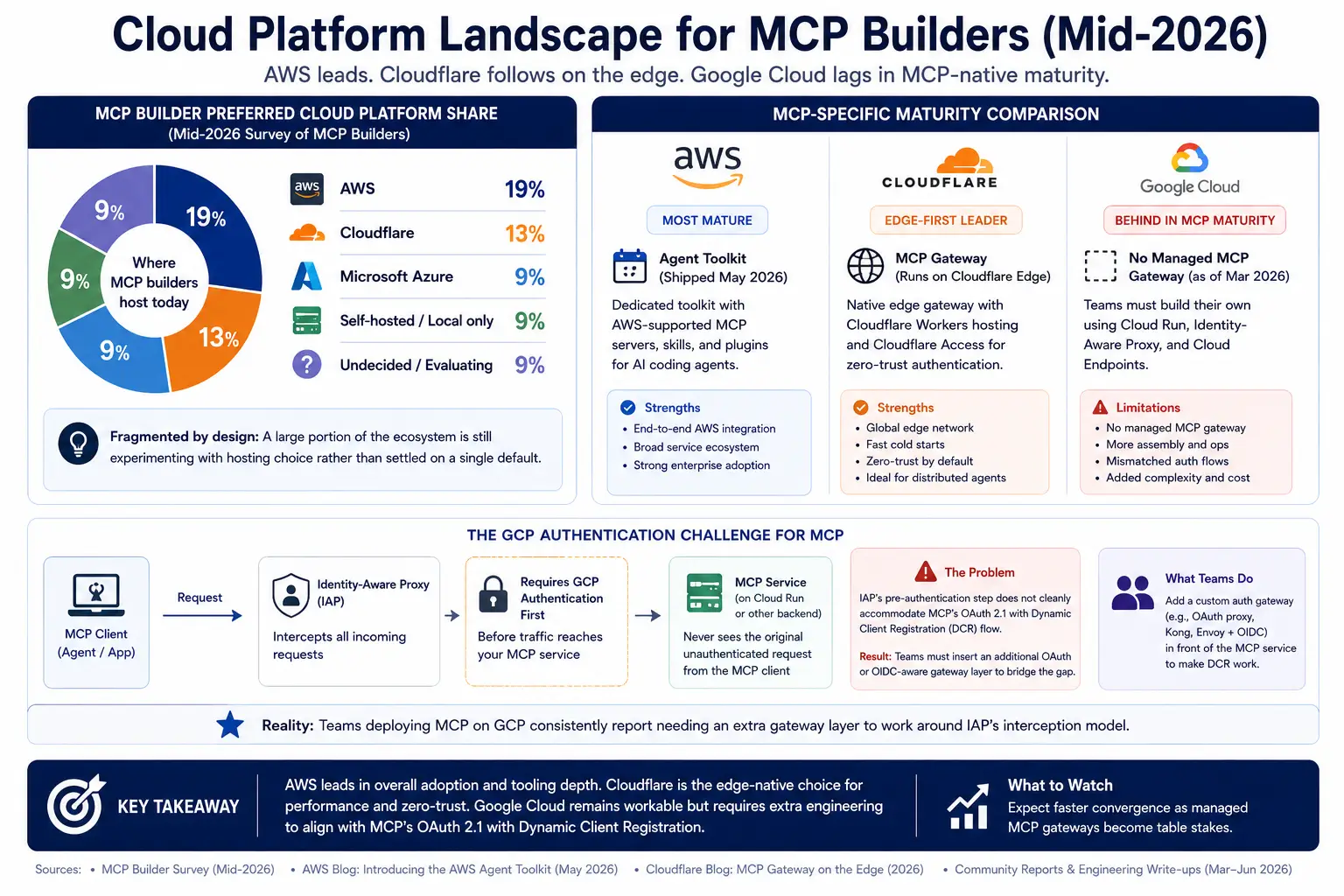
AWS leads as the preferred cloud platform among MCP builders at roughly 19 percent share, ahead of other providers, with Cloudflare capturing about 13 percent, reflecting strong adoption of edge-based, performance-focused hosting specifically for MCP workloads. Azure, local-only self-hosted setups, and undecided users each sit around 9 percent, a fragmentation that reflects how much of the ecosystem is still experimenting with hosting choice rather than having settled on a single default.
The three major clouds differ meaningfully in MCP-specific maturity, which matters more for architecture decisions than headline market share. AWS shipped a dedicated Agent Toolkit in May 2026, bundling AWS-supported MCP servers, skills, and plugins specifically for AI coding agents. Cloudflare’s MCP gateway runs natively on its edge network, integrating with Cloudflare Workers for serverless MCP hosting and Cloudflare Access for zero-trust authentication, delivering genuinely fast cold starts well suited to globally distributed agent deployments. Google Cloud, notably, still had no managed MCP gateway product as of March 2026, leaving teams to assemble their own from Cloud Run, Identity-Aware Proxy, and Cloud Endpoints, a combination that introduces a documented, recurring pain point: GCP’s Identity-Aware Proxy intercepts incoming requests and requires its own authentication before traffic even reaches the MCP service, which does not cleanly accommodate MCP’s OAuth 2.1 with Dynamic Client Registration flow. Teams deploying on GCP consistently report needing to insert an additional OAuth or OIDC-aware gateway layer specifically to work around this mismatch.
Biggest Pain Points

Security and authentication sit at the top of nearly every credible survey on this question, and the data above explains why that ranking holds. A protocol whose entire value proposition is giving AI agents controlled access to sensitive internal systems creates real exposure the moment authentication implementation lags behind the specification as badly as current figures show. Qualys and other security researchers have documented a distinct new risk category dubbed “MCP Shadow IT,” referring to individual teams or developers standing up MCP servers with access to sensitive systems entirely outside IT’s knowledge or approval, a direct consequence of how easy MCP makes it to expose an internal API without a formal review process in between.
The gap between stated priority and production reality is the second major pain point, and one worth naming honestly rather than smoothing over. Stacklok’s survey found MCP adoption ranked as a top-five technology priority for a large share of software-industry respondents, yet only 41 percent of the broader software-industry cohort and 45 percent of the software industry specifically reported even limited production use. A widely circulated claim that 78 percent of enterprise AI teams already use MCP in production does not hold up under scrutiny. At least one research team that originally published adoption estimates in that range later reviewed and revised its own numbers downward, which is a useful reminder that MCP adoption statistics vary enormously depending on what is actually being measured, intent to adopt, a server sitting in a registry, or genuine sustained production usage, and these should not be treated interchangeably.
A third pain point is more structural than technical: vendor and hosting fragmentation. With deployment split close to evenly across gateways, self-hosting, and hybrid models, and cloud provider choice fragmented across AWS, Cloudflare, Azure, and local setups, enterprises adopting MCP today are choosing among genuinely different architectural philosophies rather than variations on one standard playbook, which raises the stakes of getting the initial architecture decision right the first time.
What’s Changing to Address These Gaps
The protocol itself is evolving quickly and specifically toward the two biggest blockers enterprises have cited. MCP tunnels, previewed in May 2026, allow a single outbound encrypted connection to reach customer-side data without requiring inbound firewall rule changes, directly addressing enterprise network security concerns that had stalled several production deployments. Self-hosted sandboxes, offered through providers including Cloudflare, Daytona, Modal, and Vercel, target the isolation and governance concerns that come with granting an AI agent execution access to sensitive systems. The standardized enterprise authorization layer added in 2026, handling OAuth, RBAC, and audit logging in a consistent way across the ecosystem, is specifically credited with unblocking a meaningful share of stalled Fortune 500 deployments that had been sitting in pilot for the exact security reasons outlined above.
What This Means for Enterprises Adopting MCP Now
Pull this data together and a consistent, practical picture emerges. MCP has genuinely won the standards war, backed by every major AI vendor and cloud provider and governed neutrally rather than by a single company, which makes it a safe long-term architectural bet rather than a speculative one. But adoption intent, download counts, and registry listings are running well ahead of secure, governed production usage, and the security gap in current deployments, that 8.5 percent OAuth 2.1 implementation figure especially, is not a minor footnote. It is the actual state of the ecosystem right now, and any enterprise architecture decision that treats MCP server counts as a proxy for MCP maturity is working from the wrong number.
Also Read: Enterprise AI Adoption Report 2026-2027
The practical guidance that holds up across every credible source reviewed for this report is consistent. Start with one real, high-leverage internal use case rather than building MCP servers as an exercise. Check existing public directories before building a new server from scratch, since prior art now genuinely exists at scale. Build the enterprise authorization layer in from day one rather than retrofitting it later, since retrofitting authentication onto a system already in production is measurably harder than building it in from the start. And avoid over-committing to a single vendor’s MCP tooling, since the protocol’s entire value proposition is the ability to swap model providers without rewriting integration work, a genuinely valuable form of risk reduction in a market where frontier model leadership continues to rotate every few months.
At Cybertize Technologies, this is the exact architectural conversation we have with clients evaluating MCP for their own AI integrations, because the difference between a server that sits in a registry and one that actually runs securely in production is almost entirely about the decisions covered in this report, not about the underlying protocol itself.
How fast has MCP adoption actually grown since launch?
Extremely fast by infrastructure-standard measures. MCP SDK downloads grew from roughly 100,000 monthly at its November 2024 launch to 97 million monthly by March 2026, a 970 times increase in eighteen months, driven by sequential adoption from OpenAI, Microsoft, AWS, and eventual Linux Foundation governance.
What percentage of enterprises actually use MCP in production, not just as a pilot?
Around 41 to 45 percent of software-industry technical leaders report even limited production use, according to Stacklok’s December 2025 survey of 300 senior technical leaders. A widely circulated claim of 78 percent enterprise production use does not hold up under scrutiny and has been walked back by at least one research team that originally published it.
How many MCP servers implement the required OAuth 2.1 authentication standard?
Only about 8.5 percent, despite OAuth 2.1 with PKCE being the protocol’s mandatory security standard for any remote MCP server as of the November 2025 specification revision, representing a significant gap between the specification and current real-world implementation.
Also Read: AI Development Cost Guide 2026
What is the dominant enterprise architecture pattern for deploying MCP at scale?
The federated gateway pattern, where a centralized gateway handles authentication, routing, and audit logging for many individual MCP servers behind it, has become the dominant architecture for large enterprises specifically because it centralizes credential policy and lets individual servers skip implementing their own security layer.
Which cloud provider leads in MCP hosting?
AWS leads at roughly 19 percent share among MCP builders, ahead of Cloudflare at around 13 percent, with Azure and local self-hosted setups each around 9 percent. Google Cloud notably had no managed MCP gateway product as of March 2026, requiring teams to assemble their own from underlying GCP services.
Cybertize Technologies Private Limited helps enterprises architect secure, production-grade MCP integrations, not just proof-of-concept servers that never make it past a pilot.
Sources
- Stacklok, State of Model Context Protocol in Software 2026 (n=300 senior technical leaders, surveyed December 2025)
- The Agentics, Enterprise MCP Guide 2026
- DigitalApplied, MCP Adoption Statistics 2026: Model Context Protocol
- AffiliateBooster, MCP Adoption Statistics 2026: The Numbers Behind AI’s Fastest-Growing Standard
- TechRT, MCP Server Statistics 2026: Growth and Insights
- Effloow, MCP Ecosystem in 2026: From Experiment to 97 Million Installs
- andrew.ooo, MCP Enterprise Adoption: The July 2026 State of Play
- Knak, MCP Adoption in 2026: What Marketers Need to Know
- RockB, MCP OAuth 2.1 Authentication: Complete Developer Guide 2026
- NHIMG, MCP Server Authentication in 2026: What Practitioners Need to Know
- Datawiza, MCP Authentication Explained: OAuth 2.1, DCR and CIMD (2026)
- WorkOS, The Best Providers for MCP Server Authentication in 2026
- DigitalApplied, MCP Server Patterns for Enterprise AI Agents in 2026
- Truto, What is an MCP Server? The 2026 Architecture Guide for SaaS PMs
- Apigene, MCP Gateway on AWS, Azure and GCP: Cloud Deployment Guide 2026
- Agentic AI Foundation, Stateless MCP Ecosystem Adoption
- DEV Community, Complete Guide to MCP in 2026: Architecture, Implementation, and Enterprise Roadmap