Table of Contents
The Technologies, Architectures and AI Capabilities Businesses Should Build For
Executive Snapshot:
- 7 technologies move into Build Now:
On-device AI, Flutter, Kotlin Multiplatform, Passkeys, Offline-first architecture, Mobile CI/CD, AI-assisted development - 5 technologies move into Prepare Now:
AI agents inside apps, Multimodal AI, Edge computing, Zero-trust mobile architecture, React Native - 5 technologies remain Experimental:
Native Swift/Kotlin for new greenfield builds, Device-bound credentials, Privacy-preserving AI, Remote configuration at scale, Observability-first architecture - 5 technologies are currently Overestimated
for most businesses: Super apps, Spatial computing, Smart glasses as a mainstream channel, Foldables as a design priority, Generic chatbots without a data strategy
This report is built around a single question most trend articles never actually answer: readiness for whom, and by when. A technology being real and a technology being worth a business’s limited engineering budget in 2026 are two different claims, and this report scores both separately for 22 technologies, architectures, and AI capabilities shaping mobile development heading into 2027.
Also Read: AI Application Development Cost Report 2026-2027 by Cybertize Technologies
Why This Report Exists
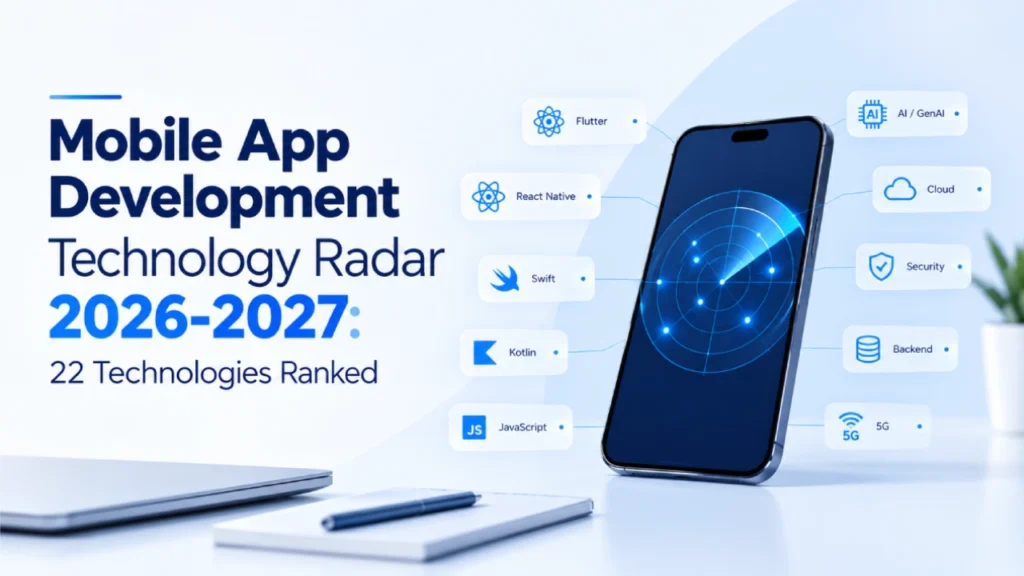
Mobile App Development Technology Radar: Most mobile technology coverage collapses into one of two failure modes. Either everything gets covered with equal enthusiasm, “AI is a trend, AR is a trend, foldables are a trend,” with no attempt to separate what a business should actually fund this year from what belongs on a watchlist.
Or coverage swings the opposite direction into pure skepticism, dismissing genuinely production-ready technology alongside genuinely overhyped technology without distinguishing between them.
At Cybertize Technologies, we build native and cross-platform mobile apps for clients across India and internationally, and the research behind this radar comes directly from that work, what we are actually recommending clients build with right now, what we are telling clients to prepare for but not yet commit budget to, and what we are actively steering clients away from despite its coverage elsewhere.
India’s own market data makes this distinction matter more than it might elsewhere. Sensor Tower’s most recent India tracking shows the market moving meaningfully beyond pure download-volume growth, with non-gaming categories contributing a growing share of consumer spending and AI emerging as one of the fastest-growing segments specifically, a maturing market where the cost of building the wrong thing is rising, not falling.
Methodology: The Mobile Technology Readiness Score
Every technology in this radar is scored using a framework we call the Mobile Technology Readiness Score, MTRS. We want to be direct about what this is and is not: it is a Cybertize Technologies research framework, developed to evaluate the practical readiness of mobile technologies for business adoption, not an industry-standard metric, and not a claim of third-party validation.
The scoring itself is our editorial judgment, grounded in current market data, developer survey findings, and our own delivery experience, and presented transparently so the reasoning can be checked rather than just the conclusion.
MTRS = (Adoption × Business Value × Technical Maturity × Ecosystem Support) ÷ Implementation Risk
Each of the five inputs is scored from 1 to 10:
- Adoption: how widely the technology is already used in shipped, production applications today, not pilots or demos
- Business Value: the realistic upside for a typical business adopting it, not the theoretical ceiling for a best-case use case
- Technical Maturity: how stable the tooling, documentation, and surrounding ecosystem actually are
- Ecosystem Support: how committed major platform vendors, Apple, Google, Microsoft, and the open-source community are, measured by investment and release cadence, not press coverage
- Implementation Risk: the inverse input, how likely a typical team is to hit a costly dead end, abandoned dependency, or platform reversal
The four positive inputs are multiplied and divided by risk, then scaled to a 100-point index. A technology scoring above 75 lands in Build Now. 60 to 75 lands in Prepare Now. 40 to 59 is Experiment. Below 40 is Watch or Avoid, depending on trajectory.
The 2026-2027 Mobile Technology Radar
| Technology | 2026 Readiness | 2027 Outlook | Business Value | Adoption Risk | MTRS Score | Recommended Action |
|---|---|---|---|---|---|---|
| On-device AI | 9/10 | 10/10 | High | Medium | 87/100 | Build Now |
| Flutter | 9/10 | 9/10 | High | Low | 91/100 | Build Now |
| Kotlin Multiplatform | 8/10 | 9/10 | High | Low | 84/100 | Build Now |
| Passkeys | 9/10 | 9/10 | Medium-High | Low | 83/100 | Build Now |
| Offline-first architecture | 8/10 | 9/10 | High | Low | 82/100 | Build Now |
| AI-assisted development (coding agents) | 8/10 | 9/10 | High | Medium | 78/100 | Build Now |
| Mobile CI/CD | 8/10 | 9/10 | Medium-High | Low | 77/100 | Build Now |
| React Native | 8/10 | 8/10 | High | Low-Medium | 75/100 | Prepare / Build (team-dependent) |
| AI agents inside apps | 6/10 | 9/10 | Very High | High | 68/100 | Prepare Now |
| Multimodal AI | 6/10 | 8/10 | High | Medium-High | 66/100 | Prepare Now |
| Edge computing | 7/10 | 8/10 | Medium-High | Medium | 65/100 | Prepare Now |
| Zero-trust mobile architecture | 6/10 | 8/10 | Medium-High | Medium | 62/100 | Prepare Now |
| Generative AI (in-app) | 7/10 | 8/10 | Medium-High | Medium | 61/100 | Prepare Now |
| Native Swift / Kotlin (new greenfield) | 7/10 | 7/10 | High (specific cases) | Medium | 58/100 | Experiment / Case-by-case |
| Observability-first architecture | 6/10 | 7/10 | Medium | Medium | 56/100 | Experiment |
| Device-bound credentials | 6/10 | 7/10 | Medium | Medium | 54/100 | Experiment |
| Privacy-preserving AI (federated/on-device training) | 5/10 | 7/10 | Medium | Medium-High | 52/100 | Experiment |
| Remote configuration at scale | 6/10 | 6/10 | Medium | Medium | 51/100 | Experiment |
| Foldables | 5/10 | 6/10 | Low-Medium | Medium-High | 43/100 | Watch |
| Smart glasses as mainstream channel | 4/10 | 6/10 | Medium (narrow) | High | 39/100 | Watch |
| Spatial computing | 4/10 | 6/10 | Medium (narrow) | High | 37/100 | Watch |
| Super apps (Western/Indian general market) | 4/10 | 5/10 | Low-Medium | High | 33/100 | Avoid / Overhyped |
The Quadrant View: Business Readiness × 2027 Growth Potential
Plotting these 22 technologies against two axes, current business readiness on the X-axis and 2027 growth potential on the Y-axis, produces five practical clusters.
Build Now (high readiness, strong or stable growth): On-device AI, Flutter, Kotlin Multiplatform, Passkeys, Offline-first architecture, Mobile CI/CD, AI-assisted development.
These are not bets. They are current best practice with continued upward trajectory, and a business delaying adoption here is accumulating real technical debt, not avoiding risk.
Prepare Now (moderate readiness today, steep growth trajectory): AI agents inside apps, Multimodal AI, Edge computing, Zero-trust mobile architecture, Generative AI features, React Native for the right team profile.
These deserve a pilot, a proof of concept, or a dedicated architecture decision this year, even if full production commitment waits until 2027.
Experiment (real but narrow, maturing unevenly): Native Swift/Kotlin for new greenfield projects specifically, observability-first architecture, device-bound credentials, privacy-preserving AI techniques, remote configuration at genuine scale. Worth a contained pilot on a specific project where the fit is clear, not a default choice.
Watch (genuinely early, hardware or ecosystem-dependent): Foldables, smart glasses as a mainstream distribution channel, spatial computing.
Real momentum exists, smart glasses shipments grew 44 percent globally in recent tracking, but business case clarity for most companies remains genuinely narrow, concentrated in specific verticals rather than general applicability.
Avoid / Overhyped for most businesses: Super apps as a general-market Western or Indian strategy, and, as covered in the next section, several adjacent patterns that get pitched as innovation but deliver weak return relative to their cost.
Also Read: AI in UI/UX Design Report 2026-2027, Tools, Data, Benchmarks
Mobile Development Stack Comparison 2026
| Stack | Development Speed | Native Access | Performance | Team Cost | Best For |
|---|---|---|---|---|---|
| Flutter | High | Medium | High (~97% of native) | Low | Most business apps, startups, multi-platform reach |
| React Native | High | High | High (~94% of native) | Low | Teams with existing JavaScript/React expertise |
| Kotlin Multiplatform | Medium | Very High | Very High (~99% for shared logic) | Medium | Native-quality UI with shared business logic |
| Native Swift / Kotlin | Medium | Maximum | Maximum | High | Platform-intensive apps, deep OS integration, on-device AI |
AI Feature Architecture: Cloud-Only vs Hybrid vs On-Device
| Dimension | Cloud-Only AI | Hybrid AI | On-Device AI |
|---|---|---|---|
| Latency | Higher, network-dependent | Variable, routes by task | Lowest |
| Infrastructure dependency | High | Medium | Low |
| Privacy | Weakest (data leaves device) | Mixed (task-dependent) | Strongest |
| Recurring inference cost | Highest, scales with usage | Moderate | Lowest after initial device cost |
| Offline capability | None | Partial | Full |
| Implementation complexity | Lowest to start | Highest (routing logic) | Medium-High (model optimization) |
Hybrid AI, routing simple, latency-sensitive, or privacy-sensitive tasks to an on-device model while sending complex reasoning to a cloud LLM, is where the strongest 2026-2027 production architectures are converging, and it matters more for the Indian market specifically than most global reports acknowledge.
On-device AI directly addresses two India-specific infrastructure realities: inconsistent connectivity outside metro areas, and a user base that has shown increasing concern about where personal data actually travels.
The on-device AI market itself is projected at roughly 33.2 billion dollars globally in 2026, growing at a 24.8 percent compound annual rate, with smartphones holding the largest device-type share at 47.2 percent, and India’s own smartphone AI feature adoption has been climbing specifically because it solves a real local constraint, not because it is the more fashionable architecture.
The Mobile AI Architecture Stack for 2027
On-device Model
Cloud LLM
Identity
This stack is worth internalizing independently of the rest of this report, because it is the architecture pattern behind nearly every Build Now and Prepare Now technology scored above. On-device AI and edge inference sit in the inference layer specifically to reduce latency and cost for simple tasks while reserving cloud LLM calls for genuinely complex reasoning.
The security layer, passkeys and device-bound credentials specifically, is not a separate feature bolted onto an AI-enabled app; it is a structural requirement once an AI agent or assistant has standing access to user data and connected services, a pattern directly relevant to businesses handling the kind of API and connector risk covered in current enterprise AI security research.
Also Read: AI Agent Development Guide for Businesses, Avoid Costly AI Mistakes in 2026–2027
Technologies Businesses Should NOT Chase
This is the section most trend reports skip, and it is where this radar is meant to differentiate itself most directly.
Super apps. A single app consolidating payments, messaging, commerce, and services works in specific markets with specific regulatory and competitive conditions, most notably China’s WeChat.
Current industry analysis increasingly questions whether the Western or general Indian super-app pattern is actually inevitable rather than a narrative repeated because one dominant example exists.
For most businesses, chasing a super-app strategy means spreading engineering effort across features users did not ask that specific app to own, when a focused, excellent single-purpose app consistently outperforms a mediocre everything-app on the metric that matters most, genuine daily retention.
Generic chatbots inside apps without a data strategy. A chatbot wrapped around a general foundation model API, with no proprietary data, no retrieval pipeline, and no mechanism to improve from real usage, has become close to a commodity feature.
As foundation model API prices continue falling, that kind of thin AI wrapper creates little durable differentiation, since any competitor can replicate it within weeks using the same underlying model.
The businesses building AI features with real, durable value are the ones feeding genuine proprietary or usage data back into a more specialized layer, not the ones shipping a chat bubble and calling it an AI strategy.
Spatial computing and smart glasses as a mainstream 2026-2027 channel for most businesses. The underlying hardware momentum is genuinely real, smart glasses specifically drove a documented 44 percent surge in global XR shipments in recent tracking, and major vendors including Meta, Samsung, Google, and Qualcomm are investing seriously.
But privacy and social-acceptance friction remains a real, unresolved barrier, with growing legal scrutiny and venue-level restrictions on always-on cameras and microphones in several markets.
For the large majority of businesses outside specific verticals, field service, industrial inspection, logistics, where spatial interfaces solve a genuine operational problem, building a primary product experience around this category in 2026 or 2027 is premature.
Rebuilding everything as fully native. A recurring, expensive mistake worth naming directly: assuming native development is automatically the safer or higher-quality choice regardless of what the app actually does.
For the large majority of business applications, lists, forms, content flows, standard e-commerce and service experiences, cross-platform frameworks now deliver 94 to 99 percent of native performance at meaningfully lower cost and faster iteration speed.
Native remains clearly justified for deep platform integration, AR, specialized hardware access, or genuine on-device AI reasoning, but defaulting to native “to be safe” for an app that does not need any of that is not caution. It is unnecessary cost.
AI features chasing a feature checklist rather than a specific user problem. The pattern repeats across every category in this report: the technologies scoring highest on business value are the ones solving a concrete, named problem, latency, privacy, connectivity, cost, not the ones added because a competitor announced something similar.
A business evaluating any technology on this radar should be able to name the specific user problem it solves before committing engineering budget, regardless of where that technology lands on the Build Now to Avoid spectrum.
What This Means for Indian Businesses Specifically Heading Into 2027
Pull the radar together through an India-specific lens and a clear pattern emerges. India’s own data makes several Build Now technologies even more urgent locally than the global average suggests.
India ranks first globally by mobile monthly active users for AI assistant usage and shows among the fastest AI adoption rates of any major market, driven by a young, mobile-first population and strong multilingual AI support across Hindi, Tamil, Telugu, and other languages.
On-device AI specifically addresses two real Indian infrastructure constraints simultaneously, inconsistent connectivity outside metro centers and a genuinely growing cultural and regulatory conversation around data sovereignty under the Digital Personal Data Protection Act, making it a stronger relative priority for Indian product teams than a global trend report would suggest on its own.
At Cybertize Technologies, this radar reflects what we are actually building with clients across the Indian and international market right now, not a forecast disconnected from delivery reality.
We will revisit and republish this scoring on a roughly six-month cadence as the underlying technology landscape moves, because a radar that never updates stops being research and becomes just another static trend list.
Cybertize Technologies Private Limited builds mobile applications across Flutter, React Native, Kotlin Multiplatform, and native Swift and Kotlin, scoped using the same readiness research behind this radar.
Sources
- Sensor Tower, India mobile app market data, 2026
- CMARIX, 80+ Essential Mobile App Development Statistics for 2026-27
- Coherent Market Insights, On-Device AI Market Size and Share Analysis, 2026-2033
- Next Waves Insight, On-Device AI in 2026: Why TOPS Don’t Tell the Whole Story
- Denebrix AI, On-Device AI News: Latest Breakthroughs and Trends in 2026
- Moonstack, The Future of AI in Mobile Apps: 7 Trends That Will Define 2026 and Beyond
- Descope, 2026 FIDO Report: Passkeys at Global Scale
- State of Passkeys (Corbado), Passkey Adoption Statistics 2026
- Father of AI, AI in India 2026: Adoption, Market, and the Future, citing Zinnov, Deloitte, and Autodesk AI Pulse Report data
- Spatial Computing Business Newsletter, April 2026
- Global Key Info Solution, Top Mobile App Development Trends 2026-2027
- Claims Journal / Reuters, From Smart Glasses to AI Pins, Privacy Fears Challenge Tech’s Next Big Bet
- Next Reality, 2026 XR Revolution: Android Platform Changes Everything
- TechTimes, Post-Smartphone Devices Could Have Spatial Computing, Smart Glasses, and Wearable Displays
- Cybertize Technologies, internal delivery data across Flutter, React Native, Kotlin Multiplatform, and native mobile client engagements, 2026