What Does a Software Development Company Actually Do?
A software development company designs, builds, tests, and maintains custom software applications, websites, mobile apps, and enterprise systems tailored to a specific business’s requirements, as distinct from off-the-shelf software that forces a business to adapt its processes to the tool. Services typically span requirements and technical architecture, custom software development, mobile and web application development, API and systems integration, quality assurance, deployment, and ongoing maintenance. At Cybertize, we deliver these as a full-service software development agency and also as a dedicated extension of an in-house team, running agile software development services with two-week sprint cycles, visible progress, and direct client involvement throughout, rather than a black-box handoff with no visibility until the final delivery date.
The category itself is large and still accelerating. The global custom software development market is valued at roughly USD 50 to 70 billion in 2026 and is projected to more than double by 2030, growing at a compound annual rate above 20% (Grand View Research; Mordor Intelligence, 2026), driven by the limitations of off-the-shelf software and the rising complexity of what businesses actually need their systems to do.
Expolore Mobile App Trends
What to Actually Look for in Software Development Firms
Plenty of software development firms promise the same things in nearly identical language. A few concrete things genuinely separate the ones worth hiring:
- Process transparency. You should be able to see what’s being built, sprint by sprint, not wait for a single large reveal at the end of the engagement.
- Senior oversight on every project, not just the sales call. The developer writing your code and the person who scoped the project should be accountable to the same standard.
- Honest scoping. A software development agency that never tells a client “that’s not necessary yet” is optimizing for billable hours, not for your actual outcome.
- A track record across comparable projects, not just a portfolio of logos with no detail on what was actually delivered or how it performed afterward.
How We Work: Engagement Models for Software Development Services
Fixed-Scope Project. A defined application or platform delivered on a fixed timeline and cost, the right fit for a well-scoped MVP or a specific feature build.
Dedicated Development Team. Ongoing developers, designers, and QA engineers embedded with your team, scaled up or down as your roadmap changes, without the overhead of direct full-time hiring.
Agile Sprint Retainer. Continuous development capacity running in structured two-week sprints against an evolving backlog, for products under active, ongoing development.
Staff Augmentation. Individual specialists (a MERN developer, a DevOps engineer, a mobile developer) added directly to your existing team and process.
Engagements are quoted in INR for Indian entities and USD for US and UAE clients, scoped after an initial discovery conversation, since a five-screen MVP and a multi-module enterprise platform are not priced on the same scale.
Industries We Build Software For
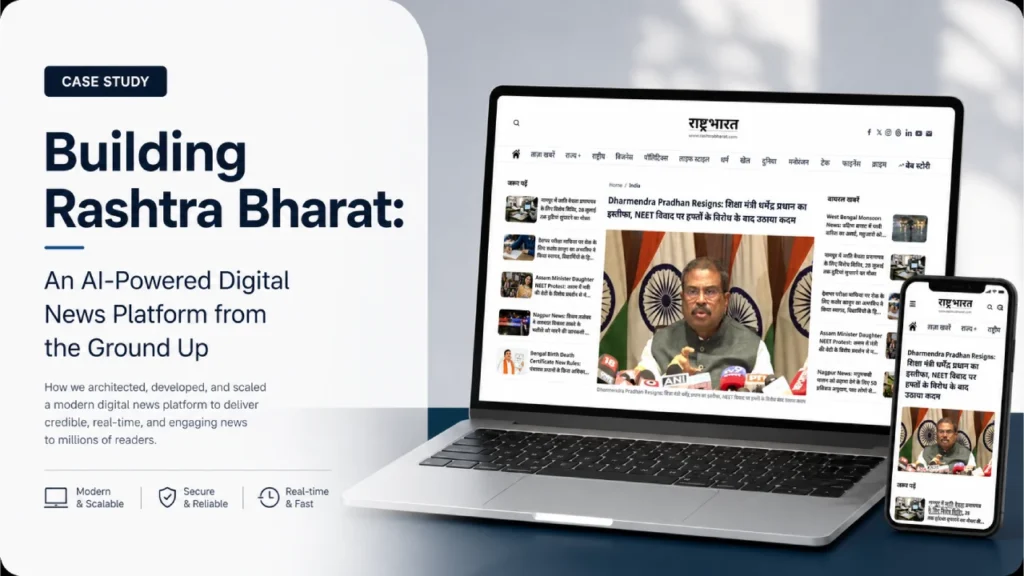
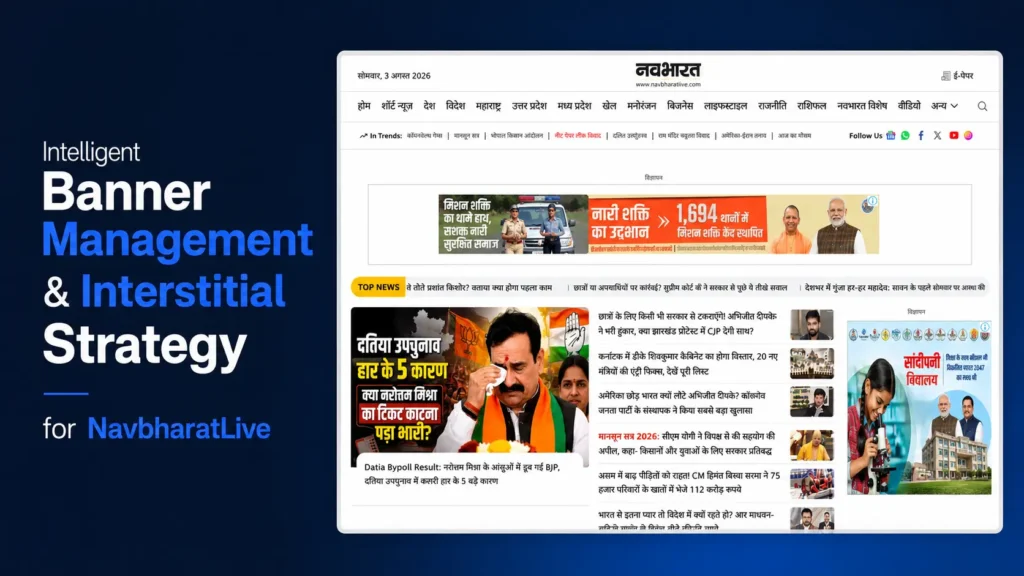
SaaS and B2B product companies, fintech and BFSI (compliance-aware architecture), e-commerce and D2C brands, healthtech, logistics and supply chain platforms, and media and content platforms, including our own Hindi-language news platform, Rashtra Bharat, built and operated on infrastructure we manage ourselves.
Why Software Projects Actually Fail (And How We Build Around It)
Requirements locked too early, revisited too late. A specification frozen before development starts and never revisited until launch guarantees the final product reflects six-month-old assumptions. Agile sprints with regular client review exist specifically to catch this early, when a correction is cheap, not at the end, when it’s expensive.
No visibility between kickoff and delivery. Projects that disappear into a vendor’s process for months and reappear at the deadline leave no room to catch drift until it’s too late to fix cheaply. We run visible sprints with regular demos specifically so surprises happen early and small, not late and large.
QA treated as a final step instead of a continuous practice. Testing bolted onto the end of a project under deadline pressure finds fewer issues and fixes them more expensively than testing built into every sprint from the start.
Technical debt from rushing the architecture. Software built fast with no attention to maintainability works fine until the team needs to extend it, at which point every new feature takes longer than the last. We architect for the product’s actual next two years, not just its launch date.
Vendor lock-in through undocumented, unfamiliar code. Software delivered without documentation or clean handoff leaves a client dependent on the original vendor indefinitely. Every engagement we run includes documentation and a genuine, usable handoff, whether or not the client ever intends to leave.
Why Cybertize Technologies & Why we are the leading Software Development Company in Asia
We run agile because the data backs it, not because it’s a buzzword on a pitch deck. Agile-managed projects succeed at meaningfully higher rates than waterfall-managed ones of comparable size, and our own delivery process is built around two-week sprints and continuous client visibility for exactly that reason.
Full-stack capability under one roof. Custom software, mobile apps, APIs, cloud infrastructure, DevOps, and AI development (RAG, chatbots, and autonomous agents) are all delivered by the same company, not stitched together across four different vendors who’ve never spoken to each other.
We operate our own production software, not just client projects. Rashtra Bharat, our Hindi-language news platform, is a live system we build and run ourselves, which means our engineering decisions are informed by what we’ve actually operated in production, not just theory.
Presence across India, the US, and UAE. With teams operating out of Delhi, Mumbai, Gujarat, Indore, and Bangalore, alongside a US presence, we support overlapping working hours for both Indian and North American clients, and UAE-based engagements benefit from that same cross-market experience.
50+ clients delivered, across startups and established corporate software development programs alike. Our experience spans the full range from a founder’s first MVP to ongoing software partnerships with businesses running critical operations through what we’ve built.