Table of Contents
MCP Gateway Architecture: Enterprises want AI agents to work with the systems they already run: CRM records, ERP data, document repositories, internal APIs. The Model Context Protocol (MCP) gives agents a standard way to discover and call those tools. It does not, on its own, answer how a company should manage dozens of servers used by many agents and teams. When every agent connects independently to every server, authentication gets implemented differently in each place, permissions drift, the same integration is built twice, and nobody can see what agents actually did.
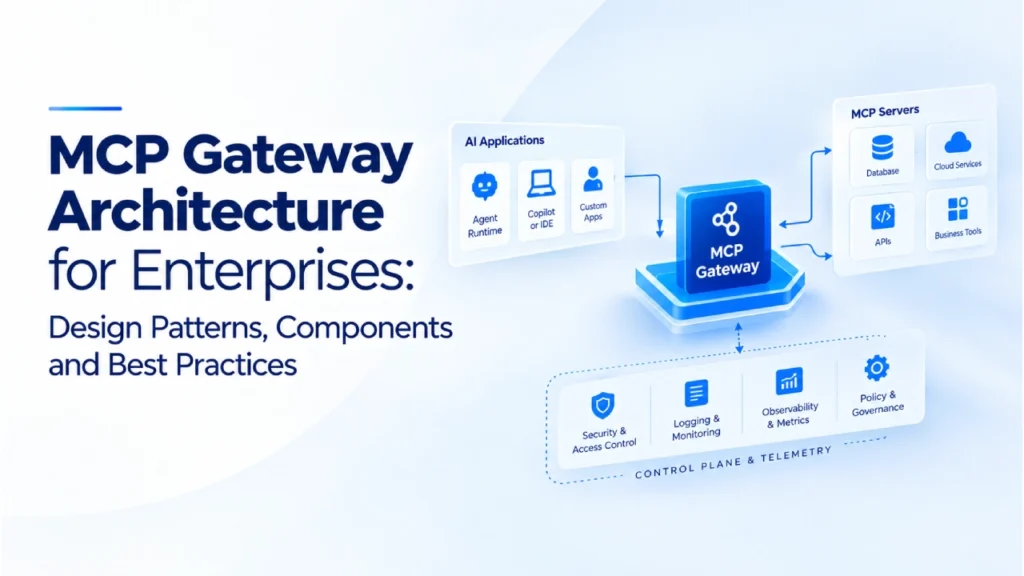
An MCP gateway is one answer to that problem: a management and access layer between MCP clients and the backend servers or APIs they use. It can centralize identity checks, policy, routing, cataloging and logging.
A gateway is not automatically required. A single team with a few low-risk tools can often connect directly to a well-secured server. The value of a gateway rises with the number of clients, servers, teams, security requirements and operational dependencies. This guide is for the point where that count starts to hurt.
Specification and source notes. This guide targets MCP revision 2026-07-28, which made the protocol stateless and overturned several assumptions found in older tutorials. We cross-checked it against AWS Prescriptive Guidance, the open-source Microsoft MCP Gateway documentation and Google Cloud’s API Gateway MCP preview documentation, last reviewed in October 2026. We do not quote adoption statistics or performance benchmarks, because we found no reliable public data on how common each pattern is. Where something is a protocol requirement, a vendor feature or our own recommendation, we say so.
What Is an MCP Gateway?
MCP is an open protocol, built on JSON-RPC 2.0, that connects AI applications to external context and actions. Its participants are hosts (the AI application), clients (connectors inside the host, each holding a connection to one server) and servers (programs that expose capabilities). Servers offer tools (executable functions), resources (data) and prompts (templates). The current revision also defines discovery, opt-in change subscriptions, optional extensions such as Tasks, and an authorization model for HTTP transports.
A gateway is not a protocol role. The specification describes hosts, clients and servers, and a gateway is an implementation pattern layered on top. To a client it usually looks like an MCP server. Behind it, it acts as a client to downstream MCP servers, or as an API consumer when it adapts REST services into tools. AWS Prescriptive Guidance describes gateways as a centralized proxy that orchestrates access to registered servers, and notes that without one each agent must register every remote server it might use.
Capabilities differ by product. Do not assume a given gateway supports protocol translation, semantic tool search, lifecycle management, fine-grained policy or tamper-evident audit logging. Ask for each, then test it.
Also Read: RAG vs Fine-Tuning, Enterprise AI Architecture Report 2026-2027
Why Enterprises Need an MCP Gateway Architecture
Problems tend to appear in the same order as deployments grow:
| Challenge | Without a centralized gateway | Potential gateway benefit |
|---|---|---|
| Multiple independent server connections | Each agent registers and maintains every server | One governed endpoint and registry |
| Inconsistent identity and access controls | Each server implements auth differently, or not at all | Shared token validation and policy |
| Duplicated tool integrations | Teams rebuild the same CRM or ticketing connector | Reusable, centrally published tools |
| Difficult tool discovery | Developers hunt through wikis and repositories | Searchable catalog with owners and schemas |
| Limited visibility into agent activity | Logs scattered across servers and clients | Consistent audit and telemetry |
| Unmanaged server versions | Outdated servers keep running unnoticed | Version inventory and controlled rollout |
| Excessive or irrelevant tool catalogs | Agents see every tool, inflating context and cost | Catalogs filtered per agent or role |
| Inconsistent rate limits | Each server protects itself differently, or not at all | Per-identity and per-server quotas |
| Fragmented incident response | Revoking access means touching many systems | One place to block an identity or tool |
| Unclear ownership | Nobody is accountable for a tool’s data access | Owner and risk class required at registration |
A gateway reduces duplicated management effort, but it does not remove the need for authorization at the backend or for sound controls in the AI application itself. It also adds a component that must be secured, scaled and operated.
MCP Gateway Architecture: Core Components
MCP Client and AI Host Layer
AI applications and agent runtimes run MCP clients that discover tools and invoke them. Under revision 2026-07-28, every request carries the protocol version and the client’s capabilities in its metadata, and a client may call server/discover to learn what a server supports. Clients that federate many servers are advised to use progressive tool discovery rather than loading every tool up front. For policy purposes, treat the host as untrusted: it submits requests but does not decide what is allowed.
Gateway Ingress and Protocol Handling
Ingress terminates TLS, validates requests and hands them to the router. Under 2026-07-28, Streamable HTTP requests carry an MCP-Protocol-Version header and an Mcp-Method header, plus Mcp-Name for named operations such as tool calls, so infrastructure can route and authorize without parsing the body. Because those headers duplicate content in the body, the gateway should verify that they agree and reject mismatches (Kong’s AI Gateway documentation describes doing exactly this), and it should validate header values to block injection.
Version support is an architectural decision. Microsoft’s open-source MCP Gateway now requires 2026-07-28 clients and offers no legacy initialization or protocol downgrade. A mixed estate may need explicit handling of older revisions. Confirm what each component supports before wiring them together.
Identity and Authentication Layer
For remote HTTP deployments, the specification treats an MCP server as an OAuth 2.1 resource server. Servers publish Protected Resource Metadata (RFC 9728) so clients can find the authorization server. Clients send the resource parameter (RFC 8707) so tokens are bound to a specific server, and servers must reject tokens not issued for them. Authorization itself is optional in the specification, which is why a gateway needs a clear position on it. Workload identity or service credentials cover agent-to-gateway calls where no user is present.
Distinguish authenticated identity from descriptive metadata. The specification says clients should identify themselves in request metadata, but that value is self-reported. Treat a client name as a label for debugging, never as proof of who is calling.
Authorization and Policy Engine
Authentication says who is calling. The policy engine decides what that caller may do. It should weigh user and workload permissions, tool-level access, resource boundaries, tenant isolation, approval requirements and risk class.
Apply the same rules to discovery and execution. If tools/list shows a tool the caller cannot run, you leak information and invite probing. If execution is checked but discovery is not, agents waste context on tools they can never use. Also treat tool descriptions and annotations as untrusted hints unless they come from a trusted server, as the specification itself advises. Your risk classification, not the server’s self-description, should drive policy.
Tool Registry and Discovery Service
The registry catalogs each tool with its schema, backend endpoint, owner, risk class and version. Microsoft’s reference gateway, for example, stores tool definitions and routes calls to registered tool servers. Filtering is where a registry earns its keep: exposing only relevant tools to each agent keeps prompts smaller, and AWS guidance suggests tracking how many tools are registered with an agent to spot context-window pressure.
Revision 2026-07-28 adds cache hints (ttlMs and cacheScope) to list results. A gateway that filters tools per user must never reuse one user’s cached list for another.
Routing and Backend Connectors
The router maps each request to a backend MCP server, an adapter around an existing API, or a registered tool server. It needs service discovery, health checks, routing rules and timeouts. Where a backend speaks an older revision or plain REST, the gateway or an adapter must translate, and translation support varies by product. Change notifications are opt-in streams under 2026-07-28 and best effort, so clients should not rely on them alone for freshness.
Secrets and Credential Management
Keep gateway and backend credentials in a managed secrets service with rotation, retrieved at run time with short-lived, least-privilege access. AWS guidance is explicit that secrets should never be hard-coded or stored unencrypted in environment variables. Do not make an agent carry long-lived secrets in prompts or tool arguments, because those flow into model context, logs and third-party systems. Give each backend its own credentials rather than one shared key.
Observability and Audit Layer
Capture structured logs, traces, metrics and correlation identifiers for every call: identity, tool, backend, outcome, latency, errors, rate-limit events and policy denials. Revision 2026-07-28 deprecates protocol-level logging for new implementations in favor of OpenTelemetry, which is a sensible default for traces. Audit records should be append-only and exported to your security monitoring.
Exclude secrets, sensitive prompts and unnecessary personal data. In India, personal data inside logs may fall under the Digital Personal Data Protection Act, so log minimally by design.
Administration and Lifecycle Management
Administration covers registering servers, configuring them, deploying, versioning, health checking, deprecating and rolling back. The gateway, an orchestration platform or a separate control plane can own these jobs. Microsoft’s reference gateway splits a control plane for adapter and tool management from a data plane for request routing, and some gateways, such as Docker’s, launch servers on demand. Decide who owns lifecycle before you choose a product.
Also Read: AI Agent Development Report for Business Market & Technology 2026-2027
Reference Architecture for an Enterprise MCP Gateway
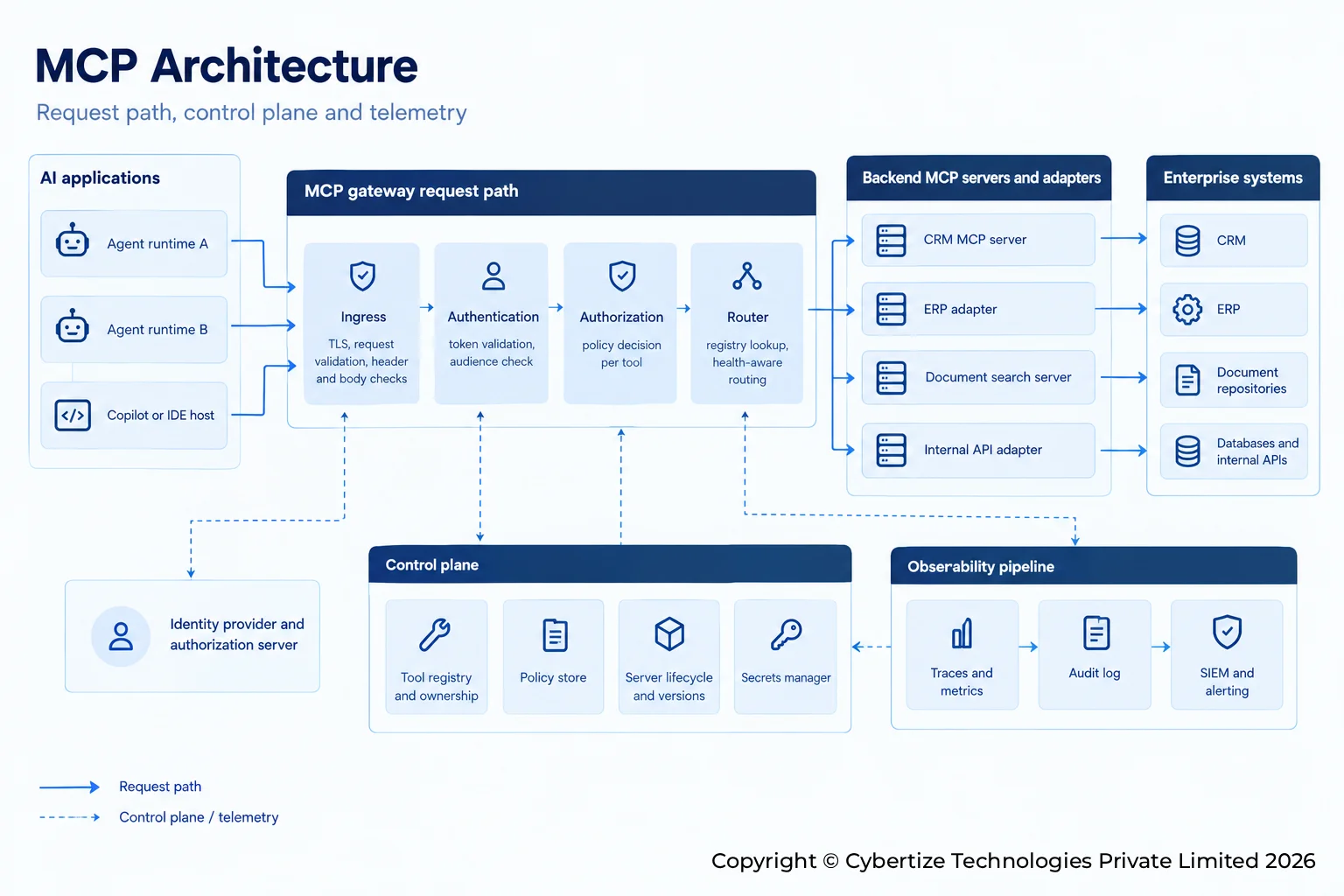
MCP Gateway Architecture request flow, step by step:
- The client sends an MCP request over HTTPS to the gateway endpoint.
- The gateway validates the request, its protocol version, and the agreement between routing headers and body.
- The gateway authenticates the caller using a trusted mechanism, such as an OAuth access token validated for signature, issuer, expiry and audience.
- Authorization policies decide whether this identity may use the requested tool with these parameters.
- The router resolves the backend from the registry, skipping unhealthy instances.
- The backend performs its own relevant authorization and executes the operation, using its own downstream credentials.
- The response returns through the gateway, which may filter or redact it.
- Telemetry and audit events are recorded for the whole path.
Exact order and supported capabilities vary by implementation. Some gateways authorize from headers before reading the body, and others combine steps.
Enterprise MCP Gateway Design Patterns
Centralized Gateway Pattern
One managed endpoint serves many clients and routes to registered servers. The benefit is a single place for identity, policy and inventory. The trade-off is a shared dependency with a large blast radius if it is misconfigured or compromised. It fits organizations with one dominant security domain and a platform team to run it.
Federated Gateway Pattern
Separate gateways serve business units, regions, environments or security domains under shared governance standards. Choose it when data residency, regulatory boundaries or organizational autonomy make one administrative boundary unrealistic. The cost is duplicated operations and the need for a consistent cross-gateway inventory.
Domain-Specific Gateway Pattern
Dedicated gateways, or logical domains inside one gateway, manage tools for finance, engineering, customer operations, HR or analytics. Owners understand their data, permissions stay bounded, and cross-domain exposure shrinks. The risk is drifting standards unless a common baseline is enforced.
Gateway with an API Adapter Layer
Selected operations from existing REST APIs become MCP tools without rewriting the business systems. Map operations individually, define strict input schemas, translate errors into forms an agent can act on, and authorize at operation level. Google Cloud’s API Gateway preview illustrates the model: it translates MCP JSON-RPC into REST calls using an OpenAPI 3.x definition and lets teams choose which paths and methods to expose. Its documented limits include no resources or prompts, no stdio transport, and no streaming or long-running tool calls.
Sidecar or Local Gateway Pattern
A gateway runs beside the workload or on a developer machine for isolation, local development, restricted networks or workload-specific policy. It enforces tightly close to the agent, but it multiplies instances to patch, configure and monitor. It is rarely the right default for a whole enterprise.
Policy-Enforcement Gateway Pattern
Centralized checks sit between clients and backends while backends keep their own controls. Typical controls are tool allowlists, input validation, approval gates, tenant boundaries and restrictions on sensitive operations. It strengthens defense in depth, but it must never replace backend authorization.
Stateless Routing Pattern
Requests are handled independently, so any gateway instance can serve any request behind a plain load balancer. Revision 2026-07-28 removed protocol sessions to make this possible. It does not remove application state: long-running jobs, approvals and multi-step processes still need explicit handles or the Tasks extension, and older clients or servers may still expect sessions.
| Pattern | Appropriate when | Main advantage | Primary trade-off |
|---|---|---|---|
| Centralized | One security domain, strong platform team | One policy and inventory point | Shared dependency, large blast radius |
| Federated | Multiple regions, units or regulatory domains | Local autonomy with shared standards | Duplicated operations, inventory drift |
| Domain-specific | Clear data owners per function | Bounded permissions, clear accountability | Inconsistent standards without a baseline |
| API adapter layer | Valuable REST APIs already exist | Reuse without rewriting systems | Poor mapping can over-expose operations |
| Sidecar or local | Isolation or restricted networks | Tight, workload-level enforcement | Many instances to operate |
| Policy-enforcement | Sensitive operations, compliance pressure | Defense in depth | False confidence if backends skip checks |
| Stateless routing | Horizontal scale, simple failover | Any instance serves any request | Application state must be designed explicitly |
Also Read: AI Application Development Cost Report 2026-2027 by Cybertize Technologies
Security Best Practices for MCP Gateway Architecture
Treat security as architecture, not an add-on. The controls below work together:
- Authenticate and authorize every call. Validate token signature, issuer, expiry and audience, then authorize per user and per workload, with tenant isolation enforced in policy.
- Use least privilege and allowlists. Grant each agent a specific tool allowlist, classify tools by risk (read, reversible write, destructive, financial) and make broad access the exception.
- Validate inputs and filter outputs. Enforce schemas at the gateway, reject unexpected fields, and redact sensitive data in responses.
- Treat tool output as untrusted. Prompt injection can arrive through any content a tool returns. A gateway cannot detect all of it, so limit what a manipulated agent can do through permissions and approvals, not filtering alone.
- Require approval for consequential actions. Payments, deletions, external messages and permission changes need human or policy approval. The specification’s own principle is that users should consent before tools run.
- Limit blast radius. Apply rate limits and quotas, segment networks, keep backends in private subnets behind a load balancer (as AWS recommends) and separate environments.
- Secure the supply chain. Record the provenance of every registered server, pin versions, scan dependencies and images, and review before publication. AWS notes that unmanaged local servers can quietly run outdated, vulnerable versions.
- Prepare for incidents. Keep audit trails and be able to revoke a token, disable a tool or block an identity within minutes. Rehearse it.
The confused-deputy risk. A gateway usually holds more authority than any single caller: service credentials, network reach and access to many backends. A confused deputy arises when it uses that authority to do something the requesting identity may not do. Prevent it by tracing every downstream action to the caller’s permissions, rejecting tokens not issued for the gateway, and never forwarding the caller’s token unchanged to another service.
MCP is a protocol, not a guarantee of safety. The specification states that it cannot enforce consent, privacy or tool-safety principles at the protocol level, so implementers must build them. A gateway cannot make a dangerous backend operation safe by exposing it through a standard interface. Sometimes the right answer is not to expose the operation at all.
Authorization, Identity Propagation and Access Control
MCP Gateway Architecture: Identity changes shape as a request moves through the system. Keep these five layers distinct:
- End-user identity: the person on whose behalf the agent acts.
- Agent or application identity: the registered client or workload.
- Gateway service identity: what the gateway uses to call backends and the control plane.
- Backend service identity: what each backend uses to reach downstream systems.
- Downstream resource permissions: what the target system finally allows.
Each hop should know who is calling and why, and each should be able to say no.
Do not forward tokens blindly. The specification states that an MCP server must not pass through the token it received from a client to upstream APIs. The upstream token is a separate token issued by the upstream authorization server. AWS makes the same point: do not reuse tokens between tools and servers, and use the audience claim so a token for one server cannot work at another. Where a downstream authorization server supports it, on-behalf-of or token-exchange flows (such as OAuth token exchange) let a gateway obtain a narrowly scoped token that represents the user. Machine-to-machine credentials suit tools that act as the service rather than the person. Choose per tool and document it, as AWS guidance advises.
Choose access models deliberately. RBAC is simple to reason about and fits coarse access to servers and tools. Microsoft’s reference gateway, for example, uses Entra ID application roles to control who can read or change adapters and tools. ABAC adds context such as data classification, environment or ticket reference, and suits per-resource decisions. Scoped tokens limit what a stolen token can do, per-tool permissions limit what an agent can attempt, backend resource checks limit what any call can touch, and just-in-time approval suits rare, high-impact actions.
Protect hop-to-hop trust. Microsoft’s reference tool router, for instance, rejects forwarded identity headers unless they carry a shared secret. In production we would prefer mutual TLS or workload identity over a static shared secret. That is our recommendation, not a protocol requirement.
MCP Gateway Architecture Reliability, Scalability and Performance
- Horizontal scaling and load balancing: run stateless gateway instances behind a load balancer, with policy and registry data in shared stores or caches.
- Health checks and timeouts: remove unhealthy backends from rotation and set per-tool timeouts shorter than client timeouts.
- Concurrency limits, rate limiting and backpressure: apply limits per identity, tool and server. AWS recommends per-server limits to protect fleets in multi-tenant setups. Shed load with clear errors rather than queueing indefinitely.
- Circuit breakers and bounded retries: stop calling failing backends, and retry with limits and jitter.
- Connection and process management: pool connections, and cap the number of processes where a gateway launches servers on demand.
- Regional deployment and graceful degradation: deploy across at least two availability zones, as AWS suggests, and serve cached tool metadata if the registry is briefly unavailable. Fail closed when authorization cannot be evaluated.
Retries are dangerous for non-idempotent calls. If a timeout occurs after a backend created a ticket or sent a payment, a blind retry can duplicate it. Retry only calls known to be idempotent, or require idempotency keys that the backend honors. AWS also recommends designing long-running operations asynchronously, using the Tasks extension or an application-level job handle.
Cache metadata, not business data. Tool lists and discovery results are designed for caching through ttlMs and cacheScope. Caching tool results can serve stale or unauthorized data, so keep it rare, explicit and tied to the caller’s permissions.
Do not assume a gateway lowers latency. An extra routing and policy hop adds overhead. The benefit is governance and operational consistency. Measure added latency in your own environment instead of relying on generic claims.
Stateless vs Stateful MCP Gateway Architectures
Earlier protocol revisions used an initialization handshake and an Mcp-Session-Id header, so remote servers often needed sticky routing or a shared session store. Revision 2026-07-28 removed both. Do not carry those assumptions forward as universal. A fleet may still contain older servers, and some managed gateway documentation still lists the initialize lifecycle methods (Google Cloud’s API Gateway MCP preview does), so verify which revision each component targets.
| Approach | How it works | Scaling and failover | Best for |
|---|---|---|---|
| Stateless request routing | Each request carries version, capabilities and client identity | Any instance serves any request; simple failover | Short, independent tool calls |
| Session-aware (older revisions) | Server tracks a session identifier across requests | Needs sticky routing or a shared session store | Clients or servers you cannot yet migrate |
| Application-managed state | Explicit handles passed as tool arguments, state in your own store | Scales with your store; you own consistency and expiry | Multi-step business workflows |
| Long-running task management | Tasks extension or job pattern with durable handle and polling | Survives instance loss if state is durable | Operations lasting seconds to hours |
MCP Gateway Deployment Models
| Model | Control | Operational overhead | Scalability | Integration effort | Governance implications |
|---|---|---|---|---|---|
| Self-hosted | Highest | High: patching, scaling and availability are yours | Depends on your engineering | Medium to high | Full control of data paths and logs, and full responsibility |
| Kubernetes-based | High | Medium to high: needs cluster skills | Strong with stateless routing and autoscaling | Medium for teams with a platform practice | Namespaces, network policy and RBAC map to governance |
| Cloud-managed gateway | Medium | Lower: the provider runs the service | Within service limits | Low to medium, but check feature gaps | Inherits provider controls and quotas |
| Integrated with an AI platform | Medium to low | Low | Platform-managed | Low inside the platform, higher across platforms | Convenient shared policy, with lock-in and uneven standards support to weigh |
| Hybrid or multi-cloud | Varies | Highest coordination effort | Flexible placement | High: identity, networking and logging across boundaries | Supports residency and federation, but needs consistent policy |
Examples show the range without ranking it. Microsoft’s open-source MCP Gateway targets Kubernetes. AWS guidance describes several ways to host remote servers, including Lambda with API Gateway, ECS, EKS, EC2 and Bedrock AgentCore. Google Cloud’s API Gateway offers MCP support in public preview. Choose by team skills, compliance needs and the estate you already operate, not by brand.
MCP Gateway vs API Gateway vs AI Gateway
| Dimension | Traditional API gateway | AI or LLM gateway | MCP gateway |
|---|---|---|---|
| Main traffic | HTTP requests to APIs | Prompts and responses to model providers | MCP requests for tools, resources and prompts |
| Typical clients | Apps, partners, services | AI applications | AI agents and MCP hosts |
| Core functions | Auth, rate limits, routing, transformation | Model routing, cost controls, key management, guardrails | Tool discovery, tool-level policy, server routing, audit |
| Protocol awareness | HTTP, REST, gRPC | Model-provider APIs | MCP revision-specific behavior |
| Policy focus | Endpoint and consumer access | Model, spend and content rules | Which agent may run which tool, on whose behalf |
These categories overlap. An API gateway can expose selected APIs as MCP tools if it supports the protocol mapping, as Google Cloud’s does in preview, and an MCP gateway may rely on existing API gateways for network security, rate limits and backend integration. Google also documents that MCP and model routing cannot be enabled together in one API Gateway configuration, a reminder that capability boundaries are product-specific. Treat these as layers, not rival product categories.
MCP Gateway Governance and Lifecycle Management
Governance is what keeps a gateway from becoming a faster way to spread unreviewed tools. Every registered tool should have an accountable owner, a risk class, a versioned schema and a defined path from proposal to retirement. Adapt this sample checklist:
- Every tool has a named owner and an escalation contact
- Naming and schema conventions are documented and enforced at registration
- Each tool carries a risk class (read, reversible write, destructive, financial)
- Versions are tracked, and breaking changes follow a notice period
- Publication to production requires approval
- Security review and functional tests are completed before publication
- Deprecation and retirement dates are published to consumers
- Configuration is stored as code, with reviewed changes
- All registry and policy changes are audited
- Development, staging and production are separated
- The tool inventory is reviewed on a fixed schedule
- Unused tools and stale access grants are removed
Common MCP Gateway Architecture Mistakes
| Mistake | Corrective action |
|---|---|
| Building a gateway before establishing a use case | Start from named agents, tools and risks, and size the gateway to them |
| Treating authentication as sufficient authorization | Add per-tool, per-resource policy after identity checks |
| Giving agents broad tool access | Use per-agent allowlists and least-privilege scopes |
| Exposing entire APIs without operation-level filtering | Map only the operations an agent needs |
| Trusting tool descriptions or outputs without validation | Treat both as untrusted, and validate schemas and results |
| Forwarding credentials indiscriminately | Use audience-bound tokens and separate downstream credentials |
| Logging sensitive content | Redact by default and minimize personal data in telemetry |
| Ignoring backend authorization | Make backends authorize independently of the gateway |
| Retrying destructive operations unsafely | Require idempotency keys or restrict retries to safe calls |
| Assuming all MCP implementations share session behavior | Verify the revision each client, gateway and server supports |
| Using one gateway for every security domain | Segment by domain, region or sensitivity, and federate if needed |
| Failing to assign ownership to registered tools | Make an owner a mandatory registration field |
MCP Gateway Implementation Roadmap
Phase 1: Discovery and inventory. Identify target agents, tools, backend systems, data classifications and existing authentication mechanisms.
Phase 2: Architecture and threat modeling. Choose the gateway pattern, define trust boundaries, document data flows and flag high-risk operations.
Phase 3: Controlled proof of concept. Integrate a few low-risk tools and validate authentication, authorization, schemas and observability.
Phase 4: Security and reliability testing. Test access boundaries, malicious inputs, failure modes, load, timeouts and safe handling of operations with side effects.
Phase 5: Production rollout. Deploy with environment separation, alerting, ownership, rollback and incident response procedures.
Phase 6: Governance and expansion. Add servers through a controlled process, review access periodically, and measure reliability, usage and cost.
MCP Gateway Best Practices Checklist
Architecture
- The chosen pattern is documented with its trust boundaries
- Each component’s supported MCP revision is recorded and tested
- Request path and control plane are separately deployed and secured
- A token issued for one server is rejected at every other route (test it)
- The gateway never forwards an inbound token to downstream services
- Unauthorized tools are absent from discovery, not just blocked at execution
- Consequential actions require approval, and the approval is auditable
Reliability
- Timeouts, concurrency limits and circuit breakers are configured and load tested
- Retries are limited to idempotent calls
- Authorization failures fail closed
Governance
- Every tool has an owner, risk class and version
- Publication requires review, and the inventory is reviewed on a schedule
Observability
- Every call can be traced from identity to tool to backend outcome
- Logs are free of secrets, and personal data is minimized
Operations
- A compromised credential can be revoked and its effect confirmed within minutes
- Rollback for gateway and server versions has been rehearsed
Conclusion
The central lesson is that an enterprise MCP gateway should be designed around trust boundaries, tool governance, identity, operational resilience and backend authorization, not around aggregating endpoints. A gateway that merely collects servers behind one URL adds a hop without adding control. One that validates identity, enforces tool-level policy, keeps backends accountable and produces trustworthy audit trails turns a growing tool estate into something an architecture review can reason about.
Start small. Pick a limited set of tools, define explicit access policies, validate the design against real failure and attack scenarios, and expand through controlled governance. Check each component’s supported protocol revision before you commit, because the 2026-07-28 changes make older assumptions unsafe.
If your team is working through MCP gateway architecture, AI agent infrastructure, custom MCP servers, API integration or enterprise AI application development, Cybertize Technologies is glad to talk it through.
Some Questions:
- What should organizations monitor in production? Track tool-call volume, success and error rates, latency by tool and backend, timeouts, rate-limit events, authorization denials and unusual access patterns by identity. Watch the size of tool catalogs presented to agents, backend health, version changes and credential-revocation activity. Use correlation identifiers across gateway and backend logs, and keep secrets and unnecessary personal data out of telemetry.
- How should an enterprise begin implementing an MCP gateway? Inventory the agents, tools and data involved, threat-model the trust boundaries and choose the simplest pattern that fits. Pilot with a few low-risk, read-oriented tools, test authentication, authorization and failure behavior, and assign an owner to every tool. Expand through a controlled registration and review process rather than connecting everything at once, and confirm which MCP revision your components support first.
Sources and Further Reading
- Model Context Protocol, Specification (revision 2026-07-28)
- Model Context Protocol, Architecture overview
- Model Context Protocol, Authorization security considerations (2026-07-28)
- AWS Prescriptive Guidance, Model Context Protocol strategies on AWS
- AWS Prescriptive Guidance, MCP deployment patterns on AWS and best practices for MCP deployments
- Microsoft, MCP Gateway documentation
- Google Cloud, API Gateway Model Context Protocol overview (Preview)
- WorkOS, MCP went stateless: What changed in the 2026-07-28 spec
- Equixly, Stateless MCP: What the 2026-07-28 specification changes for security
- Kong, AI Gateway MCP version support documentation