Table of Contents
AI Agent Development Report: A Market That Cannot Agree on Its Own Size
Start with an uncomfortable admission that most market reports skip. Ask five research firms how big the AI agent market actually is in 2026, and you will get five genuinely different answers, not because anyone is wrong, but because “AI agent market” means something different to each of them. Grand View Research and Precedence Research put the figure at 10.9 to 12.06 billion dollars. MarketsandMarkets, using a broader definition that includes orchestration platforms, agentic process automation, and governance tooling, puts the agentic AI market at 19.33 billion dollars for the same year. IDC’s enterprise-spend figure, which counts the full cost of running agents inside existing enterprise software rather than agent-specific products alone, points toward 1.4 trillion dollars in global enterprise AI agent spend by 2027.
None of these numbers is fraudulent. They are measuring genuinely different things, pure-play agent product revenue versus the broader agentic infrastructure category versus total enterprise spend touched by agentic capability, and conflating them into a single headline is exactly the kind of sloppy benchmarking that makes market reports in this space hard to trust. At Cybertize Technologies, we build agent systems for clients and we think the useful service here is presenting the real spread with its methodology attached, not picking whichever number sounds most impressive. This report does that across market size, investment, the technology stack, and what it all points to for 2027.
Also Read: Choosing the Right AI Architecture for Your Startup.
Market Size: The Real Spread
| Source | 2026 Market Size | Methodology Scope |
|---|---|---|
| Grand View Research / Precedence Research | $10.9-12.06 billion | Pure-play AI agent products |
| MarketsandMarkets | $19.33 billion | Broader agentic AI category including orchestration, governance, prebuilt apps |
| Keyhole Software (enterprise-specific) | ~$9 billion enterprise segment | Enterprise-deployed agentic AI only |
| IDC (enterprise spend, 2027 forecast) | $1.4 trillion | Total enterprise spend touched by agentic capability, not product revenue |
AI Agent Development Report: What every methodology agrees on, regardless of the base number, is the growth rate: compound annual growth in the 40 to 47 percent range through the rest of the decade, among the fastest-growing categories in enterprise software history. IDC estimates agentic AI already represents 10 to 15 percent of total enterprise IT spending in 2026, a figure that would have sounded implausible 18 months earlier, and Gartner forecasts 40 percent of enterprise applications will embed task-specific AI agents by the end of 2026, up from under 5 percent just a year prior. By 2028, Gartner projects AI agents will intermediate more than 15 trillion dollars in B2B spending, a figure that signals agents are moving from a feature inside software toward a genuine transaction layer in their own right.
Also Read: AI Agent Development Guide for Businesses: Avoid Costly AI Mistakes in 2026–2027
The Investment Landscape
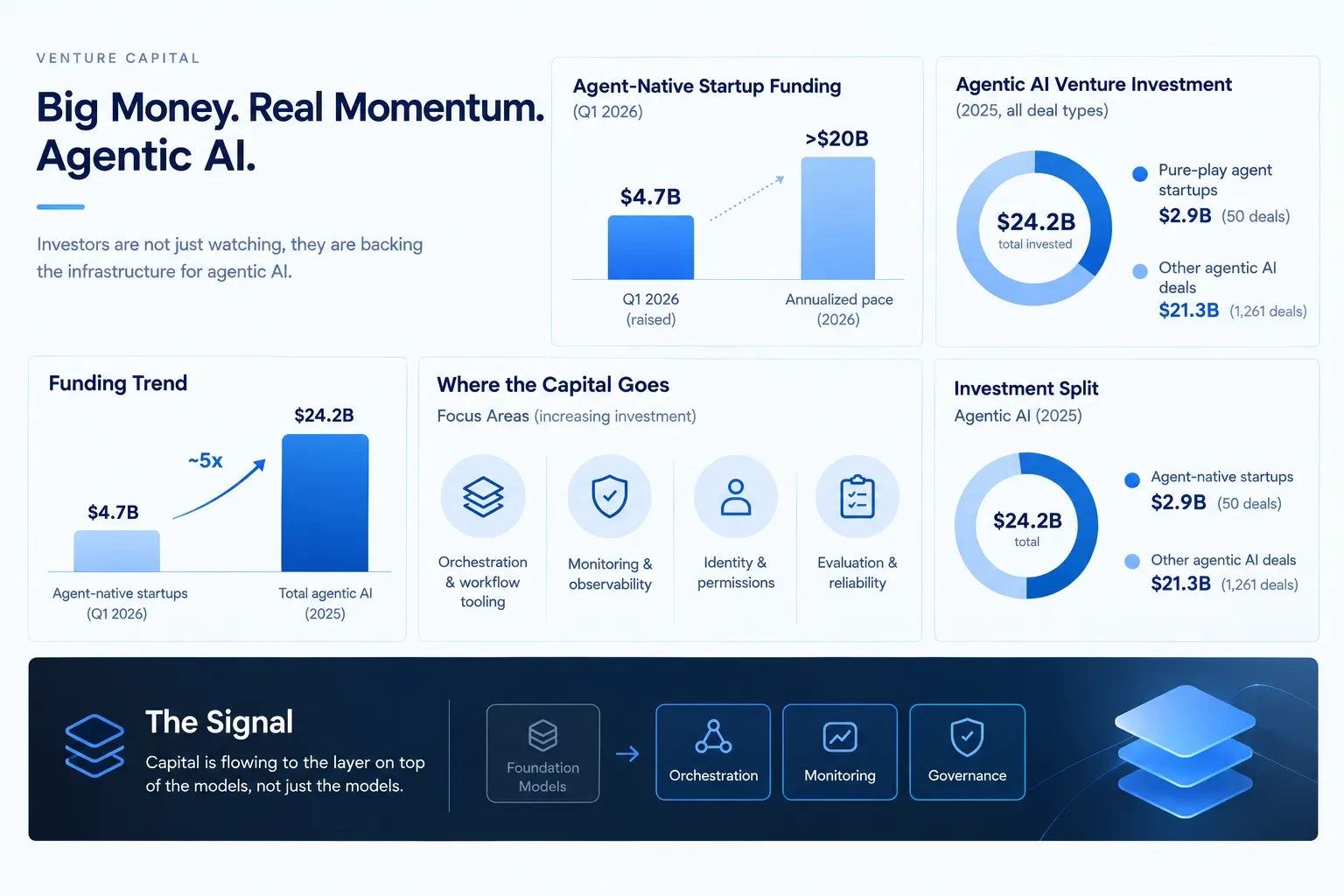
Venture capital has moved into this category with real force, not just interest. Agent-native startup funding reached 4.7 billion dollars in the first quarter of 2026 alone, an annualized pace implying a 20 billion dollar-plus full-year cohort, which several analysts describe as the largest software-vertical funding wave since cloud-native infrastructure in 2015 to 2017. Broader agentic AI venture investment across all deal types reached 24.2 billion dollars across 1,311 deals in 2025, with pure-play agent-focused startups capturing 2.9 billion dollars of that across 50 deals, concentrated heavily in multi-agent orchestration platforms and workflow execution tooling rather than foundation models themselves.
The composition of that capital matters as much as its size. Investment is increasingly flowing not to foundation model labs, who already command enormous capital from elsewhere, but specifically to the orchestration, monitoring, and governance layer sitting on top of those models, agent observability platforms, permission and identity management for autonomous systems, and evaluation tooling. That pattern is a reasonably reliable signal of market maturity: capital chasing the infrastructure layer rather than only the model layer suggests investors increasingly see the foundation-model question as settled and the real remaining value as sitting in how safely and reliably agents can be deployed on top of it.
Enterprise Adoption: Pilots Outpacing Production
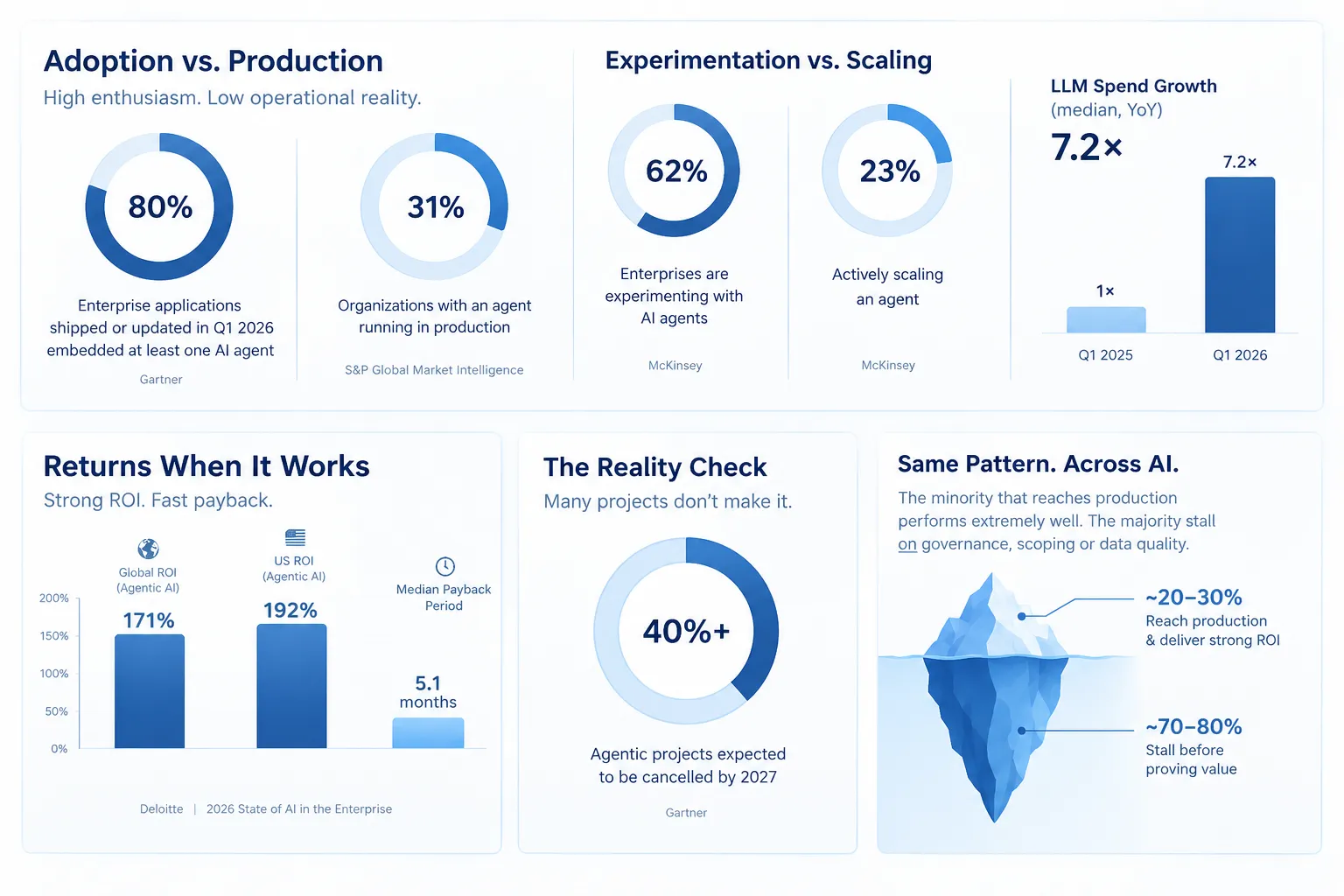
Enterprise adoption data shows a now-familiar gap between enthusiasm and operational reality. Eighty percent of enterprise applications shipped or updated in the first quarter of 2026 embedded at least one AI agent, according to Gartner, yet only 31 percent of organizations report having an agent actually running in production, per S&P Global Market Intelligence. McKinsey’s own State of AI research found 62 percent of enterprises are at least experimenting with AI agents, but just 23 percent report actively scaling one, and separate research puts the median enterprise’s monthly LLM spend growing 7.2 times year over year entering the first quarter of 2026, a cost trajectory that is itself becoming a genuine budgeting concern independent of whether the underlying agent delivers value.
Where agents do reach production, the returns are genuinely strong. Deloitte’s 2026 State of AI in the Enterprise report found agentic AI deployments averaging 171 percent return on investment globally, with US enterprises specifically reporting 192 percent, a return exceeding traditional automation ROI by roughly three times. Median payback period across successful deployments runs around 5.1 months. The gap between that return profile and the 40 percent-plus of agentic projects Gartner expects to be cancelled by 2027 is not a contradiction, it is the same pattern seen across most enterprise AI categories: the minority of projects that reach genuine production maturity perform extremely well, while the majority stall on governance, scoping, or data-quality problems well before they get the chance to prove their value.
Also Read: Complete AI Development Cost Guide
Industry Verticals
Adoption and spend concentrate unevenly across industries, with customer service and IT operations remaining the clearest, fastest-maturing use cases, both benefiting from well-structured, high-volume, relatively low-risk task patterns that suit current agent capability well. Revenue operations and business intelligence and analytics follow as the next wave, where agents increasingly handle lead qualification, pipeline analysis, and report generation tasks that previously required a human to manually synthesize data from multiple systems. Financial services and healthcare show real but more cautious adoption, consistent with the broader enterprise AI pattern of regulated industries moving more slowly given audit and compliance requirements, but with meaningful traction specifically through platforms built with governance and explainability as first-class features rather than retrofitted afterward.
Geographically, North America retains the largest share of agentic AI spend in 2026, supported by deep enterprise technology budgets, concentrated AI talent, and sustained venture capital and domestic compute investment. Asia-Pacific shows the steepest growth trajectory, with IDC projecting AI and generative AI investment in the region to reach 175 billion dollars by 2028 at a 59.2 percent compound annual growth rate, a pace that reflects both a later starting point and unusually aggressive public and private investment across China, India, Japan, and South Korea simultaneously.
The Technology Stack: How Agents Actually Talk to Things
This is the part of the agent landscape that changed most substantively in 2026, and it rarely gets covered with the technical precision it deserves in market-sizing reports. Two distinct problems need solving for an agent system to function at real scale, and 2026 produced genuine consolidation on both.
AI Agent Development Report: The first problem is vertical: how does a single agent connect to the tools and data it needs to do its job. The Model Context Protocol, MCP, Anthropic’s open standard released in November 2024 and donated to the Linux Foundation’s Agentic AI Foundation in December 2025, solves this specifically. One widely used framing describes MCP as the USB-C of tool connectivity, a single, stateful interface letting an agent discover and call tools, read contextual resources, and use structured prompts without custom integration code for every individual system.
The second problem is horizontal: how do multiple separate agents, potentially built by different vendors on different platforms, discover each other, delegate tasks, and collaborate on a shared goal. Google’s Agent2Agent protocol, A2A, released in April 2025 and also donated to the Linux Foundation, solves this specifically. Any A2A-compliant agent publishes a standardized Agent Card at a well-known URL declaring its skills, supported data formats, and security requirements, letting another agent discover and delegate work to it without bespoke integration. A2A launched with support from more than 50 industry partners, including Salesforce, SAP, ServiceNow, Microsoft, and AWS, and by its one-year anniversary in April 2026 had grown to more than 150 participating organizations, described by multiple technical surveys as the first credible cross-vendor agent interoperability deployment achieved at real scale.
A third standard, IBM’s Agent Communication Protocol, ACP, launched in March 2025 with a REST-first, asynchronous design well suited to enterprise messaging and offline, air-gapped deployments. Rather than competing indefinitely, IBM and Google announced in August 2025 that ACP would merge into A2A under the Linux Foundation’s governance umbrella, with ACP’s stateful, long-running workflow concepts absorbed directly into A2A rather than maintained as a separate standard. That consolidation, from three horizontal and vertical protocols down to two clearly complementary ones, MCP for agent-to-tool and A2A for agent-to-agent, is a genuinely significant maturation event for any business planning a multi-agent architecture, since it meaningfully de-risks the long-term viability of building on either standard.
Also Read: Cloud Migration Report, Trends, Cost & Timeline Benchmark Report 2026-2027
A fourth, more experimental protocol, the Agent Network Protocol, ANP, targets fully decentralized agent discovery and peer-to-peer communication across the open internet using cryptographic identity verification, positioning itself as infrastructure for open, cross-platform agent marketplaces rather than the more enterprise-controlled discovery model MCP and A2A assume. ANP remains considerably earlier-stage than MCP or A2A and is best understood as the forward-looking layer in this stack rather than something most businesses need to plan around in 2026 or 2027 specifically.
| Protocol | Solves | Status in 2026 |
|---|---|---|
| MCP (Model Context Protocol) | Agent-to-tool: connecting an agent to data and tools | Linux Foundation governed since Dec 2025; widely adopted, de facto standard |
| A2A (Agent2Agent) | Agent-to-agent: discovery and task delegation between agents | Linux Foundation governed; 150+ organizations by April 2026; v1.0 with Signed Agent Cards |
| ACP (Agent Communication Protocol) | Stateful, async enterprise agent messaging | Merged into A2A, August 2025; development winding down as a separate standard |
| ANP (Agent Network Protocol) | Decentralized, open-internet agent discovery and marketplaces | Early-stage; foundation for future open agent marketplaces |
Current technical guidance across multiple 2026 surveys converges on the same practical sequencing for a business building a genuine multi-agent system: start with MCP to give individual agents reliable access to tools and data, add A2A once a system genuinely needs multiple specialized agents coordinating with each other rather than one agent handling everything, and treat ANP-style open marketplace discovery as a forward-looking consideration rather than a near-term requirement for most enterprise deployments.
Agentic Commerce: A New Layer Emerging on Top
One genuinely new development worth flagging specifically for 2026-2027 planning is the emergence of payment-layer extensions built directly on top of these interoperability protocols. Google’s AP2 extension, shipping formally on top of A2A, and Coinbase’s x402 protocol both target the same emerging need: letting an autonomous agent actually complete a financial transaction, a purchase, a subscription, a service payment, as part of its task execution rather than stopping short and asking a human to complete the payment step manually. This is still an early-stage capability as of 2026, but it points toward a meaningful next phase of agent capability, agents that do not just recommend or draft an action but complete transactions end to end, and businesses in commerce, procurement, or any transaction-heavy workflow should treat this as a genuine 2027 planning consideration rather than a distant speculative feature.
What This Means for Businesses Planning AI Agent Investment

Pull the market sizing, investment, adoption, and technology data together and a few conclusions hold regardless of which specific market-size figure you choose to trust. The category is growing fast by any measure, and the protocol layer underneath it has matured and consolidated meaningfully in the past year, which genuinely reduces the architectural risk of building a serious multi-agent system today compared to even twelve months ago. The gap between pilot and production remains the central business risk, not the technology itself, consistent with everything the adoption data in this report shows, and the returns available to organizations that close that gap are large enough, 171 percent average ROI, a roughly five-month payback period, to justify serious, disciplined investment rather than either over-hyped adoption or defensive avoidance.
For a business deciding how to prioritize spend heading into 2027, the practical sequencing current data supports is building on the now-consolidated MCP and A2A standards rather than a proprietary or soon-to-be-abandoned alternative, starting with a narrow, well-scoped use case in a vertical already showing strong traction, customer service, IT operations, or sales and revenue operations, and investing in the governance and observability layer early rather than treating it as cleanup work after a pilot has already proven the underlying concept.
At Cybertize Technologies, this is exactly the market and technology landscape we build inside for clients evaluating agent investment, and the data throughout this report points to the same conclusion we bring to every client conversation: the agents that deliver real returns are built on standards that will still exist in two years, scoped to a problem the organization actually understands, and governed from day one rather than after the first incident forces the issue.
Cybertize Technologies Private Limited builds AI agent systems on standards designed to last, scoped to problems businesses actually understand, with governance built in from day one. Cybertize Technologies provides Ai Agent Development Services in India, USA, UAE. Cybertize is also one of the Leading AI Agent Development Company in Delhi, Mumbai, Bengaluru, Gujarat, Indore with more that 25+ Inhouse Development Team and 10+ ML Engineers.
Sources:
- MarketsandMarkets, Agentic AI Market Report 2026-2033
- GetPanto, AI Agents Statistics 2026: Market Size and Adoption
- Keyhole Software, The Enterprise Agentic AI Market Size: 2026 Statistics, Growth, and Adoption Data
- RaftLabs, AI Agents Statistics: Market Size, Adoption Rates, ROI
- MarkNtel Advisors, AI Agent Market Analysis, Growth and Size Forecast 2032
- DigitalApplied, AI Agent Adoption 2026: 120+ Enterprise Data Points
- Tech-Insider, Agentic AI in Enterprise 2026: $9B Market Analysis
- Paul Okhrem, Enterprise AI Agents Adoption Statistics 2026
- The Business Research Company, AI Agents Market Share, Trends Report 2026-2030
- AI Business Weekly, AI Agents Statistics: Adoption, Market and ROI 2026
- arXiv, LAP: An Agent-to-Instrument Protocol for Autonomous Science
- arXiv, Aiming for AI Interoperability: Challenges and Opportunities
- arXiv, Governance Gaps in Agent Interoperability Protocols: What MCP, A2A, and ACP Cannot Express
- arXiv, From Multi-Agent Systems and the Semantic Web to Agentic AI: A Unified Narrative of the Web of Agents
- arXiv, A Survey of Agent Interoperability Protocols: MCP, ACP, A2A, and ANP
- MindStudio, Six Agent Protocols Every AI Builder Needs to Know in 2026
- Tyk, Agent Protocols: A Complete Guide to MCP, A2A, and ACP
- StellAgent, A2A Protocol Explained: How Google’s Agent-to-Agent Standard Grew to 150+ Organizations in One Year