Table of Contents
AI Startups & Technology Trends Report: The Landscape Has Changed Shape
Go back three years and the AI startup conversation was almost entirely about one thing: whose model was biggest. That conversation has moved on. Forbes’ 2026 AI 50 list, produced in partnership with Sequoia Capital and Meritech Capital, put it plainly in its own framing of this year’s cohort. The story is no longer just about who builds the most powerful model. It is about who controls it, how it gets used, and what it costs to run.
That shift shows up clearly in the data. Companies solving for deployment, data access, and infrastructure cost, rather than raw model performance, dominate this year’s standout lists. It also shows up in how fast agentic security has emerged as its own category. CB Insights’ 2026 AI 100, now in its tenth year, drew from more than 40,000 companies and specifically called out autonomous security operations, humanoid robotics, and domain-specific vertical AI as the defining themes of this year’s winners, a noticeably different emphasis than the general-purpose chatbot wave that dominated 2023 and 2024.
Notable Companies by Category
AI Startups & Technology Trends Report: The following companies are drawn from Forbes’ 2026 AI 50 and CB Insights’ 2026 AI 100, two of the most rigorously vetted, publicly documented rankings in the industry. Companies are grouped by primary category rather than ranked, since neither source publishes a strict numerical order within its list.
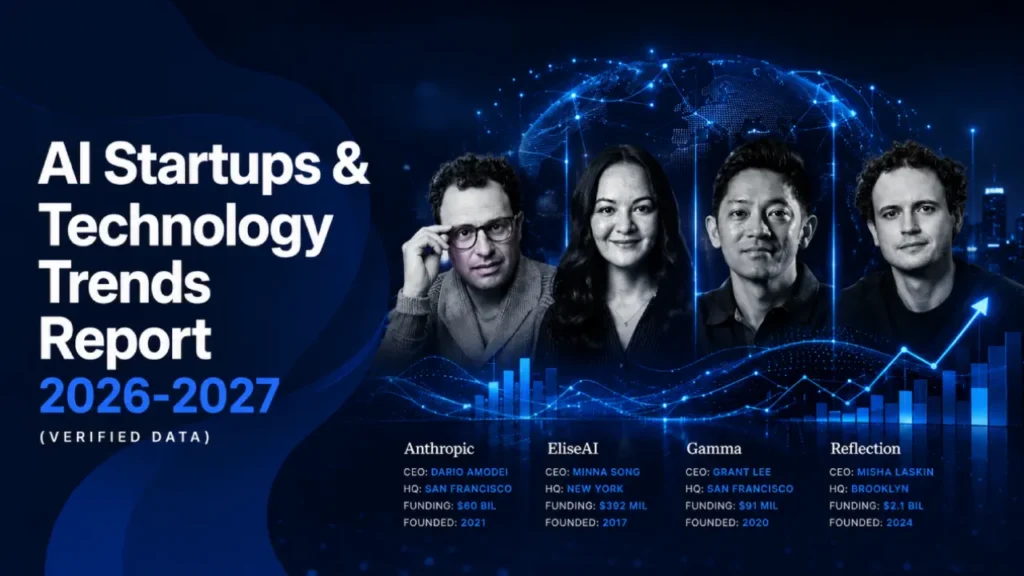
Foundation Models and Frontier Research OpenAI and Anthropic continue to lead on raw capability and remain the two largest fundraisers in the space, with OpenAI alone accounting for 182.6 billion dollars of the AI 50 cohort’s combined 305.6 billion dollars raised. Mistral AI, based in Paris, and Cohere, based in Toronto, represent the leading non-US challengers building competitive frontier models with a stronger focus on enterprise deployment and data sovereignty. Reflection, a Brooklyn-based startup founded by former Google DeepMind researchers, has raised 2.1 billion dollars at an 8 billion dollar valuation to build bespoke frontier models for international markets, positioned partly as an alternative to Chinese open-source labs like DeepSeek.
AI Coding and Software Development Cursor and Replit lead the AI-assisted coding category, alongside Cognition, known for its autonomous coding agent product. Genspark and Lovable, the latter based in Stockholm, represent the newer wave of AI app-building tools aimed at non-technical builders.
AI Infrastructure and Data Databricks, Crusoe, and SambaNova Systems anchor the infrastructure layer, each operating at a different point in the stack, from data platforms to compute. Fireworks AI focuses on fast, cost-efficient model inference. Fal specialises in infrastructure for generative media workloads specifically.
Agentic AI, Security, and Governance This is the fastest-growing new category in both rankings. CB Insights specifically highlighted Prophet Security, which has run over a million autonomous security operations investigations, and Straiker, which reports detection accuracy above 98 percent for securing enterprise AI agents. Knostic and Seekr both focus on governance and explainability for AI systems operating in regulated environments, while Cyera addresses data security specifically for AI-era enterprises.
Creative and Content Generation Midjourney and Black Forest Labs, based in Freiburg, Germany, lead image generation, notably alongside Suno for AI-generated music, both companies among the few on the Forbes list to have scaled without heavy external venture funding. HeyGen and Synthesia lead AI video generation, and Krea rounds out the creative tooling category.
Legal, Enterprise, and Vertical AI Harvey and Legora, the latter based in Stockholm, lead AI-driven legal automation. EliseAI, used by more than 80 percent of the largest US property management firms for administrative automation, represents the vertical SaaS wave applying AI to a single, deep industry use case rather than a horizontal product.
Robotics and Physical AI Physical Intelligence and Skild AI, based in Pittsburgh, lead the robotics and physical AI category, alongside Applied Intuition, which focuses on autonomous vehicle software and simulation.
Search and Productivity Perplexity continues to lead AI-native search, while Gamma has built a strong position in AI-assisted presentation and document creation.
The Technology Trends Behind the Rankings
Agentic systems are moving from demo to production. A meaningful share of this year’s standout companies across both rankings are agent-based systems executing multi-step workflows without a human approving each individual step, a functional leap beyond the single-turn chatbot interfaces that defined the previous two years. Prophet Security’s million-plus autonomous investigations is one concrete example of what that looks like at real operational scale rather than in a pilot.
Capital efficiency is becoming a genuine differentiator, not just a nice story. Midjourney and Suno both made this year’s Forbes list without raising significant external venture capital, proof that profitable, disciplined AI businesses are achievable in the right category, particularly in creative tooling where usage-based revenue can scale faster than enterprise sales cycles.
Geography is genuinely diversifying. This year’s combined rankings include companies headquartered in Paris, Stockholm, Toronto, London, Freiburg, and Pittsburgh, alongside the traditional concentration in the San Francisco Bay Area, which still accounts for the largest single cluster but no longer anything close to a monopoly on where competitive AI companies get built.
Security and governance have become a startup category in their own right. Three years ago, AI security was a feature inside a broader product. In the 2026 rankings, it is a standalone, well-funded category, Straiker, Knostic, Seekr, Cyera, and Prophet Security all made CB Insights’ list specifically for governance, security, or explainability work, reflecting how much enterprise buyers now demand auditability before they will deploy agentic systems at scale.
Vertical specialisation is outperforming horizontal breadth in several categories. Legal AI, property management AI, and healthcare-specific AI tools are showing stronger commercial traction in this year’s data than several general-purpose horizontal AI products, suggesting the market is rewarding startups that go deep on one industry’s specific workflow over those trying to serve every industry with one generic tool.
India’s AI Startup Landscape: The Fastest-Moving Piece of This Story
For a company like Cybertize Technologies operating inside the Indian market, this is the section that matters most, and the data shows India moving at a pace that outstrips most global comparisons right now.
India’s AI ecosystem drew 3.94 billion dollars in venture capital in the first quarter of 2026 alone, roughly six times the total raised across all of 2025, and deployed more than 38,000 GPUs nationwide during the same period. The country minted two new AI-linked unicorns, Neysa and Sarvam AI, within a four-month window in early 2026, and by mid-year had added a total of five new unicorns overall, Juspay, Neysa, KreditBee, Skyroot Aerospace, and Sarvam AI, with AI, fintech, and space technology standing out as the three sectors attracting the strongest investor interest.
AI Startups & Technology Trends Report: Krutrim, founded by Ola co-founder Bhavish Aggarwal, became India’s first AI unicorn in January 2024, just weeks after launch, and has since built out Krutrim-2, a 12-billion parameter multilingual model, alongside Kruti, described as India’s first agentic AI assistant supporting 13 Indian languages. Sarvam AI, founded by IIT and IISc alumni Vivek Raghavan and Pratyush Kumar, builds AI models specifically for Indian languages and infrastructure constraints and reached unicorn status in June 2026 after a 234 million dollar Series B round led by HCL Technologies. Neysa, an AI infrastructure company building domestic GPU computing capacity, raised one of the largest funding rounds of any Indian startup in 2026, reaching a 1.4 billion dollar valuation. Fractal Analytics, founded in 2000 and now valued between 1.6 and 2.4 billion dollars, leads India’s decision intelligence category, applying AI to supply chain and financial risk work for Fortune 500 retail and consumer goods companies, and completed a public listing in 2026.
The scale of the broader ecosystem is worth noting too. India now hosts more than 2,140 AI companies, of which 536 are funded and have collectively raised 5.79 billion dollars in venture capital and private equity, with seven companies having reached unicorn status specifically within the AI sector. The government’s IndiaAI Mission, backed by 1.25 billion dollars in committed funding with potential to double, and February 2026’s India AI Impact Summit, which triggered more than 200 billion dollars in investment commitments, both point toward sustained momentum rather than a short-term funding spike.
What This Means Heading Into 2027
The throughline across the global rankings and India’s own data is the same. The market has moved past rewarding raw model capability alone and is now rewarding companies that can prove real deployment, real governance, and real commercial traction. That shift favours founders who build with discipline around a specific, well-understood problem over those chasing the broadest possible AI narrative.
For Indian founders specifically, the opportunity is unusually well timed. Global investors are actively looking beyond the traditional Bay Area concentration, India’s own funding and infrastructure numbers are accelerating faster than almost anywhere else in the world, and the categories showing the strongest traction globally, agentic systems, vertical AI, and infrastructure, all map cleanly onto areas where Indian technical talent and cost structure already carry a natural advantage.
At Cybertize Technologies, this is the landscape we help founders build inside, translating where the market is actually heading into products that are grounded in real, defensible traction rather than a narrative that cannot survive scrutiny.
Cybertize Technologies Private Limited helps founders build AI products grounded in real market traction, drawing on current global and Indian industry data rather than hype.
Sources
- Forbes, AI 50 2026: How Forbes Compiled The List, and full 2026 AI 50 list
- Forbes, Forbes Unveils 2026 AI 50, Marking Shift From AI Dominance To AI Independence
- CB Insights, The AI 100: The Most Promising Artificial Intelligence Startups of 2026
- CB Insights, individual AI 100 winner press releases (Alex AI, Knostic, Straiker, Seekr)
- FoundEvo, Forbes AI 50 2026 analysis
- AIwire/HPCwire, Forbes AI 50 List Shows Data Emerging as the Core of AI Value
- Tracxn, Artificial Intelligence in India, 2026 Market and Investment Trends
- Tracxn, Unicorn Startups in India, July 2026
- AI Funding Tracker, Top AI Startups in India 2026
- Startupfeed, India AI Startups 2026, 15 Bold Companies
- Medium/Pratik Rupareliya, Top AI Companies in India 2026
- Analytics Insight, Indian Startups That Became Unicorns in H1 2026
- Business Connect India, India’s Next Unicorns 2026