Table of Contents
Why “How Much Does AI Cost” Has No Single Answer
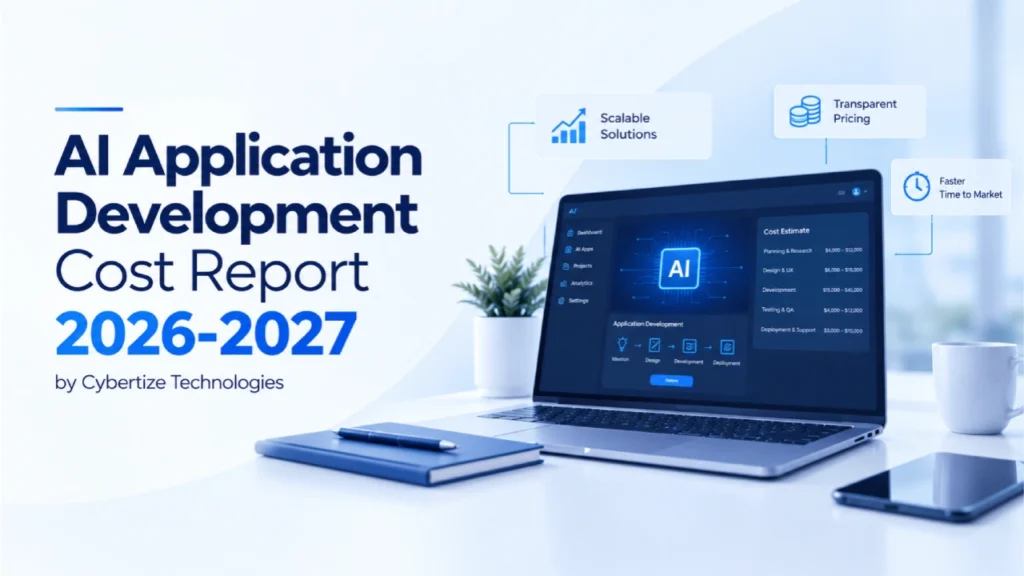
AI Application Development Cost: Every founder evaluating an AI project asks some version of the same question, and every honest answer starts the same way: it depends on what kind of AI application you mean, far more than most initial conversations acknowledge. A rule-based FAQ chatbot and a real-time computer vision quality-control system are both “AI projects,” and they sit roughly 25 times apart on cost. A recommendation engine for a 10-person retail startup and the same recommendation engine for a Fortune 500 healthcare system share almost no technical DNA once compliance requirements enter the picture.
At Cybertize Technologies, the scoping conversation we have before any proposal gets written is almost entirely about pinning down exactly these variables, application type, industry, and who actually builds it, because a number quoted without that context is close to meaningless. This report benchmarks real 2026-2027 pricing across all three dimensions, pulled from current industry’s AI Application Development Cost guides and cross-checked against each other for consistency.
Also Read: RAG vs Fine-Tuning, Enterprise AI Architecture Report 2026-2027
Cost by Application Type
This is the single most useful cut for a founder trying to benchmark their own project idea, and current 2026 pricing data converges reasonably well across independent sources once outliers are accounted for.
| Application Type | Typical 2026 Cost Range | Primary Cost Driver |
|---|---|---|
| Rule-based / FAQ chatbot | $10,000-$40,000 | Knowledge base quality, scripted flows |
| LLM-powered chatbot (RAG) | $20,000-$120,000 | Prompt engineering, knowledge-base wiring, per-token inference |
| Multi-modal chatbot (voice, vision, text) | $40,000-$100,000 | Additional input/output channel integration |
| Recommendation / personalization engine | $25,000-$200,000 | Behavioral data pipelines, cold-start handling, retraining cadence |
| Predictive analytics / forecasting | $15,000-$200,000 | Historical data depth, feature engineering, drift monitoring |
| NLP / text AI solution | $20,000-$180,000 | Fine-tuning need, domain specialization |
| Computer vision system | $30,000-$300,000+ | Annotation volume, GPU training, edge deployment |
| Agentic AI / workflow automation | $80,000-$200,000+ | Tool integrations, error recovery, approval gates |
| Generative AI product | $25,000-$300,000+ | Output quality bar, safety filtering, evaluation infrastructure |
| Custom AI model / foundation model work | $100,000-$1M+ | Training infrastructure, deep specialization |
A few patterns are worth calling out directly rather than leaving buried in the table. LLM-powered chatbots built on existing foundation models through an API, GPT, Claude, Gemini, have become dramatically cheaper than the custom, from-scratch NLP systems businesses built even three years ago, since the heavy model-training cost has effectively been replaced by prompt engineering, retrieval pipeline construction, and evaluation work. Computer vision remains the single most expensive and most variable category on this list, and for a consistent reason across every source reviewed, annotation cost. Labeling enough high-quality training images, correctly, by qualified annotators, is a labor-intensive process that scales directly with the diversity of real-world conditions, lighting, angle, occlusion, a vision system needs to handle reliably, and it is the cost center most initial proposals underestimate.
Also Read: AI Agent Development Report for Business Market & Technology 2026-2027
AI Application Development Cost by Industry Vertical:
This is the dimension most generic cost guides skip entirely, and it matters as much as application type for any founder in a regulated sector. The same technical build, a recommendation engine, a chatbot, a predictive model, costs meaningfully more in healthcare or finance than in retail or education, purely as a function of compliance overhead, not underlying AI complexity.
| Industry | Typical 2026 Cost Range | What Drives It Up |
|---|---|---|
| Education / general retail | $25,000-$150,000 | Lower compliance burden, standard integrations |
| Retail and e-commerce | $25,000-$300,000 | Catalog scale, personalization depth, demand forecasting complexity |
| Manufacturing | $100,000-$700,000 | Sensor pipelines, edge hardware, downtime cost of errors |
| Financial services / insurance | $60,000-$500,000+ | Regulatory oversight, fraud-detection accuracy requirements, audit trails |
| Healthcare / life sciences | $75,000-$1.2 million+ | HIPAA controls, clinician-annotated data, validation cycles |
Healthcare deserves particular attention because the range is genuinely the widest and the compliance tax genuinely the steepest of any vertical covered in current cost data. A patient-engagement chatbot sits at the lower end of the healthcare range, while a diagnostic imaging or clinical decision-support tool, requiring extensive clinician-validated training data and a far more rigorous testing and validation cycle before any real patient ever interacts with it, sits at the very top, sometimes exceeding a million dollars even for what would be a comparatively modest project in a less regulated industry. Financial services shows a similar, if somewhat less extreme, pattern, with fraud detection and algorithmic trading systems carrying real regulatory audit requirements that a comparable retail recommendation engine simply does not.
Cost by Team Model: In-House vs Agency vs Offshore
AI Application Development Cost Analysis: This is the lever with the single largest impact on total cost of any variable in this report, larger than application type or industry in absolute dollar terms, and it is the one most first-time AI buyers underweight relative to its actual importance.
| Team Model | Typical Annual Cost (US-based) | Best Fit |
|---|---|---|
| Full in-house AI team (US) | $1.35 million-$2.2 million+ | Long-term AI product core to the business, IP stays fully internal |
| US or UK specialist agency | $100-$200 per hour ($180,000-$720,000 project equivalent) | High-quality, structured delivery, project-based work |
| Offshore / Indian development team | $30-$80 per hour ($300,000-$800,000 project equivalent, or 60-70% below Western agency cost) | Cost-sensitive builds without sacrificing delivery quality |
| Freelancer / independent contractor | Highly variable, lowest baseline cost | Small, narrowly scoped projects, highest execution risk |
Building a full in-house AI team, machine learning engineers, data scientists, MLOps specialists, costs 1.35 to 2.2 million dollars in salaries and infrastructure in year one alone before a single feature ships to production, and current market analysis puts the AI talent demand-to-supply gap in the US at roughly 3.2 to 1, meaning hiring timelines for a genuinely qualified in-house team commonly run 6 to 12 months before meaningful development even begins. For most businesses building their first serious AI product, that math makes an agency or offshore engagement the more rational starting point regardless of long-term ambitions, not because in-house talent is worse, but because the fixed cost and hiring timeline rarely make sense before a product has proven its core value. A good Indian development team specifically delivers comparable quality output at 60 to 70 percent lower cost than an equivalent Western agency, a gap reflecting genuine cost-of-living and infrastructure differences rather than a quality tradeoff, which is a large part of why offshore and nearshore engagement models have become the default starting point for a growing share of first-time AI buyers globally, not just a budget compromise.
The most consistent practical recommendation across current 2026 guidance, regardless of which specific source is referenced, is a hybrid model: a small internal AI strategy function that owns product direction and business context, paired with an experienced outsourced or offshore development partner for the actual engineering work, capturing most of the cost advantage of outsourcing while retaining the strategic control that keeps an in-house team valuable in the first place.
Also Read: Cloud Migration Report, Trends, Cost & Timeline Benchmark Report 2026-2027
The Hidden Costs Most Quotes Leave Out
A pattern repeats across nearly every cost guide reviewed for this report, worth stating plainly because it is the single most common source of founder frustration after a project starts. Annual maintenance typically adds 15 to 30 percent of the original development cost every single year, covering model retraining, monitoring for performance drift, security patching, and ongoing inference costs, a recurring line item a first proposal frequently omits or significantly understates. Security and compliance audits add a further 1,000 to 10,000 dollars or more annually specifically in regulated industries, essential for maintaining, not just achieving, ongoing regulatory adherence. And a development phase breakdown worth internalizing before any budget gets finalized: data preparation and quality assurance together commonly represent a larger share of total project cost than the actual model-building or integration work itself, a pattern consistent with the data curation findings covered in adjacent cost research on this topic, and one that first-time AI buyers consistently underestimate when comparing an initial quote against what the real, full-lifecycle number ends up being.
What This Means for Founders Planning an AI Budget
Pull the three dimensions in this report together, application type, industry, and team model, and a practical planning sequence emerges. Start by pinning down exactly which application type your project actually is, since the AI Application Development Cost range for a chatbot and a computer vision system differ by an order of magnitude, and far too many early conversations stay vague on this point well past when they should be specific. Factor in industry compliance burden honestly from the start rather than discovering it mid-project, since a healthcare or financial services build genuinely costs more for reasons that have nothing to do with engineering difficulty and everything to do with validation, audit, and data-handling requirements that cannot be skipped. And evaluate team model primarily against project maturity, not just hourly rate, since the cheapest hourly number rarely represents the cheapest actual delivered outcome once hiring timelines, management overhead, and delivery risk are factored in alongside the sticker price.
At Cybertize Technologies, this is exactly the scoping discipline we bring to every AI engagement, because the number a founder actually needs is never “how much does AI Application Development Costs.” It is “how much does this specific application, in this specific industry, built by this specific team, actually cost,” and that is a question worth answering precisely before a single line of code gets written.
Cybertize Technologies Private Limited scopes AI projects by application type, industry compliance burden, and the right team model for each client’s specific stage, rather than quoting a single generic number.
Sources
- AVIXA Xchange, How Much Does AI Development Cost in 2026? Complete Guide
- Medium / Everything for AI, AI App Development Cost in 2026: A Detailed Breakdown
- Netguru, AI Development Cost: Full Budget Guide for 2026
- NetClues, AI Development Cost Guide 2026: Budget for Custom AI Solutions
- AddWeb Solution, AI Development Cost in 2026: Real Pricing by Project Type
- SumatoSoft, What Affects AI Development Cost in 2026
- Kellton, Enterprise Custom AI Development Cost in 2026: Complete Breakdown
- TekRevol, AI App Development Cost in 2026: Full Pricing Breakdown
- Albiorix, AI Development Cost in 2026: Complete Pricing Guide
- SpaceO Technologies, What Does AI Development Cost in 2026? Pricing Explained
- Riseup Labs, AI Agent Development Cost: Full Breakdown for 2026
- Perimattic, AI Development Cost in 2026: Complete Breakdown, Hidden Fees, and How to Budget Right
- Intellectyx, AI Agent Development Cost in 2026, and How Much Does It Cost to Hire an AI Development Team in 2026?
- 75Way, AI Development Cost: A Complete Pricing Guide (2026)
- AlphaKlick, AI Agent Development Cost in 2026: What Businesses Actually Pay