Table of Contents
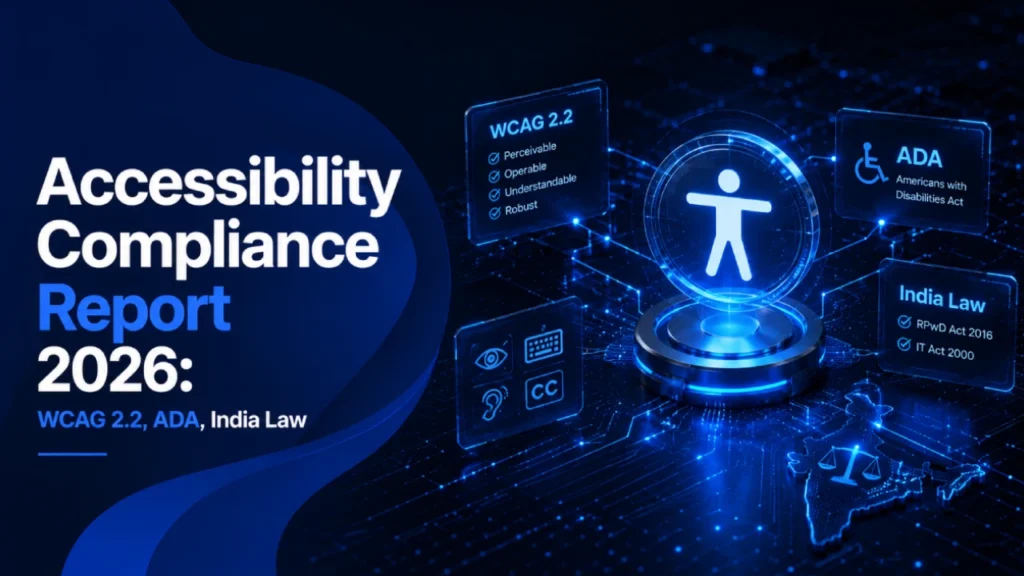
Accessibility Compliance Report: A Compliance Gap That Refuses to Close
Here is the uncomfortable number that frames everything else in this report. Ninety-five point nine percent of the internet’s top one million homepages have detectable WCAG failures, each averaging around 56 accessibility errors, according to the WebAIM Million, the largest annual audit of the web currently conducted. Put plainly, only about 4 out of every 100 major websites are genuinely accessible right now, in an era where accessibility litigation has never been more active and the legal standards have never been more clearly documented.
At Cybertize Technologies, accessibility comes up in nearly every client engagement now, not as a compliance afterthought bolted on before launch, but as a genuine architectural requirement clients increasingly ask for upfront, particularly those building for regulated sectors like banking or education, or those with any exposure to US or EU markets. This report lays out where WCAG 2.2 compliance actually stands, what is driving the current wave of litigation, and what accessibility law specifically requires for businesses operating in India.
What WCAG 2.2 Actually Requires
WCAG 2.2, published by the W3C in November 2023, is the current version of the Web Content Accessibility Guidelines, the internationally recognized standard referenced across nearly every accessibility law in the world, from the US ADA to the EU’s European Accessibility Act to India’s own IS 17802 standard. WCAG 2.2 is backward-compatible with 2.1, meaning conformance with 2.2 automatically satisfies 2.1 as well, which is why the practical guidance most accessibility consultants now give is straightforward: treat WCAG 2.1 AA as the legal floor referenced by most current regulation, and WCAG 2.2 AA as the actual target, since it delivers full coverage of the standard courts most commonly reference while adding current best practice on top.
Accessibility Compliance Report: The most common real-world failures are concentrated in a small number of root-cause issues, not scattered evenly across the guidelines. Missing form input labels appear on 48.2 percent of homepages, directly blocking users from completing basic tasks like checkout or signup. Empty or broken links appear on 45.4 percent of homepages, confusing both sighted visitors and assistive technology alike. Buttons with no descriptive text, entirely unusable to a screen reader, appear on 29.6 percent of homepages, and missing document language declarations, which prevent assistive technology from correctly processing page content at all, appear on 15.8 percent. These four failure types alone account for the overwhelming majority of documented WCAG errors, and every one of them is a markup and component-level issue, not something a surface-level fix can meaningfully resolve.
There is a genuine, if modest, sign of progress worth noting honestly. Average detected errors per homepage fell from 56.8 in 2024 to roughly 51 in the most recent WebAIM analysis, meaning the overall failure rate improved slightly from 95.9 to 94.8 percent depending on which year’s dataset is referenced. But six-year cumulative gains total only about 3.1 percent, a pace that makes clear accessibility remediation is happening, just far more slowly than the growth of digital surface area it needs to keep up with, especially as homepage complexity itself has grown roughly 61 percent over the same six-year window.
The Litigation Reality in 2026
Website accessibility lawsuits are on track to surpass 6,000 in 2026, a historic high and close to a 20 percent increase over 2025’s total. That growth follows a documented, somewhat predictable pattern: whenever federal enforcement slows, through delayed Title II timelines or reduced DOJ involvement, private plaintiffs’ firms step in to fill the gap, and 2026 has seen exactly that dynamic play out. Roughly 3,100 of 2025’s ADA Title III federal filings, about 36 percent of all such filings that year, targeted website accessibility specifically, up from 28 percent the year before, and once state court filings are added, particularly in New York, which alone accounts for more than a third of state-level accessibility suits, the annual total tops 8,600 lawsuits.
The financial exposure is not trivial. Average settlement and defense costs for a website accessibility lawsuit run 60,000 to 200,000 dollars or more, against a basic accessibility audit costing 2,500 to 10,000 dollars and ongoing monitoring running 200 to 1,000 dollars a month, a cost asymmetry that makes proactive compliance function closer to insurance than expense. That asymmetry is reinforced by repeat-offender data: 45 to 46 percent of 2025’s federal digital accessibility lawsuits targeted companies that had already been sued before, meaning getting sued once and failing to fix the underlying code measurably increases future risk rather than reducing it.
One finding in the 2026 litigation data deserves particular attention because it directly contradicts a product category many businesses have been sold as a quick fix. Accessibility overlay widgets, the one-line-of-code scripts marketed as instant compliance, provide no measurable legal protection. Roughly 22.6 percent of lawsuits in the first half of 2025 targeted websites that already had an overlay installed, a rate materially similar to sites without one, and the FTC separately fined a leading overlay vendor 1 million dollars over its compliance marketing claims. The reason is structural rather than incidental. Overlays operate client-side, layered on top of a site’s existing code, while the dominant failure types documented above, missing labels, broken links, undescriptive buttons, are markup and component-level issues that a client-side script cannot actually fix. If a site was not built with WCAG standards in its underlying code, no overlay bolted on afterward changes that reality, regardless of what the badge in the corner claims.
Where Enforcement Stands: US, EU, and India
United States. The regulatory picture has genuinely shifted mid-decade. The DOJ’s Title II final rule originally required state and local governments serving populations of 50,000 or more to comply with WCAG 2.1 AA by April 24, 2026, but an April 2026 Interim Final Rule extended that deadline by a year to April 26, 2027 for large public entities, and to April 26, 2028 for smaller ones, with a parallel extension of the first Section 504 healthcare deadline to May 2027. A federal lawsuit filed in May 2026 is already challenging those extensions. Crucially, these delays apply specifically to Title II, government entities, and Section 504, federally funded healthcare recipients. They create no general safe harbor for private businesses under Title III, which is exactly the category driving the bulk of the 6,000-plus lawsuits projected for 2026.
European Union. The European Accessibility Act took effect June 28, 2025 and applies to any website or app selling digital products or services to EU residents, regardless of where the company itself is headquartered, referencing EN 301 549, a standard that aligns directly with WCAG 2.1 AA. This matters directly for Indian software and SaaS exporters specifically, since an Indian company with no EU office but with EU-based customers is still squarely within the EAA’s scope. Unlike the US framework’s reactive, litigation-driven enforcement, the EAA follows a proactive model, requiring EU member states to designate a market surveillance authority empowered to conduct compliance checks and impose penalties directly, with Ireland’s implementing regulation, for example, allowing fines up to 60,000 euros or imprisonment up to 18 months for non-compliance.
India. The Rights of Persons with Disabilities Act, 2016, mandates digital accessibility across both public and private sector organizations, covering more than 26.8 million persons with disabilities in India according to Census data, and expanding the legally recognized categories of disability from 7 to 21 conditions compared to the earlier 1995 legislation it replaced. Section 40 through 46 of the Act directly address accessibility requirements across infrastructure, transportation, and digital services, and June 2022 marked the official compliance deadline for public and private service providers under the Act’s implementing rules. India’s technical standard, IS 17802, maps to WCAG 2.1, aligning it closely with the same underlying standard referenced by both the US and EU frameworks. The Guidelines for Indian Government Websites, now on version GIGW 3.0, mandate WCAG 2.1 AA compliance for public sector platforms specifically, formal certification requiring a five to six month STQC audit process under MeitY, including a mandatory VAPT security report from a CERT-In empaneled agency before certification can even begin.
Accessibility Compliance Report: The enforcement gap between India’s framework and the EU’s is worth stating plainly, because it shapes how seriously many Indian businesses currently treat this obligation. Unlike the EAA’s proactive market surveillance model, India’s accessibility framework remains largely reactive, placing the burden on an aggrieved individual to pursue legal redress rather than empowering a regulator to proactively audit and penalize non-compliant platforms, a gap the Supreme Court’s ruling in Rajive Raturi v. Union of India has pushed against directly, and one that disqualification from government contracts increasingly reinforces for non-compliant vendors even without a formal regulator issuing fines directly.
| Framework | Region | Core Standard | Enforcement Model |
|---|---|---|---|
| ADA Title III | United States (private business) | WCAG 2.1 AA referenced in practice | Reactive, private litigation-driven |
| ADA Title II | United States (government) | WCAG 2.1 AA | Federal rule, deadlines extended to 2027-2028 |
| European Accessibility Act | European Union (and any business serving EU users) | EN 301 549, aligned to WCAG 2.1 AA | Proactive, government market surveillance |
| RPwD Act / IS 17802 | India | WCAG 2.1 (GIGW mandates AA for government) | Largely reactive, court-driven, contract disqualification risk |
Why This Matters Specifically for Indian Software Businesses
For an Indian technology company, accessibility compliance is rarely a single-jurisdiction question anymore, and treating it that way is one of the more common planning mistakes we see. A SaaS product built in India but sold to US enterprise customers inherits real ADA Title III litigation exposure the moment it has paying US-based users, regardless of where the company itself is registered. A product with even a modest EU customer base falls under the European Accessibility Act’s proactive enforcement regime directly, since the EAA explicitly disregards company location. And any product built for or sold into the Indian government or public sector space needs GIGW 3.0 and IS 17802 alignment as a hard procurement requirement, not an optional nicety, with disqualification from government contracts a documented, real consequence of non-compliance.
Given roughly 79 percent of India’s own web traffic now comes from mobile devices, and digital transaction volume in India is projected to quadruple between FY 2022-23 and FY 2026-27, the accessibility gap in the Indian market carries a genuine business cost on top of the legal one, a meaningful and fast-growing share of digital commerce currently remains functionally unusable for a portion of the country’s roughly 27 million-plus citizens with disabilities.
The Business Case Beyond Compliance Risk
It is worth stating the upside case directly, because accessibility gets framed almost entirely as risk avoidance when the underlying data supports a stronger, more positive argument. Companies leading in disability inclusion generate 1.6 times more revenue, 2.6 times more net income, and twice the economic profit of their peers, according to Accenture’s widely cited research. On the consumer side, 69 percent of disabled online shoppers click away from websites they find difficult to use because of their disability, and 83 percent of disabled users deliberately limit their shopping to sites they already know are accessible, meaning inaccessible design does not just create legal exposure. It actively excludes a customer base representing an estimated 13 trillion dollars in global purchasing power from ever converting in the first place.
What Actually Fixes This
The consistent, evidence-backed guidance across every credible 2026 accessibility resource reviewed for this report converges on the same conclusion, and it is a less convenient one than a quick-fix vendor pitch: accessibility has to be built into the underlying code and design system from the start, not layered on afterward. Automated scanners remain genuinely useful for catching the dominant failure types documented above, missing labels, broken links, undescriptive buttons, missing language tags, but detection without an assigned owner, a real remediation budget, and an actual fix pipeline changes nothing, which is exactly why the overall failure rate barely moved even in a year when automated scanning tools were more widely deployed than ever. The practical sequence that works, referenced consistently across current remediation guides, is to audit against WCAG 2.2 directly, fix contrast tokens, alt text, form labels, and accessible component names at the design-system level rather than the individual-page level, and verify the result with real assistive technology, not just an automated scan, before calling the work done.
At Cybertize Technologies, this is the standard we build to for client projects from the start, because retrofitting accessibility onto a shipped product is measurably harder, slower, and more expensive than building it into the design system architecture from day one, and the litigation and business-case data in this report both point to the same conclusion from different directions.
Frequently Asked Questions
What percentage of websites are actually WCAG compliant in 2026?
Only about 4 to 5 percent. The WebAIM Million, the largest annual accessibility audit of the web, found 95.9 percent of the top one million homepages have detectable WCAG failures, averaging around 56 errors per page, though that failure rate has improved slightly from 95.9 to roughly 94.8 percent over the most recent year measured.
What is the difference between WCAG 2.1 and WCAG 2.2?
WCAG 2.2, published in November 2023, is the current standard and is fully backward-compatible with 2.1, meaning conforming to 2.2 automatically satisfies 2.1 as well. Most accessibility consultants recommend treating WCAG 2.1 AA as the legal floor referenced by most current regulation and WCAG 2.2 AA as the actual target.
Do accessibility overlay widgets actually provide legal protection?
No, and the litigation data confirms this directly. Roughly 22.6 percent of accessibility lawsuits in the first half of 2025 targeted websites that already had an overlay widget installed, a rate materially similar to sites without one, because overlays operate client-side and cannot fix the markup and component-level issues that cause the majority of documented WCAG failures.
How many website accessibility lawsuits are being filed in 2026?
Website accessibility lawsuits are on track to surpass 6,000 in 2026, a nearly 20 percent increase over 2025, with total digital accessibility filings across state and federal courts topping 8,600 once all categories are combined, and roughly 45 to 46 percent of federal filings targeting companies that had already been sued once before.
Does India have a legal requirement for website accessibility?
Yes. The Rights of Persons with Disabilities Act, 2016, mandates digital accessibility for both public and private organizations in India, and India’s technical standard, IS 17802, maps to WCAG 2.1. Government websites specifically must meet GIGW 3.0 requirements, which mandate WCAG 2.1 AA compliance and require formal STQC certification.
Does the European Accessibility Act apply to Indian companies?
Yes, if they have EU customers. The EAA applies to any website or app selling digital products or services to EU residents regardless of where the company is headquartered, which means an Indian SaaS company or e-commerce business with EU users falls under its proactive enforcement regime directly.
How is India’s accessibility enforcement different from the EU’s?
India’s framework remains largely reactive, placing the burden on an affected individual to pursue legal action, while the EU’s European Accessibility Act follows a proactive model, requiring member states to designate a market surveillance authority empowered to conduct compliance checks and impose penalties directly without waiting for a complaint.
What are the most common WCAG failures found on websites?
Missing form input labels appear on 48.2 percent of homepages, empty or broken links on 45.4 percent, buttons with no descriptive text on 29.6 percent, and missing document language declarations on 15.8 percent. These four issue types account for the large majority of documented WCAG failures and all require fixes at the code and component level.
Is there a real financial cost to inaccessible websites beyond lawsuit risk?
Yes, and it is substantial. Sixty-nine percent of disabled online shoppers click away from websites they find difficult to use, and 83 percent limit their shopping entirely to sites they already know are accessible, representing an estimated 13 trillion dollars in global purchasing power that inaccessible design effectively excludes before a sale ever happens.
What is the most effective way to actually achieve WCAG compliance?
Building accessibility into the code and design system from the start rather than adding it after launch. Automated scanning tools catch the dominant failure types effectively, but detection without an assigned owner, a real remediation budget, and a fix pipeline does not change outcomes, which is why sites need genuine code-level remediation and verification with real assistive technology, not a client-side overlay script.
Cybertize Technologies Private Limited builds accessibility into the design and development process from the start, for clients navigating US, EU, and Indian compliance requirements alike.