Table of Contents
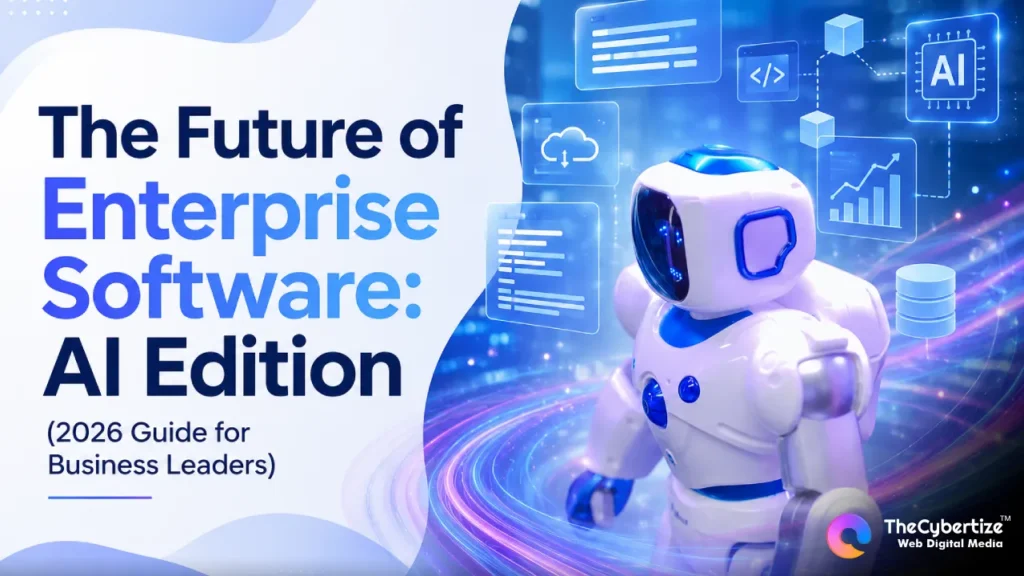
The Future of Enterprise Software: AI is No Longer an Add-on. It Is Becoming the Software Itself.
For years, enterprise software evolved by adding more modules, dashboards, and automation rules. Organizations invested millions in ERP systems, CRM platforms, HR software, accounting tools, and workflow applications hoping to improve efficiency.
Today, that approach is changing.
Artificial Intelligence is not simply another feature inside enterprise software. It is becoming the operating layer that powers decision making, predicts outcomes, automates repetitive work, and assists employees across every department.
The biggest shift is not that AI can generate text or answer questions.
The real transformation is that enterprise software is beginning to think, analyze, recommend, and execute alongside employees.
According to Gartner, by 2028, approximately one-third of enterprise software applications are expected to include agentic AI capabilities, enabling software to autonomously complete a significant share of everyday business decisions. IDC also projects worldwide spending on AI-centric systems to exceed $749 billion by 2028, highlighting how quickly enterprises are increasing AI investments.
This is not another technology trend.
It represents one of the biggest shifts in enterprise software since cloud computing.
Also Read: AI Startups & Technology Trends Report 2026-2027 (Verified Data)
AI Enterprise Software: Enterprise Software Is Entering Its Second Generation
Traditional enterprise software focused on storing information.
Modern enterprise software focuses on using information intelligently.
Consider how most businesses work today.
A CRM stores leads.
An ERP stores inventory.
An HRMS stores employee records.
A finance platform stores transactions.
These systems are valuable, but employees still spend hours searching, analyzing, comparing reports, and making decisions manually.
AI changes that model completely.
Instead of asking employees to find answers, software increasingly delivers answers before someone asks.
Imagine your ERP automatically detecting supply chain disruptions.
Imagine your CRM identifying customers who are likely to churn before they stop buying.
Imagine your HR platform recommending employees at risk of resignation based on engagement, workload, and historical trends.
That is where enterprise software is heading.
From Automation to Intelligence
Many organizations confuse automation with AI.
AI Enterprise Software: Automation follows predefined rules.
AI adapts to new information.
For example:
Traditional automation says:
“If invoice exceeds ₹50,000, send for manager approval.”
AI says:
“This vendor invoice is 22% higher than historical pricing. There is an 84% probability of duplicate billing.”
The difference is enormous.
One follows instructions.
The other understands context.
That shift creates significantly more business value.
Every Enterprise Application Is Being Reimagined
AI-Powered CRM
Sales teams no longer need software that only records customer interactions.
Modern AI-enabled CRM systems can:
- Predict deal closure probability
- Draft personalized emails
- Recommend next customer actions
- Analyze customer sentiment
- Forecast revenue
- Automatically summarize meetings
Sales representatives spend more time selling instead of updating records.
AI in ERP Systems
The Future of Enterprise Software: ERP implementations have traditionally focused on operational visibility.
AI extends that visibility into prediction.
Future ERP systems will:
- Forecast inventory demand
- Predict equipment failures
- Detect procurement anomalies
- Recommend production schedules
- Optimize warehouse operations
- Improve cash flow forecasting
Manufacturing companies especially benefit because small forecasting improvements often save millions annually.
HR Software Is Becoming a Workforce Advisor

Recruitment has already changed dramatically.
AI now assists with:
- Resume screening
- Skill matching
- Employee onboarding
- Learning recommendations
- Performance insights
- Workforce planning
The next generation of HR platforms will spend less time managing employees and more time helping organizations retain and develop talent.
Finance Platforms Will Become Strategic Advisors
Finance departments generate enormous volumes of structured data.
AI can analyze this information continuously.
Future finance software will help organizations:
- Detect fraud earlier
- Predict cash shortages
- Improve budgeting
- Forecast revenue
- Monitor compliance risks
- Optimize operational spending
Instead of producing monthly reports, finance software will provide daily business recommendations.
Enterprise Search Is Disappearing
One of the biggest frustrations inside enterprises is finding information.
Employees search emails, Slack conversations, documents, contracts, policies, spreadsheets, and multiple software platforms.
AI is replacing search with conversation.
Instead of navigating through dozens of systems, employees simply ask:
“Show all contracts expiring within 60 days.”
“Which vendors increased pricing this quarter?”
“What delayed last month’s project delivery?”
The software retrieves, summarizes, and explains the answer.
This dramatically reduces knowledge gaps inside organizations.
AI Agents Are the Next Big Leap
One of the fastest-growing enterprise trends is AI agents.
Unlike traditional chatbots, AI agents perform work.
They can:
- Read incoming emails
- Generate quotations
- Schedule meetings
- Update CRM records
- Analyze contracts
- Create reports
- Monitor compliance
- Coordinate workflows across multiple systems
Instead of opening five different applications, employees delegate tasks to AI.
This changes how software is used every day.
Industry-Specific Enterprise AI
The future will not belong to generic AI.
It will belong to industry-trained AI.
Healthcare organizations need different intelligence than logistics companies.
Retail requires different recommendations than banking.
Manufacturing has different operational priorities than education.
Organizations increasingly demand AI trained on their own business processes, documents, terminology, compliance requirements, and workflows.
This is where custom AI development becomes more valuable than generic AI subscriptions.
Why Generic AI Is Not Enough for Enterprises
Public AI tools are excellent for productivity.
However, enterprises require much more.
Business AI must understand:
- Internal policies
- Customer data
- Product catalogs
- Compliance requirements
- Pricing rules
- Historical decisions
- Security permissions
Without enterprise integration, AI becomes another disconnected application.
With integration, it becomes an intelligent employee.
Security Will Decide AI Adoption
Every executive asks the same question.
Can AI protect sensitive business information?
The answer depends on implementation.
Enterprise AI requires:
- Role-based access control
- End-to-end encryption
- Private deployment options
- Audit logging
- Regulatory compliance
- Human approval for critical actions
- Secure API integrations
Organizations that prioritize governance will scale AI much faster than those experimenting without policies.
The Rise of Vertical AI Solutions
A major shift occurring in 2026 is the growth of vertical AI.
Instead of purchasing one large AI platform, companies are adopting specialized AI assistants.
Examples include:
- Legal AI
- Healthcare AI
- Manufacturing AI
- Procurement AI
- Customer Support AI
- HR AI
- Financial AI
These systems deliver better outcomes because they understand domain-specific workflows.
Employees Will Not Be Replaced. Their Roles Will Change.
One of the biggest misconceptions surrounding AI is workforce replacement.
History suggests technology changes jobs more often than it eliminates them.
Employees increasingly become:
- Decision reviewers
- AI supervisors
- Process designers
- Strategy leaders
- Customer relationship managers
Routine administrative work declines while creative and analytical responsibilities increase.
Organizations investing in employee AI training consistently outperform those relying only on software purchases.
Challenges Businesses Must Solve
AI adoption is not without obstacles.
Common challenges include:
Data Quality
Poor data leads to poor AI recommendations.
Legacy Systems
Older enterprise software often lacks modern APIs.
Change Management
Employees require training and trust before adopting AI tools.
Governance
Organizations need clear policies defining when AI can make decisions and when humans must intervene.
ROI Measurement
Businesses should track measurable outcomes such as productivity gains, cost savings, customer satisfaction, revenue growth, and operational efficiency instead of focusing only on AI adoption.
What Business Leaders Should Do Today
Waiting for AI to mature is no longer a practical strategy.
Business leaders should begin with focused, high-impact initiatives.
Start by identifying repetitive workflows that consume significant employee time.
Prioritize data quality before deploying AI models.
Integrate AI into existing enterprise systems instead of creating isolated pilots.
Invest in employee training alongside technology implementation.
Measure outcomes using business metrics such as cycle time, customer satisfaction, revenue growth, and operational costs.
Organizations that build AI capabilities today will be significantly better positioned than competitors trying to catch up later.
The Future Belongs to Intelligent Enterprises
Enterprise software is moving beyond digital record keeping.
It is becoming an intelligent business partner capable of analyzing data, recommending actions, automating operations, and supporting strategic decisions.
The organizations that gain the greatest advantage will not necessarily be those purchasing the most AI tools.
They will be the ones integrating AI thoughtfully into everyday business processes while maintaining strong governance, security, and human oversight.
The future of enterprise software is not about replacing people.
It is about enabling people to make better decisions, move faster, and create greater value with technology that works alongside them.
For businesses planning long-term digital transformation, AI is no longer optional. It is becoming the foundation on which the next generation of enterprise software will be built.
Conclusion
Enterprise software has entered a defining moment. The conversation is no longer about whether AI should be adopted, but how effectively it can be integrated into real business operations. Companies that combine secure data, domain expertise, modern software architecture, and responsible AI governance will unlock measurable gains in productivity, customer experience, and decision making. The future belongs to organizations that build intelligent systems around people, not in place of them. AI is becoming the new operating layer of enterprise technology, and businesses that act today will shape tomorrow’s competitive advantage.