Enterprise MCP Guide 2026-2027: How It Differs From APIs, and How to Secure and Govern It
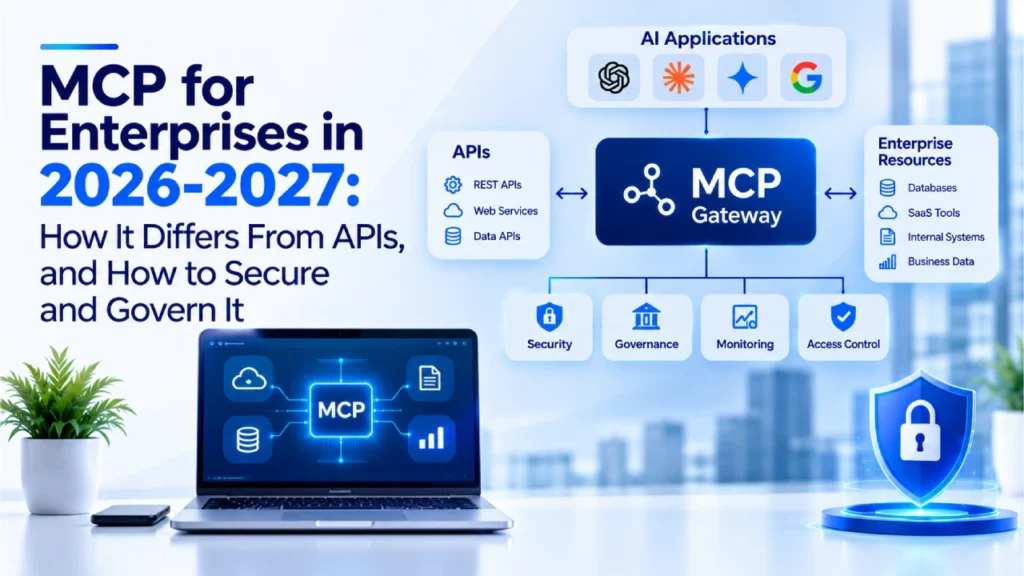
Enterprise MCP Guide: MCP does not replace your APIs. It adds an agent-facing layer on top of them, and that layer needs its own identity and governance. This guide explains what changes for enterprise integrations in 2026 and 2027, how OAuth, SSO and RBAC work with the current MCP specification, and how to build policies, audit logs and compliance evidence for India's DPDP Act, the EU AI Act and official government security guidance.
Table of Contents
Most Enterprise MCP Guide articles split this topic into three: MCP versus APIs, authentication, and governance. In a real company these are one project.
You cannot choose where MCP fits without deciding who is allowed to call it. And you cannot decide who is allowed without a policy and a log.
This guide covers all three, in that order. It is written against MCP revision 2026-07-28, the current specification.
The short answer (by Cybertize)
- MCP wraps APIs. It does not replace them.
- Treat every MCP server as a new front door into your systems.
- Authorization is optional in the specification. Make it mandatory in your company.
- SSO now has a standard path, but it rests on an IETF draft that is not final.
- The specification gives you scopes, not roles. You build RBAC yourself.
- Log every tool call: who, what, with which data, and the result.
How we researched this. We read the MCP 2026-07-28 specification and its authorization documents, the NSA’s May 2026 MCP guidance, vendor documentation for the Enterprise-Managed Authorization extension, and current legal summaries for India’s DPDP Rules and the EU AI Act. We cite no adoption statistics, because we found no reliable public data. Compliance sections are general information, not legal advice.
Part 1 ( of Enterprise MCP Guide ): MCP vs APIs
The one-line answer
MCP wraps APIs. Most MCP servers call a REST API underneath, and the API still runs the business logic.
MCP adds a layer that an AI agent can discover and use at runtime.
What actually differs
| Dimension | Traditional API | MCP |
|---|---|---|
| Who calls it | Code a developer wrote | An AI agent choosing tools at runtime |
| Discovery | Docs or an OpenAPI file, read at build time | tools/list and server/discover, read at run time |
| Schema | Describes requests for developers | JSON Schema per tool, written for a model to read |
| Integration math | N apps times M services, each wired by hand | One protocol for every client and server |
| Authentication | Any scheme you choose | OAuth-based model for HTTP, but optional |
| Human check mid-task | Not part of the contract | Supported through elicitation |
| What you audit | An HTTP request | A tool call made by an agent for a user |
The last row matters most for enterprises. A log line that says “POST /invoices” is not enough anymore. You also need to know which agent called it, for which person, and why.
An old comparison that is now wrong as per Cybertize’s AI Team
Many Enterprise MCP Guide articles say REST is stateless and MCP is stateful. That is out of date.
Revision 2026-07-28 removed protocol sessions and the initialization handshake. Each request now carries the version and capabilities the server needs.
Application state still exists, but you manage it with explicit handles. So do not choose MCP or REST on the state argument.
When to use which
| Situation | Better fit |
|---|---|
| One fixed integration between two apps | Direct API |
| Batch jobs, webhooks, scheduled sync | Direct API |
| An agent that picks from many tools | MCP |
| Several AI clients need the same integration | MCP |
| You want to add a capability without redeploying clients | MCP |
| Existing mobile or partner API consumers | Keep the API, add MCP beside it |
Most enterprises will end up running both. The API is the execution layer. MCP is the agent-facing layer.
What changes for integration teams in 2026 and 2027
These are our expectations, based on the specification and vendor direction.
- You design for a model, not only a developer. Tool names, descriptions and error messages become part of your interface.
- Identity shifts from app keys to delegated users. Agents should act as the user, not as a shared service account.
- Discovery moves from documentation to runtime. Clients ask a server what it offers, and can cache the answer.
- MCP scales like a normal web service. The stateless core removes the sticky-session problem.
- Vendors ship MCP servers beside their APIs. Notion, Supabase and PostHog, for example, document MCP access with enterprise sign-in. Expect more buy-versus-build decisions.
- Governance becomes a product requirement. Regulators and security agencies are now writing about it.
The trap: wrapping every endpoint
Tools exist that generate an MCP server from an OpenAPI file. That is fast, and risky.
It can expose delete, export and admin endpoints that no agent should touch. Expose operations one at a time, as Google Cloud’s API Gateway preview does when you choose which paths and methods become tools.
Part 2: Authentication and Authorization
Two questions, not one
At Cybertize’s tech floor we strongly believe, Authentication asks who is calling. Authorization asks what that caller may do.
MCP’s specification covers the first well and the second only partly. Keep that gap in mind through this section.
What the specification requires
| Topic | What revision 2026-07-28 says |
|---|---|
| Whether to use it | Authorization is optional. HTTP transports should follow it. STDIO servers should not, and take credentials from the environment instead. |
| Server role | An HTTP MCP server acts as an OAuth 2.1 resource server |
| Finding the auth server | Clients must use Protected Resource Metadata (RFC 9728) |
| Token binding | Clients send the resource parameter (RFC 8707). Servers must reject tokens not issued for them. |
| Code protection | PKCE with the S256 method |
| Token passthrough | Forbidden. A server must not forward a client’s token to an upstream API. |
| Client identity | Client ID Metadata Documents are preferred. Dynamic Client Registration is deprecated. |
| Issuer check | Clients validate the issuer on authorization responses (RFC 9207) |
| More permissions later | A server answers 403 insufficient_scope, and the client starts step-up authorization |
Read the first row again. The specification does not force you to authenticate. That is a company decision.
Sources: the MCP authorization specification and its authorization tutorial.
OAuth: two ways an agent can act
On behalf of a user. The agent carries a token that represents a person. Use this for anything that touches personal or role-based data.
As itself. The agent uses machine credentials (client credentials). Use this for tools that really are a service, such as a status check.
Decide per tool and write it down. Mixing the two silently is how an agent ends up with more access than the person using it.
SSO: the standard path is Enterprise-Managed Authorization
Plain OAuth asks each employee to click a consent screen for each server. That does not scale, and admins cannot see or control it.
The Enterprise-Managed Authorization extension fixes that. It was promoted to stable in June 2026. Okta ships it as Cross App Access, and you may see it called XAA.
The idea is simple. Your identity provider (IdP) vouches for the user, and the MCP server’s authorization server trusts that statement.
sequenceDiagram
participant U as Employee
participant C as MCP client (AI app)
participant IdP as Enterprise IdP
participant AS as MCP server authorization server
participant S as MCP server
U->>IdP: Sign in with SSO
IdP-->>C: ID token
C->>IdP: Token exchange, ID token for ID-JAG scoped to one MCP server
IdP-->>C: ID-JAG, a short-lived signed assertion
C->>AS: Present ID-JAG as a JWT bearer assertion
AS-->>C: Access token for that MCP server
C->>S: MCP request with access token
S-->>C: Tool result
The signed statement is called an ID-JAG (Identity Assertion JWT Authorization Grant). It is short-lived, tied to one user and one server, and it is not an access token.
What you gain:
- One admin approval instead of a consent click per employee
- IdP policy applies first. Group membership and conditional access are checked before the ID-JAG is issued, as PostHog documents.
- No extra reach. An ID-JAG cannot grant more than the user already has, as Supabase documents.
- Replay protection. Some servers record each assertion’s jti so it works once.
The caveat you should know
The MCP extension is stable. The standard underneath it is not.
The ID-JAG is defined in an IETF draft, at revision 04 from May 2026, and it is not yet an RFC. Claim names could still change, as WorkOS notes.
Support is also uneven. Your IdP and your MCP servers must both support it. Plan a fallback to standard OAuth.
RBAC: the part you build yourself
The specification gives you scopes and step-up. It does not say which role may run which tool.
That decision belongs to your gateway, your MCP server and your backend. Use all three.
| Layer | Question it answers | Failure looks like |
|---|---|---|
| Gateway policy | Can this role call this tool at all? | Tool not shown, or call denied |
| MCP server | Does the token carry the needed scope? | 403 insufficient_scope |
| Backend | Can this user see this record? | Record-level denial |
Here is an example model. It is illustrative, not a standard.
| Role | Default scopes | Tools allowed | Needs step-up or approval |
|---|---|---|---|
| Support agent | tickets:read, customers:read | search_ticket, get_customer | Refunds need step-up and a human approval |
| Finance analyst | invoices:read, reports:read | get_invoice, run_report | Exports need step-up |
| Finance approver | invoices:read, invoices:approve | approve_invoice | Amounts above a limit need a second person |
| Platform admin | read-only | list_servers | Config changes need step-up and a ticket |
The pattern is read by default, write by step-up. Connect with the smallest scope set. When a tool needs more, the server answers 403, and the client asks for just that scope.
The specification’s security guidance also recommends a minimal initial scope set. A token with admin:* turns any leak into broad access.
Common authentication mistakes
- One shared service key for every agent. You lose who did what.
- Token passthrough. The specification forbids it, and it breaks audience checks.
- Broad scopes. files:* and admin:* are convenient and dangerous.
- Trusting the client name. The client identifies itself in request metadata, and that value is self-reported.
- Long-lived secrets in config files. Use a secrets manager and rotation.
- No fast revoke. You should be able to cut off one user, one client or one tool in minutes.
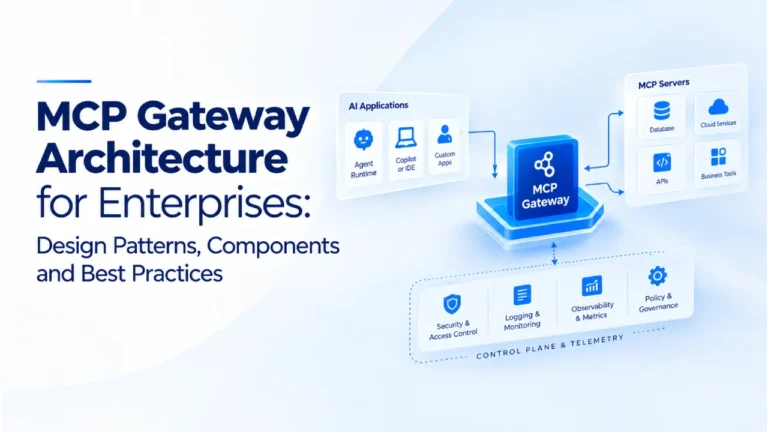
For gateway placement, trust boundaries and identity propagation across hops, see our MCP gateway architecture guide.
Part 3: MCP Governance
What governance means here (in Enterprise MCP Guide 2026-2027)
Governance answers one question: who may connect which agent to which data, under what rules, with what proof.
It is not a document. It is a set of decisions that your systems enforce and your logs prove.
Why the NSA wrote about it
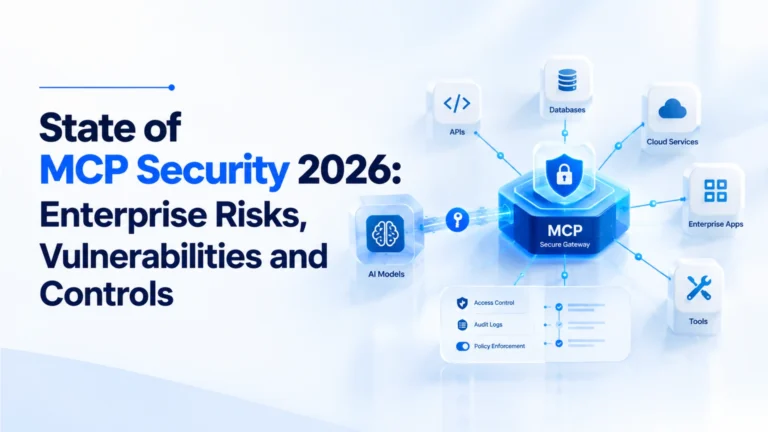
In May 2026 the NSA’s Artificial Intelligence Security Center published MCP: Security Design Considerations for AI-Driven Automation.
It says adoption has outpaced safeguards. Its themes are the ones in this guide:
- Separate systems and data by trust level
- Give each tool only the access it needs
- Validate outputs that feed other models
- Log all tool and model invocations, and send logs to your security monitoring
- Look for open or unauthorized MCP servers on your network
It also notes that the MCP specification has only basic logging guidance and leaves the rest to implementers. That is our starting point.
A starter policy set
Keep policies short enough that people follow them.
| Policy | Example rule | Enforced where |
|---|---|---|
| Server onboarding | No server goes live without an owner, a risk class and a review | Registry, CI |
| Tool risk classes | Read, reversible write, destructive, financial | Gateway policy |
| Approval | Destructive and financial tools need human approval | Gateway, application |
| Data zones | Public-data tools never share a server with regulated-data tools | Network, deployment |
| Third-party servers | Pin versions, record provenance, scan before use | Procurement, CI |
| Unapproved servers | Scan for them, and block them at the network edge | Network, endpoint tools |
| Logging | Every tool call is logged with identity and outcome | Gateway, server |
| Retention | Logs are kept for a defined period and protected from edits | Log platform |
| Credentials | Short-lived tokens, rotation, one-step revoke | Identity provider |
Access control, in plain words
The NSA sheet has a useful idea: no ambient authority. Each call should carry only the permission it needs, not a broad session credential.
That limits damage. If a prompt injection steers one call, it inherits one call’s access, not the whole session’s.
Audit logs: what to capture
A good MCP audit record answers who, what, where, why and what happened.
| Field | Why it matters |
|---|---|
| Timestamp and correlation ID | Join gateway, server and backend logs |
| User identity | Who the agent acted for |
| Client or agent identity | Which application acted |
| MCP server and tool name | What was called |
| Parameters, redacted | What was asked, without secrets or personal data |
| Policy decision | Allowed, denied, or sent for approval |
| Scopes and token audience used | Proves least privilege was applied |
| Approval record | Who approved a consequential action |
| Result status and latency | Success, error, timeout |
| Source network address | Helps incident response |
What to leave out: secrets, tokens, full prompts, and personal data you do not need.
For the pipeline, use OpenTelemetry. Revision 2026-07-28 deprecates protocol-level logging for new implementations in favor of it. Export to your SIEM, and make records append-only.
Compliance: what MCP touches
MCP does not make you compliant. Good logs and access control help you show that you are.
This is general information. Ask your counsel to review it.
| Regime | What to know (as of November 2026) | What it means for MCP |
|---|---|---|
| India, DPDP Act and Rules | Rules notified 13 November 2025. Most duties apply from 13 May 2027. Rule 6 expects reasonable security safeguards, including access control and logs. Breaches go to the Data Protection Board and affected people, with a detailed report within 72 hours. Failing to keep safeguards can cost up to ₹250 crore under the Act’s schedule. | An agent that reads personal data is part of your safeguards. Log access, limit scope, and be ready to report. |
| EU AI Act | The Digital Omnibus (Regulation 2026/1744) moved Annex III high-risk duties to 2 December 2027. Article 50 transparency duties have applied since 2 August 2026. | If agents support hiring, credit or similar uses, expect record-keeping and human oversight duties. Audit logs and approvals help. |
| NSA guidance | Not law. A US government baseline published May 2026. | A useful checklist for any enterprise, and for US customers. |
| Security audits (SOC 2, ISO 27001) | Auditors ask about access control, logging and change management. | MCP servers need to sit inside those controls. |
An operating model that fits on one page
- Owner per tool. One named person, plus a backup.
- Approval board, kept small. Security, the data owner and the platform team.
- Review on a schedule. Re-check access and unused tools every quarter.
- A kill switch. Disable a tool or block an identity without a deploy.
- A short metrics list. Servers registered, tools by risk class, tools without owners, denied calls, step-up events, and time to revoke.
A 90-day start
- Days 1 to 30: Inventory every MCP server, including unofficial ones. Name an owner for each.
- Days 31 to 60: Put authentication on everything that touches company data. Define risk classes and scopes.
- Days 61 to 90: Turn on structured audit logs, set the approval rule for destructive and financial tools, and test a revoke.
Our view
This part is opinion.
Treat your first MCP server like a new public API. Give it an owner, scopes, logs and a kill switch before it launches, not after.
And do not wait for the specification to force your hand. Authorization is optional on paper. In an enterprise it should never be.
If you are planning MCP integrations, API wrappers, AI agents or an identity design for them, Cybertize Technologies is glad to talk it through. You can start with our API development and enterprise software development services.
Frequently Asked Questions
- Does MCP replace APIs? No. MCP wraps APIs in a layer that AI agents can discover and use at runtime. Most MCP servers call a REST API underneath. Keep your APIs for apps, partners and batch jobs, and add MCP where agents need the same capabilities.
- When should I use MCP instead of calling an API directly? Use MCP when an agent chooses among several tools, or when several AI clients need the same integration. Use a direct API for a single fixed integration, scheduled jobs and webhooks. Many teams run both.
- Is MCP stateful and REST stateless? Not any more. Revision 2026-07-28 removed protocol sessions and the initialization handshake, so MCP requests carry what the server needs. Application state still exists, but you handle it with explicit handles or task mechanisms.
- Is authentication required in MCP? The specification makes authorization optional. HTTP transports should follow its OAuth-based model. Your company should require it for any server that touches company data, because the protocol will not enforce that for you.
- How do SSO and MCP work together? Through the Enterprise-Managed Authorization extension, also called Cross App Access. Your identity provider issues a short-lived ID-JAG, and the MCP server’s authorization server exchanges it for an access token. It is stable in MCP but built on an unfinished IETF draft.
- Can I do RBAC in MCP? Yes, but you build it. The specification defines scopes and step-up authorization, not which role may run which tool. Enforce roles in your gateway, scopes in your MCP server, and record-level checks in your backend.
- What should MCP audit logs include? Timestamp, correlation ID, user and agent identity, server and tool, redacted parameters, the policy decision, scopes used, any approval, the result and latency. Exclude secrets, tokens and unnecessary personal data. Export through OpenTelemetry to your SIEM.
- Does MCP help with DPDP compliance? Not by itself. India’s DPDP Rules expect reasonable security safeguards, and most duties apply from 13 May 2027. Scoped access, audit logs and a tested breach process for agents that read personal data help you meet them.
- What did the NSA say about MCP? In May 2026 the NSA’s AI Security Center warned that adoption has outpaced safeguards. It recommends least privilege, separating data by trust level, validating outputs, logging all tool and model invocations, and finding unauthorized MCP servers.
- How do I start governing MCP in an enterprise? Inventory every server and name an owner. Require authentication, define tool risk classes and scopes, and turn on structured audit logs. Add an approval rule for destructive and financial tools, then test how fast you can revoke access.
Conclusion
MCP changes who calls your systems, not what your systems do. The caller is now a model acting for a person.
That is why the three topics belong together. Integration decides where MCP sits. Identity decides who it acts as. Governance proves it behaved.
Start small, with one server and a handful of tools. Give each an owner, narrow scopes and a log, then expand through a review process instead of a rush.
Sources
- Model Context Protocol, Authorization specification, revision 2026-07-28
- Model Context Protocol, Understanding Authorization in MCP
- Model Context Protocol, Enterprise-Managed Authorization extension
- IETF OAuth Working Group, Identity Assertion JWT Authorization Grant (draft)
- WorkOS, Inside the ID-JAG: How enterprise-managed authorization actually works
- Supabase, Enterprise-Managed Authorization for MCP
- PostHog, Enterprise-managed authorization (ID-JAG)
- NSA Artificial Intelligence Security Center, MCP: Security Design Considerations for AI-Driven Automation (May 2026)
- Reed Smith, NSA publishes security guidance on designing AI systems with MCP
- WorkOS, MCP vs. REST: What’s the right way to connect AI agents to your API?
- Google Cloud, API Gateway Model Context Protocol overview
- MirvoLegal, DPDP Rules, 2025: Compliance timeline for data fiduciaries
- Legal500, DPDP data breach notification in India
- Future of Privacy Forum, The AI Act implementation timeline: what changes under the AI Omnibus
- Technology.org, EU AI Act deadlines after the Digital Omnibus