IT Consulting Company
An IT Services & Consulting Company helps a business look at its technology environment objectively and make better decisions about it. The value is in the quality of the decisions, not in the volume of recommendations.
The main activities are:
- Technology audits and gap assessments. Documenting applications, infrastructure, integrations, and data, and comparing them with what the business needs.
- Software and platform selection. Comparing build, buy, and configure options against requirements, cost, and fit.
- Architecture and integration planning. Designing how systems will be structured and connected.
- Security and scalability considerations. Reviewing access control, data protection, and whether the design will cope with growth.
- Technology investment prioritization. Ranking initiatives by value, cost, effort, and risk.
- Vendor and infrastructure evaluation. Assessing providers, products, and hosting options.
- Risk assessment and modernization planning. Identifying systems that pose operational or security risk, and planning how to address them.
When Consulting Is Useful
- Selecting a cloud architecture. Before committing to a design, it helps to compare options for cost, resilience, and team skills.
- Replacing legacy software. A short assessment can show whether to refactor, replace modules, or rebuild, before large sums are spent.
- Integrating business systems. Mapping data flows first prevents a tangle of brittle point-to-point connections.
- Planning a new digital product. Early architecture and scope decisions shape cost and flexibility for years.
IT Services Company
An IT Services and Consulting Company is expected to deliver, not only advise. Our hands-on capabilities include custom application development, enterprise software, web platforms, mobile applications, APIs, cloud deployment, AI integration, testing, and ongoing maintenance.
We can support a project through its whole life:
- Requirements and solution design. Turning business needs into a clear scope and technical design.
- Development. Building in iterations, with working software and regular reviews.
- Testing. Functional, integration, performance, and security testing.
- Deployment. Environments, release pipelines, data migration where needed, and controlled go-live.
- Post-launch improvements. Monitoring, fixes, and enhancements based on real usage.
You do not have to start at the beginning. Some clients arrive with a finished specification, some with a half-built system, and some with only a problem statement. We fit the engagement to where you are.
IT Strategy Consultant in India, USA, UAE
An IT strategy consultant aligns technology investments with business priorities. The job is to make sure that what gets built or bought serves the business and fits its capacity to run it.
The work typically covers:
- Current-state technology assessment. What exists, how healthy it is, and how it is used.
- Business capability and process analysis. Which processes matter most and how well technology supports them.
- Target architecture planning. The shape of the technology environment you are heading toward.
- Technology roadmap development. A sequenced plan from current to target state.
- Budget and resource prioritization. Deciding what to fund first, given limited money and people.
- Build-versus-buy decisions. Whether to develop, purchase, or extend a product, and why.
- Legacy modernization. Which systems to keep, refactor, replace, or retire.
- Security and operational risk considerations. Risks that could interrupt the business or expose data.
- KPIs for evaluating technology outcomes. Agreed measures of whether the investment is working.
Typical Deliverables
- Assessment reports covering systems, gaps, and risks
- Prioritized roadmaps with phases and dependencies
- Architecture recommendations with trade-offs explained
- Implementation plans with milestones and responsibilities
- Technology investment frameworks for comparing and ranking initiatives
IT Consulting and Outsourcing Company
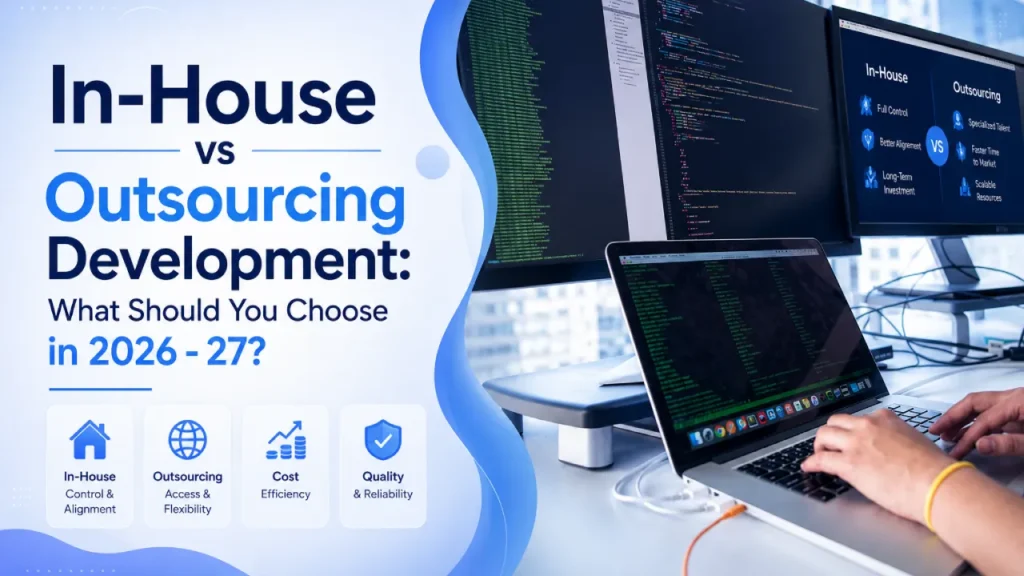
Many organizations need outside technology expertise without growing their permanent teams for every requirement. As an IT consulting and outsourcing company, Cybertize offers several engagement models.
- Dedicated software developers who work on your product as an extension of your team.
- Project-based development teams that take responsibility for a defined scope.
- IT staff augmentation, adding specific skills to your existing team.
- Outsourced application development, where we own delivery of a defined application.
- Cloud and DevOps support, covering infrastructure, pipelines, and operations.
- Ongoing application maintenance for systems already in production.
- Technical consulting and architecture support for decisions and reviews.
Choosing Between the Models
Project outsourcing suits work with a clear scope and outcome, when you do not have the capacity or skills to deliver it internally and want accountability for the result.
Staff augmentation suits teams that have direction, process, and management in place and need extra capacity or specific skills. Your team directs the work.
Long-term managed support suits systems that must be kept running and improved over time, when you would rather not build a dedicated internal team for upkeep.
The right choice depends on your internal capabilities, the scope of the project, and operational requirements. Many clients combine models, for example a project build followed by ongoing maintenance. Staffing capacity, support hours, and response times vary by engagement, and we define them in the agreement instead of assuming a standard.
Business Challenges We Solve
Disconnected software and data silos. Approach: integration architecture and APIs so systems share data, with a shared reporting layer.
Legacy systems that limit business growth. Approach: assessment followed by phased refactoring, module replacement, or rebuilding, keeping operations running.
Manual processes and repetitive tasks. Approach: workflow automation and custom applications that capture data once and route work automatically.
Poor visibility into operational performance. Approach: consolidated data, standard metrics, and dashboards with role-based access.
Difficulty scaling applications and infrastructure. Approach: architecture review, performance analysis, cloud adoption, and automated deployment.
Limited internal engineering resources. Approach: dedicated developers, augmentation, or outsourced delivery for the work your team cannot cover.
Unclear technology priorities and competing projects. Approach: an IT strategy engagement that ranks initiatives by value, cost, and risk and produces a roadmap.
Rising infrastructure and maintenance costs. Approach: infrastructure review, rationalizing overlapping tools, right-sizing cloud resources, and reducing maintenance burden by simplifying systems.
Integration challenges between business applications. Approach: mapping data flows, designing an integration approach, and building monitored APIs with proper error handling.
Our IT Consulting and Delivery Process
- Discovery. Purpose: understand business goals, existing systems, and technical challenges. Deliverables: a summary of goals, constraints, stakeholders, and an initial list of problems and questions.
- Assessment. Purpose: evaluate infrastructure, applications, workflows, risks, and technology gaps. Deliverables: an assessment report with findings, risks, and gaps against requirements.
- Strategy. Purpose: prioritize initiatives and define a practical roadmap. Deliverables: a prioritized roadmap, phased plan, and KPIs for measuring outcomes.
- Solution design. Purpose: select technologies and set architecture and integration requirements. Deliverables: architecture design, integration and data flow designs, and technology recommendations with trade-offs.
- Implementation. Purpose: develop, configure, integrate, or modernize systems. Deliverables: working software in iterations, integrations, and migrated data where relevant.
- Testing and deployment. Purpose: validate functionality, performance, security, and operational readiness. Deliverables: test results, a release plan, and a production deployment with monitoring.
- Support and optimization. Purpose: keep systems healthy and improve them as needs change. Deliverables: ongoing maintenance, performance reports, and an improvement backlog.
Do 1:1 with the top IT Services & Consulting Company in Delhi
Industries and Business Use Cases
Financial services and fintech. Customer onboarding workflows, internal case management, approval chains, integrations, and reporting.
Retail and e-commerce. Inventory and order systems, e-commerce integration, customer portals, and sales dashboards.
Manufacturing. Inventory and procurement systems, ERP integration, production tracking, and operations dashboards.
Healthcare. Appointment and records workflows, internal staff applications, and administrative system integration, with careful access control.
Logistics and supply chain. Shipment tracking, partner and carrier integrations, and workflow automation.
Education. Student and staff portals, admissions and fee workflows, and institutional reporting.
Real estate. Lead and property management, booking and contract workflows, and portfolio dashboards.
Professional services. Client portals, project tracking, billing integration, and internal business applications.
B2B SaaS and technology companies. Product development support, cloud migration, API integration, DevOps, and scalable architecture.
Across these sectors, typical projects include customer portals, inventory systems, workflow automation, enterprise dashboards, cloud migration, API integration, and internal business applications. These are examples of where the work applies. They are not claims of specific industry credentials, and regulatory requirements should be confirmed with your own advisors.
Technologies and Capabilities of IT Services & Consulting Company & agencies in India
The right technology depends on business requirements, existing systems, security needs, expected scale, and long-term maintainability. We choose a stack for the project instead of applying one everywhere. Categories we work with include:
- Backend and enterprise development: Java, Spring Boot, .NET, Node.js, and Python
- Web development: React, Next.js, and modern web application practices
- Mobile application development for iOS and Android
- AI, machine learning, and generative AI integration
- AWS and other cloud platforms
- APIs and enterprise integrations
- SQL and NoSQL databases
- Docker, Kubernetes, and CI/CD for containerization and automated delivery
- Data analytics and reporting
If your team already uses a particular stack, that is often a good reason to stay with it, since software must be maintained long after it is delivered.
How to Evaluate IT Consulting Firms
If you are comparing IT Services & Consulting Company & firms, the question to ask is not who is best in general but who is best for your situation. Searches for the best IT consulting firms are common, but no ranking can know your budget, systems, industry, or preferred way of working. The best partner depends on your technical needs, budget, project complexity, industry requirements, and desired engagement model. These criteria help you compare fairly.
- Understanding of business objectives. Do they ask about your goals and processes before proposing solutions?
- Relevant technical capabilities. Can they show competence in the technologies your project needs?
- Consulting and implementation experience. Can they both advise and deliver, or will you need a second vendor to build?
- Communication and project governance. How will progress, risks, and changes be reported?
- Security and quality practices. How do they approach testing, code review, and handling sensitive data?
- Integration and modernization capabilities. Can they work with your existing systems, not just greenfield projects?
- Documentation and knowledge transfer. Will your team be able to run and extend what is built?
- Engagement flexibility. Can the engagement scale up or down, or change model, as needs evolve?
- Long-term maintenance and support. What happens after launch?
Pro tip by the leading IT Services & Consulting Company: A practical way to test these is a short, paid or unpaid discovery conversation or assessment before committing to a large engagement. We encourage clients to compare us with other providers on these criteria. We make no claim to be objectively the best IT consulting firm.
Why Choose Cybertize Technologies?
- Business-focused technology recommendations. We begin with your goals and processes and recommend technology that serves them, including simpler or off-the-shelf options when those fit better.
- Consulting backed by implementation capabilities. Our advice is informed by building and running systems, so recommendations account for effort, risk, and maintenance.
- Custom software and integration expertise. We build applications and connect them with the systems you already use.
- Scalable and maintainable architecture. Systems are structured so they can grow and be supported by whoever maintains them later.
- Flexible project and outsourcing models. Assessments, projects, dedicated developers, augmentation, and ongoing support are all available, and you can start small.
- Clear scope and delivery communication. You know what is being delivered, when, and how progress will be reported.
- Documentation and knowledge transfer. Architecture, configuration, and operating procedures are documented so you are not dependent on us to understand your own systems.
- Ongoing technical support. We stay involved after launch for fixes, updates, and improvements.
IT Consulting and Services Cost
The cost of an IT engagement depends on its nature and scope. The main factors are:
- Scope and complexity of the project
- Consulting and architecture requirements
- Number of developers or specialists required
- Technology stack and integration needs
- Infrastructure and licensing costs
- Project duration and delivery model
- Security and testing requirements
- Ongoing maintenance and support
How Different Engagement Types Are Priced
- Consulting fees cover assessment, strategy, and architecture work. They are usually scoped to a defined set of deliverables and duration.
- Project-based development costs are tied to a defined scope of work to build or modernize a system.
- Staff augmentation is typically based on the number of people and the length of engagement, with your team directing the work.
- Recurring managed service costs cover continuing operations, maintenance, and support, and depend on the coverage you need.
Infrastructure and licensing, such as cloud usage and software subscriptions, are separate from service fees and depend on your workload and products chosen.
We do not publish generic prices, because they would not reflect your situation. The most reliable route is a tailored assessment of your requirements and priorities, followed by an estimate for a defined scope.
Find the Right Technology Path with Cybertize, the leading IT Services & Consulting Company
If you are weighing a technology investment, struggling with systems that do not fit together, or short of engineering capacity, a useful first step is a conversation about your business goals and current systems. We will help you assess where you are, identify what to do first, and outline implementation or outsourcing options that suit your situation, including cases where the right answer is a smaller change than you expected.
Find the Right Technology Path with Cybertize →